It is 1980, a contrasting era of political turbulence and cultural vibrancy in the bustling city of Calcutta in the Indian subcontinent – a boiling cauldron of various races, religions, and philosophies. A twenty-year-old man with a pair of unusual light brown eyes peers down at a broken bellowed instrument through the murky glass of an old and dilapidating music store in Bentinck Street on the Eastern wall of the Lal Bazar Police Station, headquarters of the Calcutta Police. Though young, the fellow knew his music and recognised the potential of a fantastic gem of a harmonium hidden inside the ruse of the rustic reed instrument.
Shifting his gaze from the harmonium and taking a few steps back to the edge of the footpath, Abir Mookherjee lifted his head and looked at the many old music stores on either side of the cobblestoned street. He smiled and wondered how this place had evolved over the past two centuries.
In 1780, the area was still a jungle, almost inaccessible during the monsoons. Chinese immigrants had started to settle in the region. By 1850, among other trades, butchering goats and cows had become a prominent occupation on the street, and the locality came to be known as Kasai-Tala, meaning place (Tala) of the butchers (Kasai) in Bengali. The British with their ever-twisting accents officially named the road as Cossitala Street. In memory of Lieutenant-General Lord William Henry Cavendish Bentinck, Governor-General of Bengal and India from 1828 to 1835, it was renamed Bentinck Street in 1876.
Two hundred years ago, Hindus visiting Kalighat Temple from Chitpur Road (later renamed Rabindra Sarani) abhorred walking past the area as the foul smell of raw mutton and beef deterred their spirits on their road to spirituality. Now, in 1980, the air in this stretch of the street smelled of wood, paint, glue, and brass, of old and new musical instruments, as talented artisans crafted them out on the footpaths and inside the archaic music stores that had stood there for the past few generations withstanding the test of time.
Bentinck Street had become the place in the city to buy and repair musical instruments. As most of the instruments were made by a single person from scratch to finish, musicians would often sit beside talented workers giving little suggestions here and there to customise. Conversations with the gifted craftsmen and wise store owners usually revealed unknown stories of Indian and International musicians who had visited the place and spent time there. They said that little hidden stories of the music world could be found in Calcutta’s Bentinck Street.
“How much will you sell this Harmonium for Uncle?” asked Abir, summoning up the courage to enter the shop after an hour of being lost in his thoughts and gaping at the instrument from outside.
An old and rickety octogenarian with loose and wrinkled skin and a weathered face covered in pockmarks emerged from behind the dusty counter. Wobbling toward the young man, he said, “Son, you would have never been able to buy this Harmonium if its owner was still alive. They say it belonged to a great musician who had accidentally left it in the city during one of his performances around the 1930s. Someone nicked it and sold it to someone, who sold it to someone till it landed here at the shop along with the story. It has been lying here for over half a century. Though it could be priceless, however being broken beyond repair, with no proof of its origin, and seeing you stand outside my shop gaping at it every day, I will sell it to you for twenty takas. What do you say, my brown-eyed sonny?”
Late that night, Abir tinkered with the old instrument, carefully detaching its worn-out keys and corroding wood panels under the incandescent flickering yellow light of a 40-watt tungsten filament bulb swivelling from a rusty table lamp on a jiggly wooden table inside his four-by-ten feet rented room at a student’s mess house near Sealdah Railway Station on Surya Sen Street.
His true passion – his love for music certainly played a greater role in the over-enthusiastic restoration than the fact that he was studying mechanical engineering. The career path was forced on him by his parents, who hated imagining their intelligent son playing music for a living. In those days, music, acting, and many other performing arts were not considered to be noble professions by middle-class Indian families.
Crraaakkkk… a sudden sharp noise of old wood splitting as Abir applied pressure with his screwdriver to loosen a teetering wooden rivet from the left-side panel of the instrument gave him the fright of his life. “Alas! I must have broken something,” cried out the budding engineer-musician, closing his eyes. After a moment of feeling miserable, he opened his lids to investigate the damage. “What the heck,” exclaimed Abir as he gently pulled out a secret drawer hidden behind the left wood panel, which he had accidentally cracked open.
Inside the hidden compartment were some letters, a piece of sheet music which looked like an unfinished composition, and the portrait of a woman of uncanny beauty. Saying adieu to sleep, an over-excited Abir Mookherjee plunged into this sudden mystery that literally came out of the old music machine.
There were five letters from ‘Meera’ – so Abir had a name and a photo, which meant he could perhaps find out who this beauty was. Unfortunately, the letters were addressed to ‘RS’ – perhaps someone’s initials or a nickname. Abir spent the rest of the night tearing up his hair, trying to figure out what he had stumbled upon. He had opened up the harmonium completely, and nothing else was hidden inside apart from the words ‘RS’ gilded in gold on the base of the secret compartment.
On the sudden impulse of a few music lovers from various localities of Southern Calcutta, a three-night cultural programme of drama, song, and classical and light music was organised in Dover Lane in the third week of January in the year 1952. This transcended into the formation of “The Dover Lane Music Conference” – a non-profit voluntary organisation, which has since then dedicatedly organised this music fest annually. Over the decades, it had come to become the musical event of the year in the city, exceeding any similar function in scope and scale. It would be hard, if not nearly impossible, to name any maestros of Indian Classical Music, either living or dead, who had not performed there.
Abir’s trail of research had now landed him in the drawing room of a tiny mansion of one Shriman Bhojohori Dotto on a quaint corner of this very Dover Lane, just after a few days since he had cracked open the mysterious musical instrument. Heirloom mahogany furniture, Belgium glass chandeliers, and English drapes added to the age-old charm of the antique house. “Sir, do you recognise this lady” asked Abir to the forgetful grey-hair, laying the old photograph on the centre table.
After Intensely looking at the portrait for a long time drumming his left knuckles with his right forefingers, the old-timer rose from his armchair, slowly moving toward a creaky cabinet. It took him forever to reach the wooden almirah, which was neatly racked with LP Records. Taking his time, he finally drew out the one he was searching for. After several more minutes of shaky dusting and wobbly tinkering of a rustic gramophone; the melodious voice of a woman ultimately emanated from the brass dome of the antique music machine.
“You are hearing the last song sung by the legendary singer of her time Meera Kumari at the very first music fest of Dover Lane in January of 1952. The song was recorded in the same month at the Hindusthan Record at 6/1 Akrur Dutta Lane in our beloved city. At the time, she must have been in her late 40s but unfortunately, she never sang again. I do not know what became of her or why she stopped singing. That’s the extent of my fading memory to support your investigation,” pronouncing these words Bhojohori Dotto said adieu to the young man. Though now Abir knew a bit about the lady in the photo, ‘RS’ was still a mystery. The old man could not remember anything or anyone connecting these two sequential alphabets.
In 1876, the Albert Hall was founded on College Street, as the primary residence of Ramkamal Sen, Treasurer of the Bank of Bengal and Secretary of the Asiatic Society. Later, in 1942, the Coffee Board started a coffee joint there. Following this, in 1947, the Central Government changed its name to Coffee House. Since then, it has been a meeting place for notable citizens, revolutionary youths, poets, artistes, literati, and people from the world of art and culture in the city. Abir’s investigation had now brought him into the echoing halls of this hallowed institution, where after meeting a few old music buffs, landing at a hopeless juncture in his mysterious research, he now sat on a small table sipping a glass of ‘infusion,’ the local name for the Americano style of black coffee.
Right at that moment of despair, with no new hope or leads, when the young man contemplated abandoning his quest, he could not believe his eyes as he saw the most beautiful pair of dazzling blue eyes. He saw the lady of his mysterious portrait walk into the joint and sit at the table right in front of him. How could this be? His research revealed Meera to be at least 75 years old if alive.
Here she looked to be in her early thirties, and he could not help but gape at the highlights of her beauty, her almond eyes, sharp nose, thin lips, elegant fingers and curly hair free-flowing up to the edge of her saree on the bare skin of her shapely hips. Something was different though from the photograph, perhaps the eyes. Abir could not help but fall in love instantly. He could not help but stare without blinking.
“Excuse me, if you are going to gape so shamelessly, maybe it’s better to get acquainted first to get this over with,” spoke up the lady as she left her seat and came and sat on the empty chair at Abir’s table. Dumbstruck for the next couple of moments and finally coming down to earth the young man said, “Hello Meera, I am Abir.”
“Wow, that’s really new, and you are a bit too young and a few decades late to date my mom. May her soul rest in Peace. I am Dia Kumari, the estranged daughter of an unknown man and the legendary Meera Kumari. You see my eyes are blue and my mother’s were green,” said the lady as she lit a filter-less mini-Charminar cigarette between her sensual lips.
As the confusion cleared and the atmosphere relaxed, Abir told her the story of the mysterious harmonium and his research till now. He showed her the letters, the unfinished sheet music, and Meera’s portrait. The photo being black-n-white Abir could not have known the colour of her eyes. Though initially sceptical of Abir’s quest, Dia gradually felt the urge to dig deeper into the mystery.
That day the two spent many hours at the Coffee House discussing the Harmonium’s story. As time passed both of them started spending a lot of time together trying to solve the mystery. They met many elderly musicians, artists, and historians who shared tales of the city’s artistic renaissance of the early to mid-twentieth century.
Their relationship transcended to the next level and Dia spent many nights in Abir’s loving embrace in his tiny hostel room on Surya Sen Street. As the days turned to weeks, and the weeks to months, their love grew stronger, they made love, repaired the harmonium and completed the unfinished composition, till Abir became excessively obsessed with the investigation. Dia saw the young man losing his grip on reality and had to make the painful decision to end their relationship.
It is 2024, and more than four decades have passed by. A well-polished man in his mid-sixties in an English Tweed walks into the iconic Oxford Bookstore on Park Street established more than a century ago in 1919. A song lightly playing from an overhead speaker at the entrance of the store lured him into the shop. It was the same unfinished sheet music by a mysterious musician to his secret love, an iconic singer of her time. It was the same unfinished composition that the old man had finished in his youth in the loving embrace of his beloved in the tiny hostel room on Surya Sen Street.
Taking a few steps, he froze as his eyes fell on a newly launched book on the central display. The cover showcased an old black-n-white picture of the singer ‘Robi Shonkor’ from the thirties in thick black-rimmed bakelite glasses playing “The Harmonium” that the old engineer, a long time ago in his youth, had been obsessed with.
As he started reading the book, distant recollections of a short and lost love from his youth flashed at the back of his mind. Those days were, however, long gone. After his beloved ended their relationship, he focussed back on his studies and eventually had a successful career as a recognised engineer in London. He was back in the city for a few days on official business but never thought that he would encounter such a painful and subdued memory.
In the midsection of the book, there were some retouched and colourised photos of Robi Shonkor, and while scanning them he could not help but realise that the man had the same distinctive blue eye that he had seen and fallen in love with at the Cofee House so many years back.
Summoning up all his courage the old engineer walked up to the charming author, a replica of her grandmother and mother to get a copy of the book signed. Its title read ‘The Harmonium’s Melody – A Tale of Love, Music, and the Enduring Spirit of Kolkata during a Time of Change’ by Adrita Kumari Mookherjee. The author neither had her grandmother’s green, nor her mother’s blue, but an unusual light brown, the same colour as the old engineer’s eyes.
Copyright © 2024 TRISHIKH DASGUPTA
This work of fiction, written by Trishikh Dasgupta is the author’s sole intellectual property. Some characters, incidents, places, and facts may be real while some fictitious. All rights are reserved. No part of this story may be reproduced, distributed, or transmitted in any form or by any means, including printing, photocopying, recording, or other electronic or mechanical methods, without the prior written permission of the author, except in the case of brief quotations embodied in critical reviews and certain other noncommercial uses permitted by copyright law. For permission requests, send an email to the author at trishikh@gmail.com or get in touch with Trishikh on the CONTACT page of this website.
ABOUT THE AUTHOR
Trishikh Dasgupta
Adventurer, philosopher, writer, painter, photographer, craftsman, innovator, or just a momentary speck in the universe flickering to leave behind a footprint on the sands of time... READ MORE
These stories are Free and if you have found something here that stayed with you, some of my other books are now available in print and digital editions. They gather longer journeys, quieter questions, and stories that continue beyond this page.
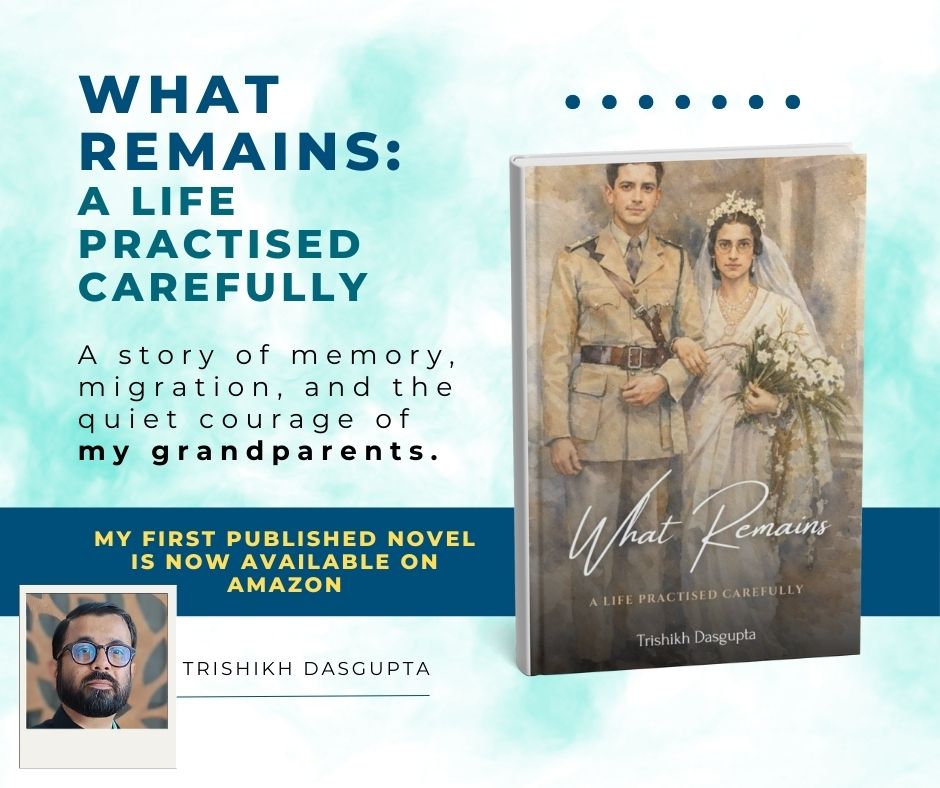
You may also like to read my1st Published novel now available on Kindle and Paperback versions.
 Weekend Stories by Trishikh
Nice blog about the timeless appeal of music in a person’s life and how it helps us accept our aging more successfully.
LikeLiked by 1 person
Thank you so much for always appreciating my stories. So glad that you liked this tale of mine.
LikeLike
Thanks . What do you know about Rishikesh? Why is it called the “Yoga Capital of the World”
LikeLiked by 1 person
Well Rishikesh is simply amazing. There is so much of rich spiritual, religious, nature history to the place that cannot even start to try and explain it in chat.
Long time back I wrote a short piece on it, you can read it in my other blog: https://trishikh.wordpress.com/2007/04/24/viagra-for-the-soul/
LikeLike
I like how you post only quality content! Always worth the read.
LikeLiked by 3 people
Thank you, glad that you like my stories.
LikeLiked by 1 person
This is an amazing story.
LikeLiked by 3 people
Thank you. So happy that you liked it.
LikeLiked by 1 person
☺️🙏
LikeLiked by 1 person
Dear Trishikh
I love हार्मोनियम & that lady model in b/w photo
I like the post very much!
Thanks for liking my post ‘Night’. 🙏
LikeLiked by 2 people
So glad that you liked the photos. I used AI to create the image.
LikeLiked by 1 person
What a beautifully layered narrative, Trishikh 🎶 The way you intertwine music, memory, and mystery feels timeless. It’s touching how music here becomes both a bridge across generations and a keeper of hidden love, history, and resilience.
LikeLiked by 3 people
Dear Livora, your quote “music here becomes both a bridge across generations and a keeper of hidden love, history, and resilience,” describes the very essence of my story. It seems that not only have you enjoyed the story, but felt it very deeply.
Thank you for always enjoying my stories to such levels.
LikeLiked by 1 person
Thank you so much, Trishikh! 🌟 Your acknowledgment means a great deal. It’s a rare joy to connect so deeply with a story and feel its heartbeat across time and emotion. Your writing truly bridges the invisible threads of love, history, and resilience. I’m honored to share in that journey. 🎵💛
LikeLiked by 1 person
Dear Livora, the honour is equally mine.
LikeLiked by 1 person
Thank you! The honor is truly mutual.
LikeLiked by 1 person