The sea does not announce itself when it decides to swallow the horizon. It simply closes in. Somewhere off the coast of Madagascar, the water lay dark and deceptive, its surface betraying nothing of the steel behemoth slicing through its depths. The submarine moved slowly, deliberately, like a thought one dares not complete too quickly. Inside, the air was thick with oil, metal, and the faint sourness of men who had learned to live without daylight. U-180 did not welcome passengers. It tolerated them.
The Unseen Witness felt this immediately. He had never imagined the world could be reduced to such narrowness, such unrelenting proximity. Every surface seemed to breathe back at him, damp and warm. The walls sweated quietly. Pipes hummed and hissed. Somewhere deeper in the vessel, machinery pulsed with a rhythm that replaced the sound of the sea, a mechanical heartbeat that never allowed forgetfulness. He was not meant to be here. None of them were.
When Subhas Chandra Bose entered the submarine, there was no ceremony. No announcement. Just a brief pause in movement, a recalibration of glances. The German officers acknowledged him with nods that carried both respect and calculation. To them, he was cargo and consequence combined. To the Witness, he was something else entirely.
Bose moved carefully, his body already attuned to spaces where standing upright was a luxury. He wore a simple uniform, its fabric stiff with salt and travel. His face was composed, but his eyes carried the unmistakable alertness of a man who understood the stakes of breath itself. This was no escape now. This was a crossing.
The hatch closed with a sound that reverberated through bone and memory. A heavy, final clang that seemed to echo longer than physics allowed. The Witness felt it in his teeth, in the base of his skull. Above them, the sea resumed its indifference. They descended.
The pressure announced itself not through pain, but through silence. The familiar sounds of the surface world disappeared, replaced by the submarine’s internal language. The steady churn of propellers, the occasional hiss of valves, the creak of metal adjusting to the weight of water. Days blurred.
Time aboard U-180 did not behave properly. It folded in on itself, marked not by sunlight or shadow, but by meals and maintenance checks. The Witness learned to measure hours by sound, the clatter of utensils in the galley, the muttered exchanges between crew members, the subtle change in pitch when the vessel adjusted course.
Bose spent long periods seated at a narrow desk bolted to the wall. He wrote when conditions allowed, his handwriting steady despite the constant sway. At other times, he simply listened, eyes closed, absorbing the rhythm of confinement. He spoke little, but when he did, his voice was low, deliberate, conserving both energy and intention.
One night, or what passed for night, the engines slowed. A hush fell, unnatural and immediate. The Witness felt his breath catch instinctively, as though silence itself might demand obedience. Somewhere, a command was whispered. The submarine hovered, suspended between depths, listening for threats that travelled through water faster than thought. In that stillness, Bose opened his eyes. He did not move. He did not speak. He listened.
The Witness realised then that this was not new to him. That Bose had been preparing for this kind of silence long before he ever set foot on a submarine. The kind of silence that required attention rather than fear, patience rather than panic. The engines resumed. The vessel moved on.
The meals were sparse, functional. Bread, preserved meat, a thin soup that tasted faintly of rust. The Witness ate mechanically, his appetite dulled by the closeness of bodies and the knowledge that above them lay miles of water that could turn fatal in an instant.
Once, during a rare moment of conversation, a German sailor asked Bose if he was afraid. Bose considered the question carefully. “Fear,” he said finally, “is a sound. You learn to listen to it without letting it decide your direction.” The sailor nodded, perhaps not fully understanding, but respectful enough not to ask further.
At the rendezvous point, the sea changed character. The Witness felt it before anyone spoke. A shift in movement, a tension in the air. Orders were exchanged in clipped tones. U-180 slowed again, rising cautiously toward the surface. The vessel’s hull groaned softly, protesting the reversal. When the hatch opened, light poured in like an intrusion. Another submarine waited. Japanese. Sleeker. Quieter.
The transfer was swift, efficient, stripped of sentiment. Bose stepped from one vessel to another as though crossing a threshold he had already imagined many times. There was no handshake, no lingering. Only the shared understanding that history was now being ferried piece by piece across hostile waters.
As the hatch closed once more, the Witness felt a strange sense of dislocation. As though something essential had been left behind in the depths, even as the journey continued.
The second submarine felt different. The air was cleaner, the movements more restrained. The crew spoke less; their discipline shaped by a different tradition of silence. Bose adjusted quickly, his body absorbing new rhythms without resistance.
Here, he spoke of the Indian National Army. Quietly. Precisely. He spoke of men and women scattered across continents, of prisoners and labourers and students who might yet become something more. He spoke not of victory, but of preparation, of dignity in effort regardless of outcome. The Witness listened, committing the words to memory he would never be asked to recount. The sea outside remained unknowable.
At times, the submarine surfaced briefly, the hatch opening to reveal nothing but darkness and stars. The Witness glimpsed the sky then, vast and indifferent, a reminder that even the most secret journeys occurred beneath an uncaring universe.
In those moments, Bose stood still, looking upward. He did not smile. He did not close his eyes. He simply watched, as though marking his place between elements, between histories.
One evening, as the vessel cut through calmer waters, Bose turned to the Witness. “You will not be remembered,” he said, not unkindly. The Witness inclined his head. “That is not a loss,” Bose continued. “That is freedom of another kind.” The submarine moved on.
When land finally announced itself, it did so reluctantly. A faint change in air, a subtle easing of tension. The engines slowed for the last time. Orders were given. Bose gathered his papers. He stood at the hatch as it opened, the smell of land reaching him before sight. Vegetation. Earth. Life uncontained by steel. He stepped forward without hesitation.
Behind him, the Witness remained where he was, watching the silhouette recede into another chapter of the journey. He felt no regret. Only the quiet certainty that he had carried something essential across an impossible distance.
History would write of alliances, of submarines and secret routes. It would marvel at the audacity, the improbability. It would chart the coordinates and dates with clinical precision. It would not record the sound of breath held underwater. It would not describe the way silence pressed against the chest, demanding trust. But the sea remembered. And so did those who travelled beneath it.
Other stories in this series of six stories sorrounding the life and time of Netaji Subhash Changda Bose:

1st Story: The Lost Letter To RSS: The monsoon had not yet slipped fully into the memory of summer…
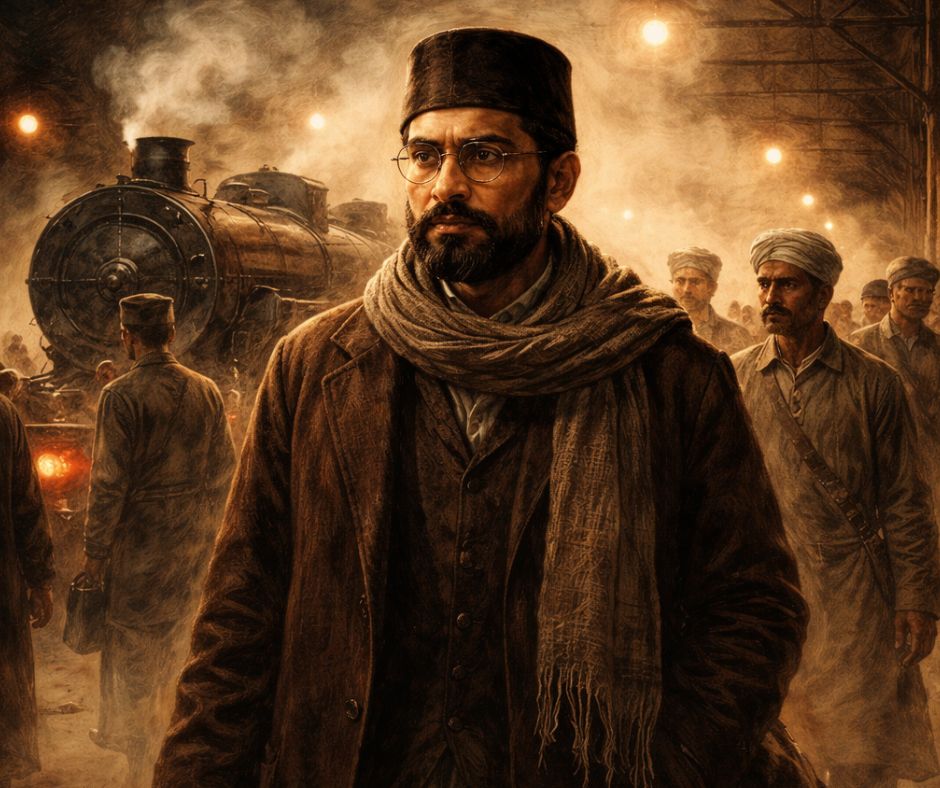
2nd Story: Three Disguises To Berlin: The night Calcutta learned how to hold its breath was not…
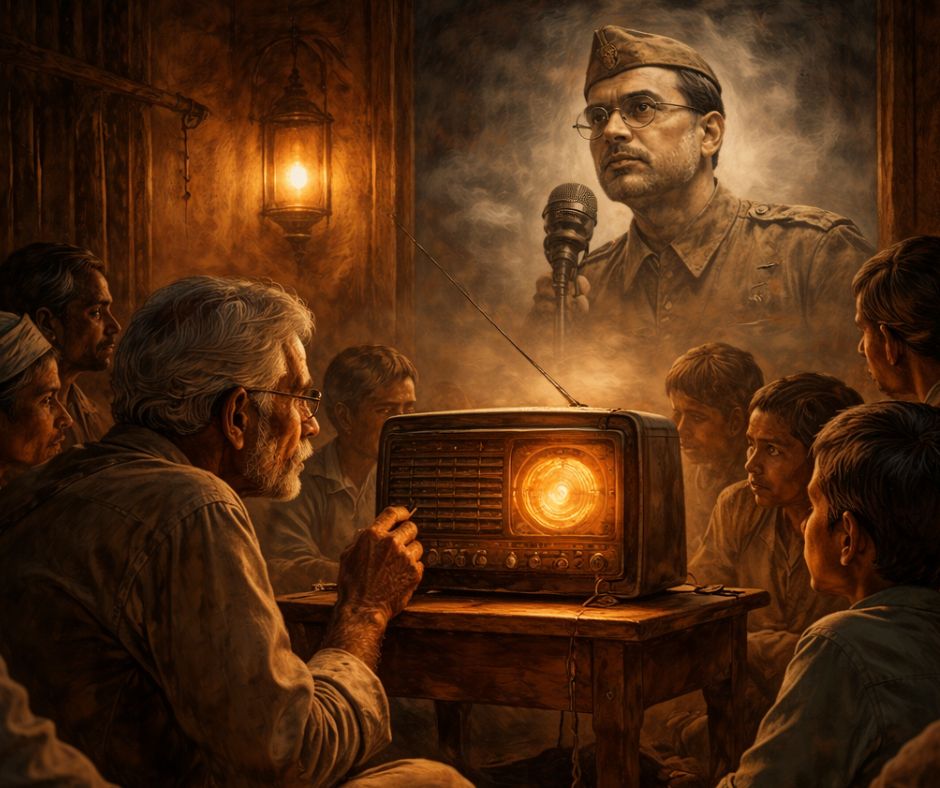
3rd Story: The Radio That Roared: The radio arrived in the village like a rumour. No one could…
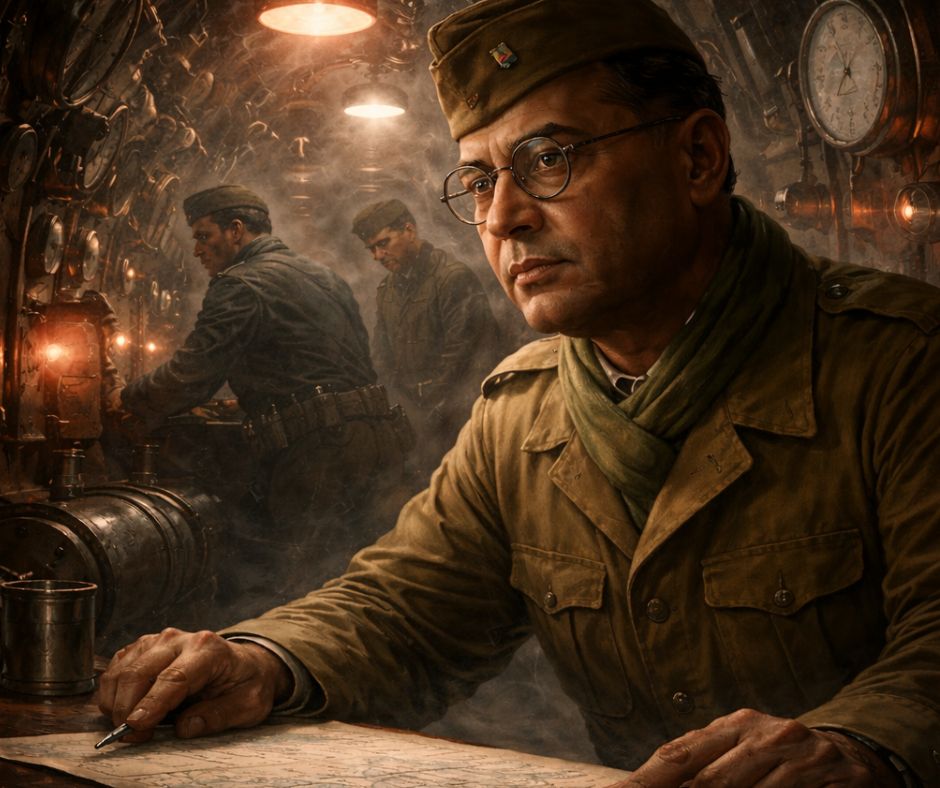
4th Story: The Secret Voyage Aboard U-180: The sea does not announce itself when it decides to…
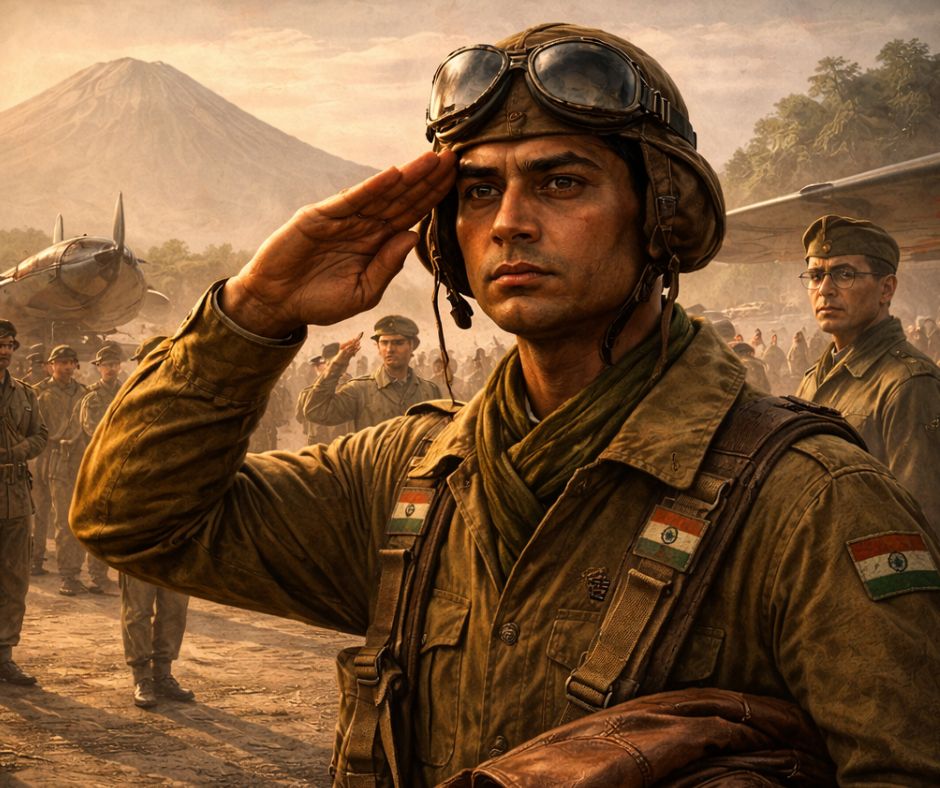
5th Story: The Tokyo Cadets: They arrived in Tokyo carrying the smell of salt, sweat, and old paper…

6th Story: The Shadow of Renko-ji: The temple does not face the street. It turns inward, as though…
Copyright © 2026 TRISHIKH DASGUPTA
This work of fictionised history, written by Trishikh Dasgupta, is the author’s sole intellectual property. It draws inspiration from documented wartime voyages, covert alliances, and the perilous maritime passage undertaken by Netaji Subhas Chandra Bose during the Indian freedom movement. While this story can be read and experienced independently, it also forms the fourth part of a six story narrative arc, where each piece stands alone yet together deepens the understanding of Netaji’s resolve, transformations, and the unseen journeys that carried history forward. Some characters, incidents, places, and facts may be real, while others are imaginatively reinterpreted.
All rights are reserved. No part of this story may be reproduced, distributed, or transmitted in any form or by any means, including printing, photocopying, recording, or other electronic or mechanical methods, without the prior written permission of the author, except in the case of brief quotations embodied in critical reviews and certain other noncommercial uses permitted by copyright law. For permission requests, send an email to the author at trishikh@gmail.com or get in touch with Trishikh on the CONTACT page of this website.
ABOUT THE AUTHOR

Trishikh Dasgupta
Adventurer, philosopher, writer, painter, photographer, craftsman, innovator, or just a momentary speck in the universe flickering to leave behind a footprint on the sands of time... READ MORE
These stories are Free and if you have found something here that stayed with you, some of my other books (collection of short stories, novels, and more) are now available in print and digital editions. They gather many unique journeys, quieter questions, and stories that continue beyond this page.

You may also like to read my1st Published novel now available on Kindle and Paperback versions.
 Weekend Stories by Trishikh
Marking this story to read later
LikeLiked by 1 person
Thank you. I am sure that you would enjoy the story, it’s the fourth in a series of 6 stories. To more to be released in the two coming Fridays.
LikeLiked by 1 person
Brother, you could write about paint drying in the summer and I would enjoy it. You have a gift. I am
Blessed you ever followed me.
LikeLiked by 2 people
You honour me so much with your beautiful words of appreciation. I am so glad to be able to share my gift with friends like you, who look at the world through a humane lens.
LikeLiked by 2 people
Yes your works have helped to calm me down. Soothe my soul. It has shown me the beauty of humanity.
LikeLiked by 1 person
This crossing does not seem to ask for attention.
What moves here is not drama, nor courage made visible, but a discipline already learned long before the sea closed in — a way of listening that does not hurry meaning, and does not seek to be carried forward by memory.
The silence aboard U-180 feels trained rather than empty. It holds without insisting, endures without asking to be seen.
In that sense, not being remembered no longer reads as loss, but as release — a freedom history rarely knows how to mark, except by letting it pass.
LikeLiked by 4 people
Dear Livora, thank you for such a finely tuned reading. I am deeply moved by how you recognised the silence aboard U-180 as something trained rather than empty, a discipline carried long before the sea demanded it. That sense of not being remembered as release rather than loss touches the quiet centre of the story, where freedom arrives not through recognition, but through passage. I am grateful for the way you listened to this crossing and allowed it to pass without insisting it be held.
LikeLiked by 3 people
Thank you, Trishikh, for another interesting story, beautifully written.
Joanna
LikeLiked by 2 people
Dear Joanna, you are most welcome. Its always such a pleasure to be able to write these short stories and share it with the world. This was the 4th in the series of 6 stories surrounding Netaji. Two more to go to complete the narrative arc.
LikeLiked by 1 person
Thank you, Trishikh, for the beautiful reply! As always, you are more than welcome!
Joanna
LikeLiked by 2 people
🙏
Aum Shanti
LikeLiked by 1 person
Thank you so much.
LikeLiked by 1 person
Good story, thank you. I went on a submarine long ago when I was a teenager, it was a British naval sub and I completely freaked out when it went under.. I was so scared of been locked in ~ remember it well. ❤️
LikeLiked by 5 people
Thank you, Fiona, for sharing that memory. It resonated with me deeply. My father served in the Navy, and I once went inside a Foxtrot class submarine myself. It was docked and had not submerged, yet even then it felt like a different world altogether, enclosed, heavy with metal and silence. I can only imagine how much more intense that feeling must be once the vessel goes under water. That first rush of fright and disorientation you describe feels entirely natural, and it was very much in my mind while writing this piece, the idea that a submarine asks you to confront confinement before it asks for courage.
LikeLiked by 2 people
I felt like I was there smelling the rust tasting food and feeling the silent fear. A very evocative story as I have come to expect from you. What a wonderful gift you have been given by the Almighty!
LikeLiked by 2 people
Thank you so much for reading it so closely and for feeling the world of the story so vividly. I am glad the smells, tastes, and that quiet undercurrent of fear came through, because those sensory details were essential to carrying the weight of the crossing. I am grateful for your kind words, and for the encouragement you continue to offer with such warmth.
LikeLiked by 1 person
What a great opening, it got me hooked straight away.
LikeLiked by 2 people
Thank you, Michael. I am glad the opening drew you in right away, because that first descent into the story had to carry both tension and restraint. It means a great deal to know it held your attention from the start.
LikeLiked by 2 people
What a remarkable journey…
As you rightly said we only remember the landmarks and milestones clinically documented. Nobody talks about what actually happened, how it was felt when history happened and how it was carried forward.
The realisation that one day nobody would remember is an anathema irrefutably and inherently intertwined with the courage , spirit and calculations of carrying out a rebellion.
Those at that point of time did not know whether it would bear fruits or diffuse with dust as an another forgettable encounter.
Those who wait impatiently for results should for once contemplate the countless such stories which were never written, never spoken, never reminisced and those stories which remained etched not only in history but also in the hearts of the million.
LikeLiked by 3 people
We have been communicating for so long, but I do not know your name, my bad for not asking till now. What do you call you.
Thank you for such a deeply felt reading of this journey. Your reflection on how history records landmarks while overlooking the lived experience of those moments touches the quiet centre of this story. That awareness, of acting without knowing whether anything would endure, is inseparable from the courage and calculation of rebellion. For many, the possibility of being forgotten was not a deterrent, but part of the cost they accepted in carrying something larger than themselves. I am grateful that you paused to remember the countless stories that were never written or spoken, yet remain etched in the hearts of millions, because it is in that remembering that these journeys continue to live.
Trishikh
LikeLiked by 3 people
If you visit my blog space my name is there. I am Geetashree.
LikeLiked by 2 people
Yes, but do you prefer to be referred to as GC?
LikeLiked by 2 people
Geeta or Geetashree
LikeLiked by 1 person
Thanks Geeta, many more stories to come. Two more remaining in this complete to complete the Netaji curve.
LikeLiked by 1 person
Looking forward to
LikeLiked by 1 person
Gripping and atmospheric—every line tightens the sense of claustrophobia and quiet inevitability, pulling the reader deep into history’s shadowed depths.
LikeLiked by 2 people
Thank you for such a generous and attentive reading. I am glad the atmosphere and that sense of quiet inevitability came through, because the story was meant to draw the reader into the confined, uncertain space where history unfolds without spectacle. Your words mean a great deal to me, and I am grateful that you travelled into those depths with the story.
LikeLiked by 2 people
Grateful for your like! 💖 Subscribing to my channel would truly encourage me, and your feedback would guide me to improve. ✨
LikeLiked by 2 people
Yes Safia, I am already subscribed to your channel.
LikeLiked by 1 person
Grateful for your like! 💖 Subscribing to my channel would truly encourage me, and your feedback would guide me to improve. ✨
<a href="/@safiabegum-h7m
LikeLiked by 2 people
Yes, I have subscribed to your YouTube channel. Though I do not visit YouTube all the time. I only visit YouTube when I need to see or research a certain topic or video, and sometimes I also casually visit. But your channel is pretty good. Keep up the great work.
LikeLiked by 2 people
Thank you so much for subscribing and for your thoughtful words—I truly appreciate them. I completely understand. It really means a lot to know you find the channel worthwhile. Your encouragement motivates me to keep improving and creating meaningful content. Thanks again for your kindness and support. 🌷
LikeLiked by 1 person
Thank you so much. I really treasure our interactions.
LikeLike
I have removed your channel link from the comment as I only allow links in my comments that are directly or indirectly linked to the particular story. But I really like your channel, and would be visiting it whenever I get a chance. I treasure your constant application for my stories.
LikeLiked by 2 people
Thank you so much for letting me know—I completely understand and respect your comment policy. I truly appreciate your kind words about my channel; they mean a lot to me. I’m grateful for your thoughtful response and honored that you value my engagement with your stories. I always enjoy reading them and look forward to continuing the conversation around your wonderful work.
LikeLiked by 1 person
It is my great privilege to follow your channel. Thank you so much.
LikeLike
I felt as if I was underwater with your story, brilliant, and fascinating story..
LikeLiked by 2 people
Dear William, thank you so much for reading it so closely. I am glad the story could carry you into that submerged world, because that feeling of being underwater, held by silence and uncertainty, was central to the experience I hoped to create. Your words mean a great deal to me.
LikeLiked by 2 people
I wrote one lengthy comment last night but it’s just vanished.
I like the way you have retold history from the human perspective. Not merely documented it, as you say, clinically.
It requires a lot of heart and imagination to do so.
I also like the way you have mentioned that time may erase the event, monumentous for those who have lived it, from people’s memories.
We have to carry that anathema with us, however historical the landmark may be, it’s transient.
It’s really awe inspiring to recall how Bose painstakingly lived through a journey which in history is just part of a passage made for survival and strategic strife.
LikeLiked by 3 people
Thank you for taking the time to write again, and please don’t worry about the comment seeming to vanish. Comments on the stories appear only after I approve them, and sometimes it takes me a day or two, or even a little longer, to go through them carefully. I did see your earlier comment today, approved it, and have also replied to it.
I am truly grateful for the way you read this piece, not as a retelling of events, but as an attempt to recover the human weight behind what history often reduces to passages and strategies. What you say about transience is especially important to me. Even the most momentous acts carry within them the knowledge that memory fades, that monuments outlast emotions, and that those who live through history rarely know how, or if, it will be remembered. Netaji’s journey, when seen up close, was not just strategic survival, but an endurance of uncertainty, of acting without guarantees. If the story could honour that fragile, human dimension, then it has done what I hoped it might.
Your reflections add a great deal to the life of the story, and I am thankful that you continue to engage with it so thoughtfully.
LikeLiked by 3 people
well written and you have captured the scene beautifully.
LikeLiked by 2 people
Dear Savitha, thank you so much. I am really happy that you liked the way I imagined and captured the scene inside the submarine. I don’t think that anyomne is alive today who was there in that submarine.
LikeLiked by 1 person
Thank you for your continuous high quality story telling.
LikeLiked by 2 people
And it is I who must thank you for your constant appreciation for these stories, and for encouraging me to keep on writing them.
LikeLiked by 2 people
Fear is a sound. I loved that insight!
LikeLiked by 2 people
Thank you, Geoff. I am glad that line stayed with you. Fear often announces itself before anything else does, and learning to listen to it without letting it decide the journey felt essential to this story.
LikeLiked by 1 person
Another wonderful story. This story brought up claustrophobia, the sense of being pressed on all sides. The tension and waiting was very heavy.
Was Bose then aligned with the Nazis?
LikeLiked by 4 people
Dear Katelon thank you, for reading it so closely and for feeling that pressure and waiting so viscerally. That sense of being pressed on all sides, physically and historically, was very much what I wanted the crossing to hold.
Your question is an important one. Bose’s engagement with Nazi Germany was not an ideological alignment in the way it is often simplistically framed. It was a strategic and deeply fraught choice made within the brutal constraints of the time, driven by his single minded commitment to ending British colonial rule. He was clear eyed about the moral compromises involved, and his alliances were born of necessity rather than belief. History rarely offers clean paths, only difficult ones, and this story sits precisely in that uncomfortable space where urgency, calculation, and conscience intersect.
I am grateful that you asked the question, because sitting with that discomfort is part of understanding both the man and the moment.
LikeLiked by 2 people
You sound and write like the Unseen Witness ! Pretty amazing.
LikeLiked by 2 people
Dear Kajoli, thank you so much. I am really happy that my stories touch your heart.
LikeLike
The story seemed to be almost an autobiographic evidence. Everything feels so real.
LikeLiked by 2 people
I think I would get claustrophobia in a submarine. It must be a trying situation for everybody involved, you are bringing that alive in your story. So many men enclosed in a small space under miles of water, but still an easy target. What must they feel? And so, Bose went to Japan, interesting. I am looking forward to read the next part.
LikeLiked by 1 person
Thank you for reading it so closely and for imagining yourself inside that confined world. That sense of claustrophobia, of being enclosed under miles of water while remaining vulnerable, was very much what I wanted the story to hold. It is difficult to imagine what those men must have felt, carrying fear, discipline, and resolve in such close quarters, knowing how exposed they truly were. And yes, Bose’s journey to Japan opens yet another complicated chapter in his story.
I’m glad to share that the next part of the series is already out. You can read “The Tokyo Cadets” here:
I hope you enjoy stepping into that next space of the journey as well.
LikeLiked by 1 person
Nicely put!
LikeLiked by 1 person
Glad that you liked the story.
LikeLike