When the dark aura of a cold and misty night gasped its last breath before surrendering to the faint illuminations of the awakening sun, a tall and dark figure walked through the nodding wheat fields to reach a solitary palm gently swaying in the chilly breeze of an early winter morn. Barring only a white loin cloth and a traditional thin cotton towel wrapped around his head, he wore nothing else to fend against the elements. His lithe and leathery body did not seem to mind. After offering a silent prayer to the Monkey God, he ascended the living monolith.
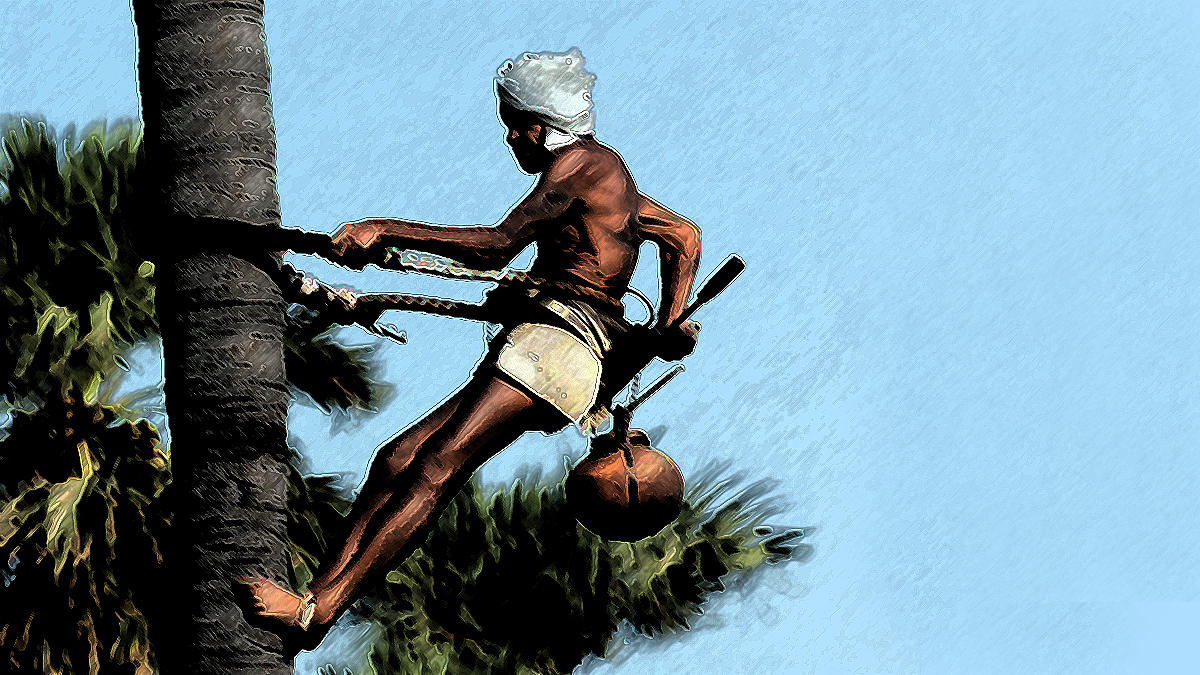
Using two harnesses of jute ropes, one around his waist and the other around his ankles, he slithered upwards like a squirrel on a sprinting spree. Reaching the canopy, he leaned backwards, locking himself in mid-air. Then he unfastened five round earthen pots from around his waist and tied them on the tree trunk. Taking out a thin and worn iron sickle, tucked behind his back, he made precise cuts on the flowers of the old palm just above the pots. After a few seconds, glistening golden nectar trickled out of the gashes into the chubby earthen cauldrons. Chabila Rai climbed down and laid a grass mat below the swaying tree to set up his open-air palm wine outlet for the village day drinkers while his pots slowly filled away in the oscillating canopy high above.
With the ban on alcohol in the state of Bihar in India in April 2016, there was a glimmer of hope that the majority of poor men who squandered away their daily wages on getting high and abusing the women and children at their homes, would rectify their lives to a great extent. Many believed that more than social reform, it was a political manoeuvre by the Government to secure the votes of the womenfolk. While legal businesses of manufacturing, selling and serving alcohol vanished, many illegal enterprises sprung up to cater to the drunkards of the state. Those with money and guts could seek out these nefarious sources to get high but the poorest of village folks with lesser means and gusto relied on palm tree tappers like Chabila for their daily quota of organic high.
“Is the spirit ready my man,” enquired his first customer for the day. The chubby little man came and sat in front of Chabila just after a few hours since the tapper had hung his first batch of pots on the palm canopy above his head. “Half an hour more of fermentation in the sun, and it will be ready Baru’bhai,” replied Chabila and continued tidying the place. Soon a considerable conglomeration of ten drunkards huddled around Chabila at the base of the solitary palm tree in the middle of the nodding wheat fields waiting to get high.
Palm wine or Toddy was a poor man’s drink, popular in various parts of Africa, the Caribbean, South America, and South Asia, where it was known by names such as lagmi, sodavi, mimbo, tuaka, tope, toutou, doka, tuba, arak, ballo, bandji, mnazi, karewe, lagbi, nira, dhoaraa, omulunga, demangi, emu, oguro, tombo, segero, kalou, poyo, ubusulu, ra, kallu, pombe, kache, lagmi, kaleve and others. In Bangladesh, Nepal, and the six Indian states of Assam, Bengal, Bihar, Maharashtra, Odisha, and Uttar Pradesh in India it was known as Tari or Tadi.
“There you go Baru’bhai, my first pot of the day reserved for my best customer,” said Chabila and passed a warm pot of Tadi to the plump man, who had been nodding impatiently for the past few hours, waiting for the palm juice to ferment into alcohol under the mellow winter sun. “Gulp, gulp, gulp, ahh… nothing like a refreshing pot of Tadi to begin the day with,” satisfactorily grinned the pot-bellied drunkard bringing down the oversized earthen chalice from his dripping chin, very similar to the attics of an infant sucking from his mama’s tits.
“You tap the best Tadi Chabila bhai, hic, hic… I pray to Lord Hanuman to continue blessing you with your climbing skills, hic, hic…,” stuttered Ramdeo, another of his regulars. “Stop with this nonsensical blabber Ramdeo. Do you wish to curse me with climbing palm trees for the rest of my life? Is this a life worth living, climbing the tall palms every day to help good-for-nothing drunkards like you get high,” angrily shouted Chabila? Some of the drunkards agreed while few others promoted the benefits of palm tree climbing, to keep Chabila motivated to provide them with their daily quota of natural hootch. Soon the drunkards fell into a great debate and kept on talking nonsense, while Chabila sulked in a corner, unable to even dream of an alternate way of life.
As the dawning sun arched from the wooded horizon to the top of the swinging palm, around fifteen pots of watered-down and a secret powder mixed Tadi were benevolently consumed by the group of poor drunkards. By twelve o’clock in the afternoon, after three trips to the canopy, while all of Chabila’s pots lay dry, most of the talkative drunkards lay snoring here and there scattered around the golden wheat field, unconsciously waiting for their howling wives and pestering children to come and resuscitate them back to the morbid realities of their mundane rural lives.
That day in the night, back in his rickety bamboo and palm leaf shanty, Chabila cursed his wife Luxmi for serving only smoky white rice and a blob of salt. Two of his twin daughters, Chumki and Chutki, consumed the meal without making a sound, lest their father’s anger found its way to them. After everyone ate, Luxmi had what was left over. Clearly, palm tapping was not that lucrative, and the poor family faced the financial crunch that came with it.
“You know Luxmi when I was a child, I thought that climbing was my greatest gift. I felt that Lord Hanuman had blessed me with this unique talent. It made me feel like a superhero. Now, after all these years, I have come to realise that it’s not a boon but a curse,” sighed Chabila lying on the palm grass mat on the cold earthen floor of their mud abode. “Don’t fret so much dear. At least it helps to provide food,” consoled Luxmi as she caressed her poor husband’s thinning forehead with her toiled and bony fingers.
“The girls have to be taken out of school. Though their education is free, thanks to the Government, it does not put food on the plate. It would be better if they worked as farm labourers. At least they could earn something, and we could perhaps save a little to get them married off in a few years. Tomorrow I will go to the school and cancel their enrolment,” regretfully blabbered Chabila in the darkness, pushing away his wife’s caressing hands.
“There’s a function at the school tomorrow. They are installing a statue of Lord Hanuman. The girls are all excited about it. Please do not break their heart. At least let them attend the function,” pleaded Luxmi to her husband and surrendered to the silence of the night.
That night in his dreams, Chabila saw Lord Hanuman leap over the flames on the rooftops of burning Lanka. The vision felt so real and the heat of the flames so intense that Chabila startled and woke up from his sleep drenched in perspiration. Unable to decipher what the vision meant he could not sleep anymore, tossing and turning, mumbling, and complaining to the divine simian for disrupting his slumber.
Early in the morning the next day when Chabila stepped out of his hut, he felt very uneasy, something was just not right. He thought, “it must be one of those cursed days when everything would go wrong.” As the day progressed Chabila catered to the drunkards of the golden wheat fields and by noon all the din and excitement of the morn fell silent as the dipsomaniacs lay snoring on their hungry bellies and hardened backs.
Then at a distance, something caught the tapper’s eyes. A column of grey smoke gradually swelling into an alarming black cloud in the far sky. Kicking Baru, Ramdeo and a few of his slumbering customers back to consciousness, Chabila and his patrons dashed towards the black and orange fiery mushroom spreading against the backdrop of the turquoise winter sky.
Within minutes they were in front of the three-storey village school, which was recently refurbished from the old and donated mansion of a rich landlord, who had willed the property to be converted into a school and died. A score of people stood speechless in front of the building as the first-floor sputtered raging flames fuelled by a burning inferno from inside. Apparently, an inexperienced helper, while trying to light a gas stove had done something wrong and the downstairs kitchen where a feast was being prepared for the installation ceremony of Lord Hanuman’s statue caught fire. Finally, someone took the initiative and the crowd breaking away from their freeze of horror dashed to pass pots, pans and buckets of water to subdue the raging wood and concrete pier.
“Few children are still trapped on the terrace,” came a shrieking cry from amidst the panicked crowd and everyone looked towards the sky. There on the north parapet, they saw five children huddled and screaming clinging on to dear life.
Without giving a second thought, Chabila dashed towards the tall palm that swayed on the north face of the charring edifice, a few feet away from the flames that were spreading fast in an insatiable quest to devour anything that lay on its path.
It was as if the Monkey God had possessed the climber himself. Everyone saw Chabila sprint across the greens on his four and zip up the wobbling palm. Within minutes he was on the tree canopy, a few feet from the parapet. That day everyone witnessed the humble palm tapper of an unknown Indian village transform into Lord hanuman himself as he took an unbelievable leap of faith from the nodding palm across a wall of flame, with a line of jute tied around his waist anchored to the swaying tree of the Arecaceae family, to land on the parapet where five little children loudly prayed to the diving Maruti to save their lives.
With the Wind God, Pavan or Marut, father of Lord Hanuman on his side the flames somehow swirled sideways and downwards instead of reaching up to devour Chabila’s line across the palm tree and the school parapet. Chabila saw both of his daughters amongst the five. Deciding to take them last given their history of tolerance and obedience, one by one Chabila took the other three children across the ropes, lowering them back to the safe embrace of the villagers on the ground.
At last, Chabila tied both of his daughters clinging to his torso. He had to take them across in one shot as the raging flames below were just minutes from devouring his jute lifeline. Halfway across the line, the flame did its thing, and the rope broke burning away and detaching from the parapet. The father and his two daughters clumped as one fell from the canopy cutting through the flames and dangled halfway from the sky. The rope held itself anchored to the treetop. Somehow, as if through some divine intervention the flames parted just right with a gust of wind creating a straight pathway downwards, and Chabila descended the tree with his daughters just moments before the gash in the fire closed and engulfed the palm.
Everyone dashed and lifted Chabila high above the ground. The tapper floated on scores of human hands. The crowd cheered and bellowed praises to the Wind and the Monkey Gods. The climber radiated in his moment of heroic triumph. After hours of burning, an old and ramshackle fire engine finally arrived to douse whatever remained of the giant wood and concrete pier.
For the next few days, there was much talk about Chabila’s heroism. About him being possessed by Lord Hanuman and blessed by the wind God himself. Some Government minister even came to the village and garlanded him on a podium. The fire department gave him an honorary certificate for performing a selfless act in face of great danger. Influential people used his momentary glory to get personal mileage.
As the days turned to weeks and the weeks to months soon a year was over. Gradually everyone nearly forgot about Chabila’s heroism, seldom did anyone speak about the incident. Though the school was rebuilt, Chabila had taken his daughters out. They now laboured on the same wheat fields, where their father tapped on the occasional palm here and there catering to the village drunkards. Though not much had changed, and poverty secured a tighter grip, the climber was happy and convinced that his climbing skill was a divine gift and not a cursed bane.
Copyright © 2022 TRISHIKH DASGUPTA
This work of fiction, written by Trishikh Dasgupta is the author’s sole intellectual property. Some characters, incidents, places, and facts may be real while some fictitious. All rights are reserved. No part of this story may be reproduced, distributed, or transmitted in any form or by any means, including printing, photocopying, recording, or other electronic or mechanical methods, without the prior written permission of the author, except in the case of brief quotations embodied in critical reviews and certain other noncommercial uses permitted by copyright law. For permission requests, send an email to the author at trishikh@gmail.com or get in touch with Trishikh on the CONTACT page of this website.
ABOUT THE AUTHOR

Trishikh Dasgupta
Adventurer, philosopher, writer, painter, photographer, craftsman, innovator, or just a momentary speck in the universe flickering to leave behind a footprint on the sands of time... READ MORE
These stories are Free and if you have found something here that stayed with you, some of my other books are now available in print and digital editions. They gather longer journeys, quieter questions, and stories that continue beyond this page.
You may also like to read my1st Published novel now available on Kindle and Paperback versions.
 Weekend Stories by Trishikh
Beautifully written!
LikeLiked by 1 person
Dear Chris, thank you so much. Appreciation really makes my day. So glad that you liked this little story of mine.
LikeLiked by 1 person
My good friend, I greatly appreciate all of the work that you do. I also appreciate the many likes that you give to my posts.
LikeLiked by 2 people
Always a pleasure. Always a pleasure dear old friend.
LikeLiked by 1 person
I am grateful, and thankful for your friendship
LikeLiked by 2 people
I am also grateful for our friendship.
LikeLike
Many blessings to you. I never lose a friend (true)
LikeLiked by 1 person
You are truly blessed.
LikeLiked by 1 person
Thank you.
LikeLiked by 1 person
Lovely
LikeLiked by 1 person
Thank you so much. Always treasure an appreciation.
LikeLiked by 1 person
Thank you so much for showcasing my story in your blog. It is such a pleasure to see this.
LikeLike
Bonjour AMI
Je vous écris ce petit texte pour vous dire au revoir
Par un message poétique
A toutes les personnes qui m’ont suivi jusqu’à maintenant
Que ce soit par les liens du net, par messages, sms, un face à face, une rencontre
A tous ceux qui ont suivi mon blog
En me laissant une marque de leur passage
Je tiens à vous dire
Qu’avec vous j’ai vécu une belle histoire d’amitié
Je vous en suis plus que reconnaissant
Mais j’ai décidé de m’arrêter là
Comme une poésie qui s’éteint
Merci pour ces moments magiques, particuliers
Une page se ferme
Comme une histoire d’amour
Ainsi vas la vie
Gardez l’espoir, bonne continuation à vous tous
Par ces derniers mots
Joyeuses fêtes de fin d’année
LikeLiked by 5 people
Dear Bernard, this is really sad to hear, however, life is never the same it always changes and that is the only constant. I treasure our friendship and wish you all the best on your next adventure. It’s not goodbye as long as the possibility to interact once again exists. Take care dear old friend.
LikeLike
Bernard Bonjour Ami amie
Que le ciel soit gris ou ensoleillé
Je t’envoie ces mots pour égayer ta journée
Que cette journée te soit douce et enivré de bonheur et d’amour
Bise Amicale
LikeLiked by 1 person
Have a great day Bernard.
LikeLike
J’aime Bien !
LikeLiked by 1 person
Thank you.
LikeLike
Another awesome story, thanks for sharing
LikeLiked by 1 person
Always treasure your appreciation. Thank you so much Denise.
LikeLike
Congratulations, Trishikh, on your excellent new story! It looks like you and your talent are back, and we can only rejoice at the prospect of reading more. Thank you!
Joanna
LikeLiked by 1 person
Oh you are always too kind with your appreciation. Am also glad to have been able to get back to writing. Yes, have started my next story, will hopefully complete and publish it soon.
LikeLike
We call them ‘palmwine tappers’ in Nigeria . . .
🇳🇬
LikeLiked by 2 people
Yes, the same profession. Glad that you could relate. There are many similarities between Nigeria and India.
LikeLiked by 1 person
You’re right about the similarities – Same colonial masters, same English language, and of course, there are a good number of the Indian population around here in Lagos to the extent that there’s an Indian School.
LikeLiked by 1 person
Yes very true. There are many Nigerian students in India as well, who come for higher studies. Some are also part of sports like football, rugby, and cricket.
LikeLiked by 1 person
What a powerful narrative, Trishikh! 🌾 You captured not only the hardship of village life but also the inner struggle of a man caught between survival and dignity. The imagery of the palm tree, the fire, and Hanuman’s presence makes the story unforgettable.
Beyond the drama, the tale speaks of hidden gifts—skills that may seem like a burden until the right moment reveals their true purpose. Chabila’s climb reminds us that what feels like a curse can, in God’s time, become a channel of redemption.
LikeLiked by 2 people
Dear Livora, you have very rightly said, “a curse can, in God’s time, become a channel of redemption.” This is so true for any of us. We need to treasure the skills that we have no matter how insignificant they may appear.
Thank you once again for liking another story of mine. Yes this one is very close to my heart, and I wrote it when I was in Bihar, witnessing such climbers and village life.
LikeLiked by 1 person
Dear Trishikh, thank you for sharing the heart behind this story. 🌿 Your reflections carry both wisdom and tenderness, reminding us that even the smallest skills or scenes of village life can reveal God’s redeeming touch. Truly inspiring! ✨📖🙏
LikeLiked by 1 person
Dear Livora, much obliged. I hope to continue writing many more of these stories in the days to come.
LikeLiked by 1 person
Dear Trishikh, that is wonderful to hear! 🌿 May your pen never run out of stories, and may each one continue to touch hearts in fresh and meaningful ways. ✨📖🙏
LikeLiked by 1 person