The city of Kolkata had just begun to close its eyelids. The clock tower at Esplanade yawned past midnight, rain flirting with the edges of every lamp post, swaying shadows on water-logged streets. The storm had been brewing all evening, first in the skies, now in the hearts of those still wandering the city’s underbelly.
From the outside, Club Nirvana shimmered with loud, neon confidence – the kind that masks its hollowness with tequila shots and EDM. Outside its grand gate, a group of sharply dressed young men smoked nervously. Laughter floated, a tad forced. Between them stood a girl, eyes scanning the road for salvation, heels trembling on the pavement. Her sequined dress, wet at the hem, clung awkwardly like a secret exposed too soon.
She had come with them. Old college acquaintances. Trust, she thought, was still a currency. But it had turned counterfeit tonight. Just then, through the smudged mist of rain, a faint honk cut through the air – old, familiar, like a song from childhood. Phonk-phonk.
It came again. And out of the darkness rolled a yellow beast – an Ambassador, the bulbous-bodied monarch of Kolkata’s once-glorious streets. Timeworn but proud, its headlights blinked like an old woman’s eyes adjusting to the world. It halted beside her.
At the wheel sat a towering man with a neatly wound turban, royal blue. His white beard was streaked with silver and monsoon dust. A gentle smile lingered in his eyes, but his frame carried the weight of decades of the city’s stories.
“Putar,” he said in a tone as warm as autumn sun, “Kitthey jete chai,” in a mix of Gurmukhi and broken Bengali, meaning, where do you want to go child? The girl hesitated. One of the boys laughed behind her. “Sir, she’s with us.” “I asked her, beta,” said the Sardarji, eyes now sharper than a kirpan. “Not you.”
That split-second of assertion was all she needed. She dashed across the narrow puddle-filled gap and opened the cab’s back door. It creaked like an old opera singer clearing his throat. The inside smelled of sandalwood, old vinyl, and a whisper of attar. Safety in the face of imminent danger.
The moment she shut the door, the Sardarji revved the engine. The boy knocked angrily on the window. “Hey, old man! What’s your problem?!” But the Sardarji didn’t flinch. With a gentle churn of the gear and a determined clutch of the wheel, he whispered to his car, “Chal oye, Rani. Aj vi shaan dikhani hai!” Let’s go, Rani, let’s show them what we are made of. And Rani responded like a lioness woken from slumber. The Ambassador surged into the night of flashing darkness.
This wasn’t just any taxi. This was Rani, named after his late wife, Ranjit Kaur, who once sat beside him in the front seat humming old Mukesh songs. This was the same Ambassador that had ferried brides, babies, barristers, and beggars. It had seen the birth of new Kolkata and the fading footsteps of the old.
Once upon a time, thousands of these yellow Ambassadors ruled the roads of Kolkata. Produced by Hindustan Motors from 1957, the Ambassador became the emblem of the city’s lifeblood. Its round, sturdy build, inspired by the British Morris Oxford, made it the choice of netas and naukars alike. The city trusted the yellow beast – an elephant in traffic, yes, but a gentle one. In the golden age of the 70s and 80s, Kolkata was painted in these curves.
But time, like an impatient passenger, never stops. Newer, sleeker cars came. Ubers beeped. Apps replaced whistles. And slowly, the yellow tribe disappeared into the scrapyards or withered down nostalgic memory lanes. Only a handful remained, like heritage ghosts refusing to fade. And among those few were the Sardarji drivers – guardians of the wheel, men of trust, the last of the nocturnal sentinels.
Sardar Balvinder Singh was one of the last of this kind. Born in a one-room house in Bhowanipore, son of Kartar Singh, who had arrived in the 1920s with nothing but a turban and the will to work. The first Sikh taxi drivers in Calcutta were wrestlers, horse caretakers, and chauffeurs. They built not just garages, but a legacy.
His grandfather drove a Victoria carriage. His father, the first car in their mohalla. But Balvinder chose the Ambassador, just like his soul chose old-school decency. Women would prefer his taxi late at night. Elderly folks called him ‘puttar’. He had driven poets, panicked mothers, drunken dancers, runaway grooms – and never once did he let his morals slip through the cracks of his resolve.
“Where to, beti?” he asked gently, stealing a glance at the girl through the rear-view mirror. “Anywhere safe,” she whispered, her eyes moist but fierce. He nodded. “Hold tight. Tonight, the storm will not decide your fate. Waaheguru has sent me to intercede.” The storm outside screamed to terrify, but the cab hummed like a serene lullaby.
But as they turned towards Southern Avenue, a black SUV appeared in the rear-view – menace on wheels. “They’re following,” she said, her voice trembling. Balvinder smiled. “Don’t worry. We play by old rules. And the old ones are hard to defy.”
He turned left sharply into a narrow lane near Ballygunge Place – known only to those who knew the city like their heartbeat. Water splashed like petals. The SUV couldn’t keep pace through the slender veins of this vintage neighbourhood. But they caught up again at Gariahat crossing. Balvinder smirked. “These children… no patience.”
He slowed down. The SUV came closer. One of the boys shouted, “Let her out! We just want to talk!” Balvinder rolled down his window. “Bachhe, she doesn’t want to talk. And in our Punjab, no means no, samjhe?” “Who the hell are you?” “I?” He raised an eyebrow. “I’m the last line your bad intentions will ever cross.”
Then he leaned out of the window and did something strange. He waved his turban. Within five seconds, from nearby paan shops and garages, emerged two more Ambassadors – yellow and roaring like wounded lions. Inside them, two other Sardarji drivers. One of them, Uncle Harjeet, wielded a hockey stick like a maestro. The SUV screeched to a halt. The boys jumped out – confused, half-drunk, but no match for experience soaked in honour and years of quiet rage.
Before they could raise a finger, Harjeet and the other Sardarji had surrounded them. No blood was shed. But dignity? Stripped. And fear? Served hot and steaming. Balvinder turned to the girl. “Stay inside. This will take two minutes.” True to his word, in exactly two minutes, the boys were apologising. Profusely. One even promised to never drink again. Another asked if he could donate to langar. Balvinder smiled. “Langar doesn’t take repentance. It gives love. Try being a good human for a change.” They fled.
Later, he dropped her home. She lived in one of those tall condos where security men salute your shadow. As she stepped out, she held his hand. “I had given up on the world tonight. But you… you were everything I needed.” Balvinder simply said, “A daughter’s fear is not her burden alone. It’s the city’s shame. And as long as I drive these streets, no daughter will ride in fear.” She hugged him. Rain still fell, but it didn’t matter anymore.
According to National Crime Records Bureau (NCRB) data, Kolkata is often touted as one of the “safest metros” for women in India; however, this statistic is misleading. While the city records fewer rape cases compared to other metros, underreporting, social stigma, and police apathy still cast long shadows. In 2023, West Bengal recorded over 11,000 cases of crimes against women, with many incidents involving stalking, harassment, and attempted assault in urban public spaces. For every Balvinder Singh behind the wheel, there are far too many streets still unsafe for our daughters, sisters, and friends.
As the sardarji drove off, the sky cracked open – one last thunder. And beneath it, Rani – the yellow queen of Kolkata’s soul – rumbled on, carrying one of the last yellow knights whose courage still kept the city’s dignity awake.
Copyright © 2025 TRISHIKH DASGUPTA
This work of fiction, written by Trishikh Dasgupta is the author’s sole intellectual property. Some characters, incidents, places, and facts may be real while some fictitious. All rights are reserved. No part of this story may be reproduced, distributed, or transmitted in any form or by any means, including printing, photocopying, recording, or other electronic or mechanical methods, without the prior written permission of the author, except in the case of brief quotations embodied in critical reviews and certain other noncommercial uses permitted by copyright law. For permission requests, send an email to the author at trishikh@gmail.com or get in touch with Trishikh on the CONTACT page of this website.
ABOUT THE AUTHOR
Trishikh Dasgupta
Adventurer, philosopher, writer, painter, photographer, craftsman, innovator, or just a momentary speck in the universe flickering to leave behind a footprint on the sands of time... READ MORE
These stories are Free and if you have found something here that stayed with you, some of my other books are now available in print and digital editions. They gather longer journeys, quieter questions, and stories that continue beyond this page.
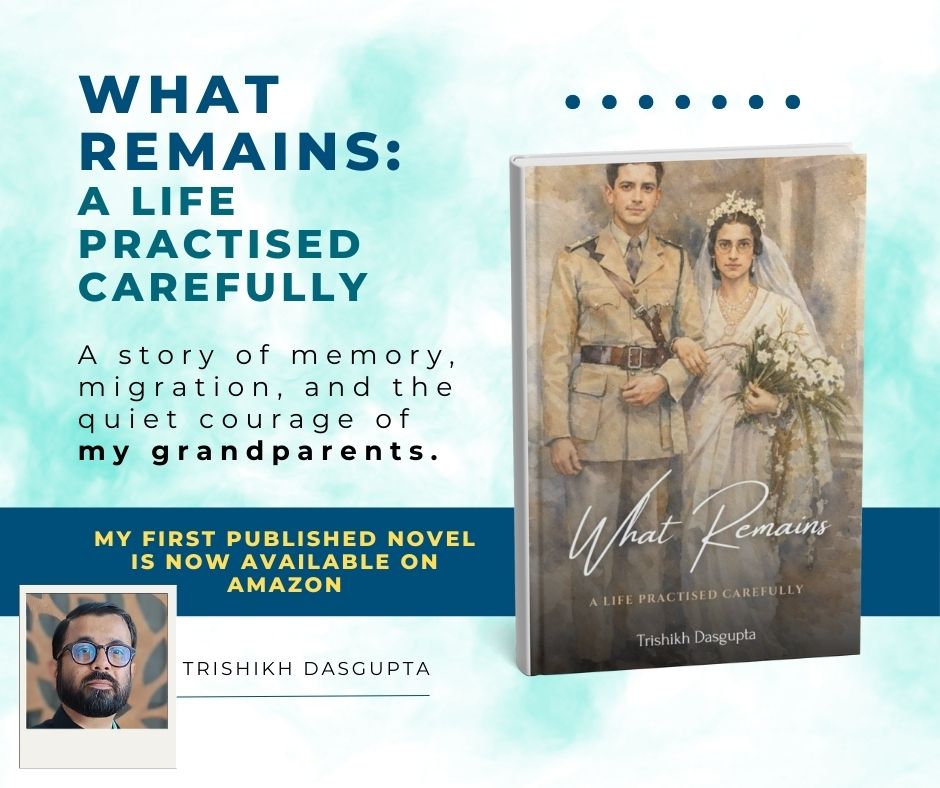
You may also like to read my1st Published novel now available on Kindle and Paperback versions.
 Weekend Stories by Trishikh
That is a wonderful and captivating story. I wish there were more people like the taxi driver with a blue turban. What happened to her is an unfortunate reality for women worldwide.
LikeLiked by 3 people
First of all I must thank you for the first comment on my latest story. I really treasure this. You are very right, unfortunately women are still not safe on our streets even in this so called modern age.
LikeLiked by 2 people
Very informative and yes, kolkata is not the safest metro.
LikeLiked by 3 people
Very right Verma’ji, unfortunately Kolkata has its dark side like any other city.
LikeLike
Yes that is unfortunate. Thank you very much Trishikh.
LikeLiked by 3 people
You are most welcome.
LikeLiked by 1 person
Thank you so much Ned for always promoting my stories. So glad that you like them so much.
LikeLike
Lovely writing – brought the story to life. Sad statistic about women though.
LikeLiked by 2 people
Glad that you like it. Yes, unfortunately women still are unsafe on our roads.
LikeLike
This is true in many cities unfortunately.
LikeLiked by 1 person
Sad but true, but there is hope, things are changing for the good. Hopefully someday in the future, maybe not in our lifetime, women will be able to live a more safe and secured life.
LikeLiked by 1 person
Thank you, Trihikh, for the beautifully told a morality story that is as moving as interesting. I am so glad that you are back!
Joanna
LikeLiked by 3 people
Thank you so much. Am really happy that my story touched your heart. It feels so good to be back. More stories in the coming days.
LikeLike
Nicely portrays that women are not safe in the streets of Kolkata still in this 21st century but there are people like the Sardarji who still exist, who appear as an angels at the time of need. Liked it!
LikeLiked by 2 people
Thank you so much. Your constant inspiration and encouragement gives me the fuel to keep on writing.
LikeLike
An evocative piece that gave me goosebumps. Very well written piece, especially loved the descriptions of the Ambassador which took us all over the country.
LikeLiked by 4 people
Indeed we really grew up the Ambassador. I always dream of owning one someday. Thank you for your beautiful comment, nothing makes my day better than a little bit of appreciation.
LikeLiked by 1 person
Sad, we don’t know when we could be hurt, and we will need help, so people shouldn’t hurt others… Good one
LikeLiked by 4 people
Yes you are absolutely right. Further life is too short to spend time in hurting others. Glad that you liked this story of mine.
LikeLike
Thanks, Trishikh, for another wonderful story. I love how you weave history, culture and such rich descriptive language together in your intriguing stories.
LikeLiked by 3 people
Thank you so much Katelon. History, culture, and vivid description have always been my favourite ingredients in cooking up a good old story. Always treasure your comments.
LikeLike
An engaging and hopeful story, Trishikh.
LikeLiked by 2 people
So happy that you like it. Thank you Rosaliene.
LikeLike
Very nice; a paean to a different time, with the vehicle almost a character itself.
LikeLiked by 2 people
Very true, vehicles always have a character. I personally have named all my vehicles over the years, and all of them had unique characters. Thank you for liking my story.
LikeLiked by 1 person
Oh what a wonderful tale..
You write so brilliantly..
Thank you, Fiona ❤️
LikeLiked by 3 people
You are most welcome Fiona. I also must thank you for loving my story so much.
LikeLiked by 1 person
This is poetry in its finest, giving us an experience in which various perceptions, thoughts and emotions interpenetrate. This is a timely reminder of a situation that plaguing the world all over in epidemic proportions, demanding to be consciously addressed in the early stages of childhood.
LikeLiked by 2 people
You have nailed it when you say this is something that needs to be “addressed in the early stages of childhood.” Though other factors also play their respective parts in forming up a character. Thank you for liking my stories so much.
LikeLiked by 1 person
A story that could have ended in a nasty way … you made it into a poetic knight’s story, both, in content and words. I love it. And yes, all places, not even big cities only, have their dark sides. Humans are a weird species.
LikeLiked by 1 person
Ya, I too strongly feel that these kind of survivor stories should have a positive ending – it should be like an encouragement to those who have faced, seen, heard, or experienced similar difficulties.
LikeLiked by 2 people
And there is also the message to other people: don’t look the other way, help people in need (whatever need).
LikeLiked by 1 person
That is so true, maybe we cannot always help in the way we should, but should always try to however we can. It’s never too late to start helping.
LikeLiked by 1 person
This is an astounding narrative, rich with detail and compelling. The story moves like the special taxi.
LikeLiked by 3 people
Reading an appreciation for one of my stories in the very morning really makes my day. Thank you so much for liking my narrative. Do visit again there are many more stories here that I am sure that you would love to read.
LikeLiked by 1 person
Nice one and could visualise the scenes.
LikeLiked by 2 people
So happy that you find my story visually appealing. I always treasure an appreciating.
LikeLike
I think we need more Balvinder Singh in our city to stop such crime against women. Beautiful story 👏🏼
LikeLiked by 2 people
Absolutely right, in the olden days there were many men of such strong character. Unfortunately as we have evolved so has our evil nature.
LikeLiked by 1 person
Yes
LikeLiked by 1 person
Thanks for your likes of my post on “The Jewish Prophets.” you are very kind.
LikeLiked by 2 people
You are most welcome.
LikeLiked by 1 person
An excellent story! If more people were like Balvinder, the world would be a much better place.
LikeLiked by 2 people
Very very true, if only there were more of Balbinder’s, and less of those ruffians, the world would certainly be a better place.
LikeLike
After a long time, I got an opportunity to read your captivating story, that too, on women’s safety, a burning topic, especially for Kolkata, which has witnessed heinous crimes against women recently. This story is a wake up call. Thank you, Trishikh!
LikeLiked by 1 person
Dear KK, I am so delighted to hear from you. Your comment is something I always look for dearly. Yes, you are right, “women’s safety” is certainly a burning topic, especially in Kolkata, after so many heinous incidents. We all need to speak about it more, and pray that the coming generations would be better human beings.
LikeLiked by 1 person
You’re welcome, Trishikh 🙏
LikeLiked by 1 person
A gripping blockbuster story , poetically told….
LikeLiked by 3 people
Thank you. So glad that you enjoyed my story. Yes, I try to be a bit poetic with my stories. Do visit again and read more of my stories. I am sure that you would love them. I try to write one story every week. Will publish my next story today.
LikeLiked by 1 person
Ah! Such a true reflection of our Kolkata as it is today. Gripping and realistic.
LikeLiked by 3 people
Unfortunately very true. It’s a shame, what our belt Kolkata has become.
LikeLiked by 1 person
😢
LikeLiked by 1 person
A treasure of a story about courage, honor, and decency, something so precious at all times. Sadly, as the story implies, these values are increasingly more difficult to find. 💜
LikeLiked by 4 people
Very true “these values are increasingly more difficult to find.” Thank you for liking my story. Really appreciate the comment.
LikeLiked by 2 people
You are talented and sensitive.
LikeLiked by 5 people
Thank you.
LikeLiked by 1 person
Refined and resonant
LikeLiked by 3 people
Thank you. So happy that you liked my short story.
LikeLiked by 1 person
o this is exquisite writing: the prose is energetic and muscular, the story has momentum, the characters sharply delineated; you have the goods !!!
LikeLiked by 2 people
Dear John, thank you so much. Appreciation is the miracle fuel for my writing engine. So glad to receive it from you.
LikeLiked by 2 people
your writing is superior to numerous books I’ve suffered through ; it’s such a pleasure to read energetic, enthused prose. I have subscribed 🙂
LikeLiked by 2 people
I am so glad and thankful. Keep visiting and reading. I try to publish a story every weekend, mainly on Friday’s.
LikeLiked by 2 people
look forward to it; drop by my post now and then to see what I’m up to: I honour language as you do —
LikeLiked by 2 people
Oh certainly, I enjoy your writing too, subscribed, and like the posts now and then.
LikeLiked by 2 people
Great story!
LikeLiked by 3 people
Thank you. So happy that you liked my story.
LikeLiked by 2 people
Great story.
LikeLiked by 4 people
Thank you so much. Glad that you liked the story.
LikeLiked by 1 person
I am happy to see you back 😊
LikeLiked by 2 people
Thank you Sunitha, glad to be back.
LikeLike
Your story has the ring of truth. I too was watched over by a taxi driver who offered me a ride when he saw a young man nervously following me on a deserted NYC night. The driver was an oasis of safety who I still appreciate.
LikeLiked by 3 people
It feels really good to know that these kind of knights still exist today. So glad that you could relate to my story.
LikeLiked by 1 person
This tale shines not only in its lyrical description of Kolkata’s rain-soaked nights, but also in the moral heartbeat it carries. The yellow Ambassador becomes more than a car—it’s memory, safety, and resistance. Stories like these restore faith in both literature and humanity.
LikeLiked by 1 person
Dear Livora, I am so happy that you think my story “restores faith in both literature and humanity.”
Your constant encouragement works as magical fuel for my writing engine. And I am so thankful for it.
LikeLiked by 1 person
Dear Trishikh, your stories already carry that magic—happy to be part of the journey that fuels it. ✨📖
LikeLiked by 1 person
Dear Livora, without fans who really appreciate these kinds of stories, writing them would not have found its purpose.
LikeLiked by 1 person
I like the way you describe the sardarji ! No nonsense sardar like his Ambassador ! Well written. Thank you for sharing.
LikeLiked by 1 person
Thank you Vinod, such a pleasure to have your comment on this story of mine.
LikeLike
This was incredibly helpful and easy to understand. I’ve learned a lot.
LikeLiked by 2 people
Thank you.
LikeLike