Pandit Pankaj Pandey had been waking at the auspicious hour of 3:00 AM for as long as he could remember. Long before the swelling roar of the city fully stirred from its dreams. On this particular winter morning in 1984, as the faint chill of mist clung to the crumbling rooftops of Banaras, he rose the way a priest rises before lighting the first lamp, unhurried yet purposeful. The thick clay tumbler beside his bed contained his sacred concoction. A mixture of crushed fennel seeds, ashwagandha bark, tulsi leaves, and a drop of wild honey, all swirled into warm water. He drank it steadily, allowing the mixture to travel slowly down his throat and settle calmly in his belly, then walked out in the dim corridor, passing the flickering brass oil lamp at the entrance of the house, and headed to the small outhouse to relieve his bowels.
That, of course, was merely an introduction to the sacred symphony that was his morning. With his white cotton kurta flowing and his forehead still bare of any tilak, he took position in the once-red courtyard and began his ritual of yogic discipline – Surya Namaskar, Bhastrika Pranayam, Kapal Bhati in vigorous bursts, Anulom-Vilom as steady as the flow of the Ganges itself, then Uddiyana Bandha, and finally the difficult Mayurasana which made his arms tremble only slightly after so many years of practice. By the time his breathing calmed, the earliest birds had just dared their first chirps.
At 4:30, he stepped outside with his brass kamandalu and walked toward the ghat. Banaras woke with measured reverence, tiny stone shrines glowing under freshly lit diyas, stray dogs trotting along the steps, the sacred river still half-asleep in shimmering strands of silver. He stepped into the frigid Ganga, his hands folded, eyes half-closed, reciting ancient shlokas under his breath, and dipped his body thrice in the holy water. A curl of steam rose gently from his shoulders when he emerged, and he walked back up the steps with wet clothes dripping like blessings.
The British tongue found it easier to pronounce “Varanasi” as “Banaras”, and the name stuck in the common lingo, but long before, when the world was still searching for its earliest religions and the pyramids were but an architectural dream, Varanasi, then known as Kashi, already stood by the sacred river as a cradle of civilisation. Founded, as legend goes, by Lord Shiva himself, the city became a sanctum of learning and spirituality, where ancient sages compiled the Vedas, and scholars from far-off ancient universities, such as Takshashila and Nalanda, came to debate philosophy. Through the rise and fall of empires, Mauryas, Guptas, Mughals, the British Raj – Kashi remained unmistakably itself: a holy labyrinth of temples, ash-smudged priests, and eternal fire, where death was not an end but a passage back into the cosmic cycle.
As the city slowly unwrapped itself from its misty cocoon. Ancient lanes that twisted like prehistoric serpents opened, Pandit Pankaj Pandey strolled down them as though they belonged to him, and in a way, they did. At a corner close to Dashashwamedh Ghat, he greeted Murlidhar, the flower-seller, who was stringing marigold garlands and sprinkling water over crushed rose petals to keep them fresh. A little further down stood Chandan Pal, the milk-vendor, his buffalo already lazily chewing cud. The old man bowed with reverence as Pandit’ji walked past. At Chandramaulishwar Lane, he stopped briefly at the brassware shop of Abdullah Khan and inspected a newly polished prayer bell. “The curve of this bell is not correct, Abdullah-bhai,” he said softly, noticing how one side had been inadvertently over-buffed. Abdullah grinned, bowing. “Only Panditji’s eyes can see such things.”
Across the street, Sabitri Devi measured masalas in a brass scale. “Too much coriander. Your hand is hurried today,” said the Pandit, smelling the tiny mound on the paper. Without protest, Sabitri reduced the quantity and bowed slightly, impressed at his accuracy.
Breakfast awaited at Dwarika Mishra’s snacks stall – 4 piping-hot kachauris filled with black gram paste, a heap of spicy aloo sabzi, one crisp samosa glowing with ghee, and two jalebi rings coiled like golden bangles soaked in syrup. He ate in perfect silence, savouring each bite the way a raga savours each note. He finished with a cup of thick milk tea flavoured with cardamom and ginger, and resumed his walk through the alleys, picking up fresh vegetables, mustard oil, rock salt, and a large bundle of spinach for the day.
After reaching home and handing everything to his wife, Shobha, he kissed both his children on their foreheads – Rani, his bright-eyed sixteen-year-old daughter who already showed signs of incisive thinking, and Suresh, the mischievous ten-year-old who had swallowed half the scriptures indirectly by listening to his father’s chanting. By 8:00 AM, Pandit Pankaj Pandey reached the Manikarnika Ghat and opened the wooden shutters of his small riverside stall.
It was no ordinary shop. The wooden board above bore the faded red lettering, Panchang Bhavan – Jyotish Seva (Since 1843). His great-great-grandfather had sat in this very spot. Inside, he arranged his weathered brass armillary sphere, a thick Bhrigu Samhita, a smaller text of Laghu Parashari, jade prayer beads, a kalash of holy water from the Ganges, and a framed image of Adi Shankaracharya. He carefully spread out his saffron cotton cloth, placed the brass bell precisely 9 inches from the eastern edge, and aligned his small hourglass facing the river.
Outside, life breathed and burned. Smoke coiled from the funeral pyres, as doms in sooty langots hefted thick mango, banyan, and sandalwood logs. The steady “thak-thak” of axes splitting wood rang with an uncanny rhythm. A barber sat under a patched umbrella, shaving the scalps of grief-stricken sons. A stout masseur moved from client to client, rubbing herb oil, singing in a hoarse voice – “Champi tel malish”. The pujari at the adjoining stall prepared silver bowls of rice and ghee for the pinda daan. Occasionally, a boatman yelled out to passing pilgrims, promising a ride across the water “where even gods bow their heads”.
By ten, Panditji’s clients began to arrive. The first was a young weaver from Teliabagh who wanted to know why his sales had been low. The seer watched how his shoulders slumped, how his fingers anxiously tapped the wooden desk – he needed reassurance more than a solution. “You have Saturn in your seventh house, but Jupiter has begun watching it,” he said calmly. “Offer a little jaggery to small children on Fridays and chant ‘Om Shri Shanaischaraya Namah’. You will see changes soon.” The weaver’s eyes glowed with hope.
A middle-aged schoolteacher from Lanka Road followed, worried about her unmarried daughter. A quick glance at her face, her slightly bitten nails, and the calloused fingers told the Pandit that she was overly strict. “Your daughter is artistic,” he said. “You must let her take the brush in her hand, let the planet of love, Venus, breathe. A white lotus offered at a Devi temple on Monday will balance her stars.” The woman silently nodded, impressed at the astrologer’s precise insight.
Then came an old boatman with a lung infection, a pujari haunted by recurring dreams, and a clerk terrified of a possible transfer. Every face was a riddle and every horoscope a map. Pandit Pankaj Pandey did not merely read the stars or the palm; he read souls.
At noon, Rani arrived holding a 5-tiered aluminium tiffin carrier. He touched her head affectionately and opened each layer like a sacred scroll – steamed rice in the first, pumpkin-sabzi in the second, arhar dal tempered with cumin in the third, fried okra in the fourth, and a small bowl of homemade sweetened curd in the fifth. He ate calmly, savouring every grain, and then reclined briefly for his afternoon siesta, wrapping himself in a thin white shawl.
Throughout the day, a little boy in an unwantedly ventilated half-pant darted over with tea, and the Pandit rewarded him with a coin and kind words. The astrologer offered tea to his customers as well, watching keenly how each held the cup – for grip revealed character, gaze revealed desire, and the way one sipped revealed so much more.
When the sun mellowed and the pyres flickered crimson, he closed the stall, packed his belongings with sacred care, and stood silently to watch the spectacle of the evening aarti. The river glowed golden and trembled under the sway of brass lamps. Priests in silk dhotis moved in coordinated arcs, bells rang out in cascading waves, conch shells roared through the air, and thousands of tiny diyas drifted along the river like fireflies. The saffron sky bowed as if the gods had stepped onto the stage of the ghats. He turned to leave. That was when the tall Englishman appeared.
The Britisher was towering, rakishly broad-shouldered, with sharp grey eyes and a trimmed beard. Dressed in a dusty brown trench coat despite the mild weather, he carried no bag. His shoes were impeccably polished, unusually so for one wandering the ghats. When he spoke, his voice was calm and silky – the kind that could easily slip into the ears of unsuspecting strangers. “You are Pankaj Pandey, the astrologer. I’ve… observed you for some time,” he said with a little smile.
Pandit’ji instinctively adjusted his shawl and gave a polite nod, noticing at once how the man’s fingers were unusually long and moved like a pianist’s. His collar bore two light spots of dried mud – almost like dried blood. A faint scar ran under his earlobe, and his left eye seemed to blink half a second slower than the right. Yet his attire held not the slightest sign of prayer, no rudraksha, no cross, nothing.
“You would like a consultation?” Pandey’ji asked calmly, quietly sliding the brass bell into his shawl pocket. “Yes. I have been… curious,” the foreigner replied, eyes fixed on the Pandit with a strange mix of interest and detachment. Pankaj produced his 1928 Oxford publication of Panchang and opened it leisurely. “Your date and time of birth, sir?”
The man gave a precise answer – 6 August 1945, 2:17 AM, Liverpool. Before the Pandit could even draw a chart, the Englishman shed a dry laugh. “Let’s not waste time. Tell me – do you really believe in this? Or are you just deceiving these poor, desperate people?”
Pankaj looked up slowly. “Faith is not deception. It is a gentle flame that keeps men from losing themselves in darkness.”
The man’s pupils dilated only slightly – like the pupils of a predator that had spotted unusual prey. “But surely you know half of them come because they are blinded by fear?”
“Fear,” the Pandit replied gently, “can be healed, just like a wound. I only guide them to medicines prescribed by destiny.”
“Destiny.” The Englishman’s smile turned cold. “What of those whose destiny ends in fire and screams? Those who beg for mercy from God… and receive none?”
Pandit Pankaj Pandey’s gaze deepened. This was no casual traveller in search of exotic rituals. The posture of his shoulders, firm but restless, indicated a man used to violence. The faint scratch on his knuckle was recent, the kind one gets not from doors but from knifing through flesh. The barely visible tattoo under his sleeve resembled a military insignia, perhaps a former soldier. A pongo who had lost faith. Or discarded it with deliberate hate.
“You have seen many deaths,” Pankaj said quietly, not as a question but a statement. “Perhaps even caused a few… in the name of justice.”
The Englishman blinked. “Justice? No… I punished hypocrites. Those who dared speak of God yet behaved like devils.”
The man’s lips parted, as though to speak, but no words emerged. A long silence drifted between them; the lamps of the aarti still flickered behind.
“You carry an unbearable burden,” the Pandit continued softly. “I see it in the way your left hand trembles when still. That is not the tremble of age or exhaustion… It is guilt. And guilt is a shadow only light can disperse.”
The Englishman’s breath became uneven. He glanced at the river, then back to the seer. “Are you not afraid that I might… punish you too? That I might deem you a fraud?”
Pankaj closed his Panchang and stood upright. “If your judgement is sincere and pure, I accept it. Kill me if you must. But know this – deception and truth are not found in words alone. They live in the heart.”
The Englishman stood very still. The aarti bells rang louder, as though the gods themselves grew impatient for an answer.
“What do I do with… the blood?” the man said hoarsely, almost whispering. “It stains everything.”
“Wash it,” said the Pandit, moving one step closer. “With acts of mercy. Offer water to the living, not fire to the dead. Seek forgiveness not from gods you doubt, but from the world you wounded. Walk away from the path of judgement.”
The man lowered his gaze. For a full minute, neither spoke. When he looked up again, the sharpness in his eyes had softened, replaced by a sudden flicker of sorrow.
“I… will try,” said the Englishman, and for the first time his voice trembled.
The astrologer offered a deep namaskar. The Brit hesitated, then gave the faintest nod, turned, and disappeared into the darkening labyrinth of the Manikarnika Ghat.
Pandit Pankaj Pandey stood still for a while, feeling the cool wind off the Ganges brush against his face. Then, calmly, he folded his shawl tighter, gathered his brass bell, and started his walk back home. The streets of Varanasi glowed under oil lamps and the gentle chanting from the temples. Somewhere, a conch shell sounded – strong, timeless, blessed.
Tomorrow would begin again at 3:00 AM, with crushed herbs and holy water. And somewhere, perhaps in some corner of this vast earth, a murderous Englishman would look at his hands… and bow to the sunlight of a new beginning, the awakening of a new dawn.
Copyright © 2025 TRISHIKH DASGUPTA
This work of fiction, written by Trishikh Dasgupta is the author’s sole intellectual property. Some characters, incidents, places, and facts may be real while some fictitious. All rights are reserved. No part of this story may be reproduced, distributed, or transmitted in any form or by any means, including printing, photocopying, recording, or other electronic or mechanical methods, without the prior written permission of the author, except in the case of brief quotations embodied in critical reviews and certain other noncommercial uses permitted by copyright law. For permission requests, send an email to the author at trishikh@gmail.com or get in touch with Trishikh on the CONTACT page of this website.
ABOUT THE AUTHOR

Trishikh Dasgupta
Adventurer, philosopher, writer, painter, photographer, craftsman, innovator, or just a momentary speck in the universe flickering to leave behind a footprint on the sands of time... READ MORE
These stories are Free and if you have found something here that stayed with you, some of my other books are now available in print and digital editions. They gather longer journeys, quieter questions, and stories that continue beyond this page.
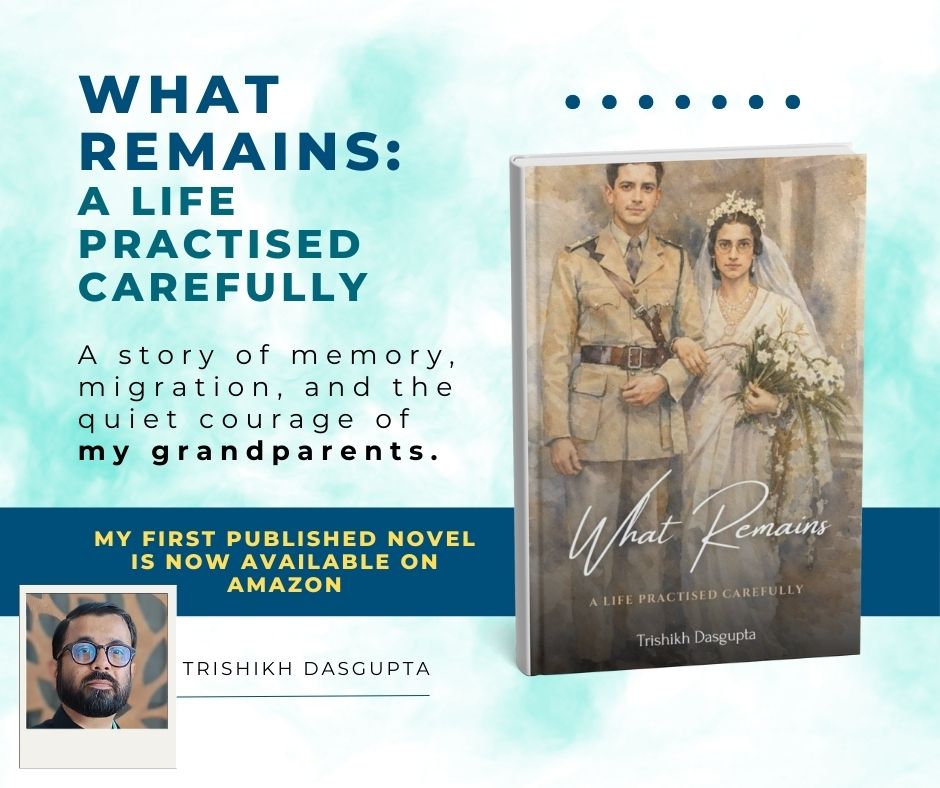
You may also like to read my1st Published novel now available on Kindle and Paperback versions.
 Weekend Stories by Trishikh
This is an absolutely mesmerizing piece of writing! 🌟✨
You have painted Banaras in 1984 with such rich detail that every scene comes alive before the reader’s eyes. From the sacred stillness of 3:00 AM and Pandit Pankaj Pandey’s yogic rituals, to the mist-laden ghats, bustling bazaars, fragrant kachauris, and the haunting aura of Manikarnika Ghat — the imagery is breathtaking and immersive.
The narrative flows like the Ganga itself — calm in places, turbulent in others, yet always carrying with it the weight of history, spirituality, and human emotion. What stands out most is the way you’ve balanced the grandeur of Kashi’s timelessness with the intimate routines of the Pandit — his tea, his family, his observations of others. It makes him not just a character but a living, breathing embodiment of tradition and wisdom.
LikeLiked by 8 people
Dear Verma’ji, the first comment on any of my stories is always very special. I must thank you for giving such a deep and thoughtful reflection of the story.
So glad to have been able to bring out the imagery, sights, sound, and smell of Banara. It is always challenging in a short story, as there is limited space, and you always fight on deciding what to include and what to leave out.
Your comment has really made my day.
LikeLiked by 3 people
Mercury-sharp expression
LikeLiked by 1 person
Thank you so much.
LikeLike
this is an especially good one! well done!! thank you🙏🏼❤️🙏🏼
LikeLiked by 3 people
You are most welcome. So happy that you liked my 78th short story. It gives me great joy when someone smiles, reading one of my stories.
LikeLiked by 2 people
Thank you for sharing your thoughts. I genuinely value your feedback and look forward to improving together.
LikeLiked by 2 people
You are most welcome.
LikeLiked by 1 person
🙏
Aum Shanti
LikeLiked by 2 people
Thank you so much 🙏
LikeLiked by 1 person
Thank you, Trishikh, for this excellent vision of India, and the exotic rituals of your protagonist. All wonderfully descriptive and illuminating to those not born in India. It is a fascinating travelogue with a twist of the universal moral lesson that transcends the time and place and is immortal.
Joanna
LikeLiked by 5 people
Dear Joanna, I can’t thank you enough for your constant appreciation. You have been one of the ardent admirers of my stories from the very beginning.
So glad that you liked this tale as well. Especially the introduction to life in a religious (Hindu) city like Banaras, the likes of which you will not find anywhere else in the world. There’s no doubt about the uniqueness of the city.
LikeLiked by 2 people
Your writing is beautiful. I could visualise the Varanasi I visited. A special memory.
LikeLiked by 3 people
So glad that my writing brought back your memories of Varanasi. Thank you so much for always liking my stories.
LikeLiked by 1 person
Wonderful tale! It feels alive, every detail immersing you in Banaras, while the closing exchange between the Pandit and the Englishman holds a quiet, lingering power. Rarely are spirituality and human frailty interwoven with such effortless grace.
LikeLiked by 3 people
Dear Indrajit, your heartfelt comment gives me great joy, I also did not realise that the story would turn out like the way it did.
LikeLiked by 2 people
This feels like it’s breathing, every detail soaks you into Banaras, and that ending exchange between the Pandit and the Englishman carries such quiet power. It’s rare to see spirituality and human frailty woven together so naturally.
LikeLiked by 5 people
Your deep felt comment touches my heart. You have really enjoyed this story. So glad that my little take could give you a bit of joy. Thanks for always enjoying my stories.
LikeLiked by 2 people
Another step along your zodiac path…
LikeLiked by 1 person
Thank you for your kind words.
LikeLike
This is a beautiful message and a story superbly told Trishikh. Thank you for this ray of light you share in your excellent writings. Blessings.
LikeLiked by 3 people
Thank you Suzette for your beautiful words of appreciation, they encourage me a lot to keep on writing these stories.
LikeLiked by 2 people
You are most welcome, Trishikh! Namaste.
LikeLiked by 1 person
Yet another wonderful tale.. enjoyed it immensely.. thank you ❤️
LikeLiked by 3 people
Thank you so much Fiona, always treasure your appreciation and encouragement.
LikeLiked by 2 people
Dear Ned, thank you so much for always promoting my stories on your website. Highly treasure your constant support.
LikeLike
Excellent story of the seer’s encounter with embodied Mr. Death…
LikeLiked by 2 people
Thank you Ned, so glad you liked the story.
LikeLike
Your stories, Trishikh, are very exceptional and not easy for me! I love the way Pandit observes the people and the advice he gives the Englishman such as “Seek forgiveness not from gods you doubt, but from the world you wounded” Many thanks Martina
LikeLiked by 3 people
Dear Martina, so happy that my stories interest you. You have always read my stories with great enthusiasm. I am so glad for that. I know sometimes, some portions of my stories can be a bit difficult. I will try my best to not make them very hard.
LikeLiked by 2 people
Very touching story Trishikh! Your tale takes me into a familiar spirituality but a very different culture and do so with such descriptive language.
LikeLiked by 2 people
Thank you Katelon.
LikeLike
Kudos on your engaging stories, that teach and touch.
LikeLiked by 3 people
Thank you so much. Always happy to share a good story.
LikeLiked by 2 people
You put me there. I was with him. Thank you.
LikeLiked by 3 people
Dear Jacqui, thank you so much for liking my story. So glad that I was able to teleport you to Varanasi through my story.
LikeLiked by 2 people
Sorry. Ich habe keine Zeit momentan gehabt aber versprochen in diese Wochenende alles! lesen!! Liebe Grüße- Ala🌺
LikeLiked by 2 people
Dear Ala, so good to hear from you after a long time. Certainly do visit my website and read some of the stories that you have missed. I am sure that you would love them.
LikeLike
Thank you for promoting my story in your blog.
LikeLike
Another wonderfully portrayed story about the city of Banaras during 1984. Good one, keep on writing.
LikeLiked by 3 people
Thank you so much dear. Your support makes writing these stories possible.
LikeLiked by 1 person
nice and enjoyed reading.
LikeLiked by 3 people
Thank you so much. You are very kind with your appreciation. I treasure it.
LikeLiked by 1 person
Amazing details. Hooked by each word till the end. Already a fan of your stories.
LikeLiked by 4 people
Dear Sumita, nothing gives me greater joy than when someone really enjoys one of my stories. So glad you liked this one.
LikeLiked by 2 people
Your stories will be read by numerous students in their text books in future because of the research that goes behind every story that you write.
LikeLiked by 2 people
May your words come true. Yes, research and history are integral parts of my stories. I grew up reading short stories of RK Narayan, Ruskin Bond, Rabindranath Tagore, Satyajit Ray, Antony Chekov, and so many more brilliant authors. They influenced much of what I am today. Every generation should have this gift I believe.
LikeLiked by 2 people
I really feel bad that the new generations are missing out reading the wonderful treasure of ‘rochonabolis’ that Bangla sahito offers to the world. Not much is done to market the translated versions too.
LikeLiked by 2 people
This is very true, Bengali literature is so rich, the short and long stories of the Writers and Bards of Bengal have so much influence on my writing too. Like you I too wish that more people get to read them.
LikeLiked by 2 people
I believe this to be true: “Faith is not deception. It is a gentle flame that keeps men from losing themselves in darkness.” In my corner of the world, there is so much darkness and judgement by those who seek to impose their beliefs/disbelief on others. In response, the words of the Pandit hold much wisdom: “Offer water to the living, not fire to the dead. Seek forgiveness not from gods you doubt, but from the world you wounded. Walk away from the path of judgement.”
LikeLiked by 3 people
Dear Rosaliene, thank you so much for identifying the real message in this story, which is perhaps – respecting and living harmony with the beliefs of others. In India also there is a lot of hatred towards many beliefs, though it is not very apparent, and people in general are tolerant of each other, but it’s like a fire keg, you never know when things ignite.
LikeLiked by 2 people
Trishikh, it’s a pleasure reading your soulful stories. Intolerance is a human weakness with explosive consequences for society.
LikeLiked by 2 people
Very true, very true… “Intolerance” is perhaps the root of all evil.
LikeLiked by 2 people
A beautiful parable, the cosmic mystery, the logically unknowable, challenges western rationalism.
The confrontation of the ‘doubting Thomas’ with a man pure of heart without fear of death, who understands life and death are part of destiny and lives in moral harmony with the universe.
LikeLiked by 3 people
What a beautiful after-thought to my story. When opposites collide the outcome though anticipated to be disastrous, many times is something rather beautiful and productive.
Thank you so much for admiring my story. Always treasure your encouragement.
LikeLiked by 2 people
Another gripping tale! Trishikh you astound me with the detailing which is captivating and mesmerizing. Bravo.
LikeLiked by 3 people
Dear Dahlia, thank you for liking my latest short story. Your constant appreciation gives me much encouragement to carry on writing these stories – it feels like I am doing something right.
LikeLiked by 2 people
Dear Trishikh
My whole day’s drudgery is forgotten when I read your post.
Thanks for liking my post ‘SilenceTwo’. 🙏
LikeLiked by 1 person
Thank you Raj. So glad that my stories bring little bits to joy in your life.
LikeLiked by 1 person
Dear Trishikh
I found your post quite interesting.
Thanks for liking my post ‘Aamti’. 🙏
LikeLiked by 1 person
Thank you so much Raj, always a pleasure to receive your appreciation.
LikeLiked by 1 person
Dear Trishikh
I found your post quite interesting.
Thanks for liking my post ‘SilenceTwo’. 🙏
LikeLiked by 2 people
Thank you so much Raj. This makes me so happy. It’s my pleasure to like your posts too.
LikeLiked by 1 person
Once again, a beautiful story, the tale of Banaras is truly wonderful, Trishikh!
LikeLiked by 4 people
Thank you so much Daisy. It really makes my day when I read a bit of appreciation for one of my stories.
LikeLiked by 3 people
The narrative masterfully weaves together two starkly different worlds. The story isn’t just about a city; it’s about the timeless, almost cosmic, balance between faith and cynicism, peace and turmoil, and forgiveness and guilt.👌👌
LikeLiked by 4 people
Dear Aparna, as I woke up and read your comment, the first for the day, it gave me immense joy. Analysis of my stories to this level of understanding really makes writing these stories worthwhile. Thank you for always appreciating my short stories.
LikeLiked by 3 people
Obliged to the core 😇🤝
LikeLiked by 2 people
A beautiful story with such elegant descriptions I felt as if I was there observing everything.
LikeLiked by 4 people
Thank you so much. So happy that my writing could teleport you into the story.
LikeLiked by 3 people
Another fantastic work! Bravo sir!
LikeLiked by 4 people
Thank you so much. Always treasure your appreciation. My best wishes to you and especially your precious daughters.
LikeLiked by 3 people
They will be delighted to hear that 8 )
LikeLiked by 2 people
Luminous wisdom
LikeLiked by 4 people
Thank you so much.
LikeLiked by 2 people
Just wonderful!!
LikeLiked by 3 people
Thank you so much.
LikeLiked by 2 people
what a beautifully descriptive story, enjoyed the opening a lot.
LikeLiked by 3 people
Thank you Ambica, so glad that you like my story. It’s always a treat to receive appreciation. I really treasure it.
LikeLiked by 2 people
The Ganga, often referred to as the Ganges, is one of the most significant rivers in India, holding immense cultural, spiritual, and ecological importance. Stretching across northern India and Bangladesh, it is not only a lifeline for millions of people but also a symbol of heritage and faith. Revered as a goddess in Hinduism, the Ganga occupies a unique position that blends geography with spirituality.
https://www.indianetzone.com/ganga_river
LikeLiked by 3 people
This is so brilliant. My stories tend to give birth to the interest of certain subjects, and your blog is just brilliant in bringing light on the history, geography, and other facts of the thing. Do read my other stories, I am sure that you would find many common topics, on which both of us have perhaps written in our own style.
LikeLike
What an extraordinary narrative—your weaving of everyday rituals with layers of discipline, faith, and redemption feels like a living tapestry of Banaras itself. The precision of Pandit Pandey’s character speaks to how consistency nurtures strength, while the subtle exchanges with townsfolk show how wisdom often lies in quiet details, not grand gestures. The meeting with the Englishman, shadowed by guilt, then opens a space where compassion turns confrontation into transformation—a reminder that sometimes a soft word is sharper than a sword.
When you speak of faith, it is not blind belief but living trust. As Hebrews 11:1 beautifully phrases it, “Now faith is confidence in what we hope for and assurance about what we do not see.” This understanding harmonizes with your portrayal: faith as a steady flame guiding through darkness. You have not just written a tale but offered a mirror—showing us how discipline births faith, and faith unlocks redemption, even for a soul burdened by blood.
LikeLiked by 6 people
Dear Livora, I really liked it when you say, “consistency nurtures strength.”
I like the reference to the Hebrews verse that you pointed out. I have seen that all religions speak the same language at the core.
I was born in a Hindu family, to a Hindu father and a Christian mother. My father believed that a child should follow the religion of his/ her mother. So I was baptised and raised as a practicing Christian in a Hindu family.
Calcutta/ Kolkata being so cosmopolitan, I had friends from different faiths in school from Muslims, to Buddhists, to Jews, and so many others. This has really widened my horizon, and I came to treasure the goodness in all religions.
I am so thankful to you for this beautiful comment. Reading it brings tears of joy and feelings of literary triumph.
LikeLiked by 2 people
Dear Trishikh, thank you so much for sharing your personal journey and reflections. It’s truly inspiring to see how your upbringing and experiences in Kolkata shaped your appreciation for the universal goodness in all faiths. Your stories not only tell tales but also carry wisdom that resonates deeply with readers like me.
LikeLiked by 1 person
Dear Livora, there can be no greater reward for me other than my stories resonating deeply with my readers. I am thankful to the Almighty for giving me fans such as you, who really treasure my stories.
LikeLiked by 1 person
Dear Trishikh, your words mean a lot—thank you for sharing such treasures with us. 🌸✨
LikeLiked by 1 person
Dear Livora, the joy of sharing is so satisfying.
LikeLiked by 1 person
Thank you for this insightful piece. It’s given me a lot to think about.
LikeLiked by 2 people
Thank you.
LikeLike