The whistle shrilled like a winter’s breath, sharp and cutting, in the frosty air of the Calcutta Cricket and Football Club field, better known as the CCFC. A low sun filtered through the overhead clouds, scattering gold upon the dew-kissed turf. La Martiniere Old Boys or LMOB Captain, Harrington “Harry” Devlin, full back, stood at the halfway line, his shadow long and menacing. Opposite him, the Armenians – ragged, hopeful, clustered around their Captain, Emin Arakelian, his height towering among most of the tallest of Kolkata boys.
The trumpets of the club band, the murmur of anxious parents, the chatter of over-excited school-uniformed children, the sharp smell of wet grass and cold sweat mingled with the distant sweet smoke of roasting peanuts, fried Telebhaja, and egg rolls sold at carts just beyond the club gates at Ballygunge. The galleries were packed: club members in tweed coats sipping their favourite poisons, journalists with notepads, rugged fans warmed by scarves, Armenians clutching small talismans of their faith. It was winter 1997, and the underdog Armenians faced LMOB, the heavyweights, favourites, and a terrifyingly powerful team, in the final match of the Under-18 Rugby Tournament.
Yes, you heard right, it’s Rugby, and not the many other sports the city boasts of, like football under the Maidan skies, cricket at Eden Gardens, or hockey in old school fields. Few outside the city ever knew that rugby had been played here for over a century and carried a legacy as rich as any. The Calcutta Football Club, founded in 1872, was the second-oldest rugby club in the world still in existence, and it was in Kolkata that the famed Calcutta Cup, now the most storied trophy in international rugby, was born when British players melted down silver rupees to fashion it. To this day, the game survives quietly in corners of the city, carrying with it whispers of camaraderie, bruises, and unlikely legends.
Now, Kolkata also carried centuries of Armenian footprints with it that winter morning in 1997. In Burrabazar and Armenian Street, the fragrance of incense drifted out from the Holy Church of Nazareth, one of the city’s oldest, built in 1688 and rebuilt in 1724 after a fire had gutted the original wooden structure. Its pale walls, with arched windows and weathered gravestones in the courtyard, had absorbed the prayers of traders, priests, and children across three centuries. The soft toll of its bells had guided generations to worship, just as the Armenian College and Philanthropic Academy, founded in 1821, had schooled young minds in the ancient tongue of Ararat alongside Bengali, Hindi, and English.
Once traders in silk, salt, indigo, and precious stones, Armenians had been the hidden merchants of the Mughal and Company eras, carrying goods on camelback from Isfahan to Agra, and later by sea to Surat and Madras. By the late 1990s, their community in Kolkata had dwindled to fewer than two hundred souls, many elderly, many preparing their children to study abroad. Yet their legacy lingered like perfume on an old shawl, faint, but unforgettable.
They had left their footprints in stone. Rezabeebeh Sookia’s tomb, dated 1630, is the oldest Christian grave in the city, marking the early presence of Armenians before even Job Charnock raised the Union Jack on the River Hooghly. The city’s great hotels and landmarks bore Armenian fingerprints too: Arathoon Stephen, a Baghdadi Armenian, built the Grand Hotel and Stephen Court, landmarks of Esplanade that became symbols of cosmopolitan Kolkata. The Armenian Philanthropic Academy gave scholarships to children from poor families, Armenian or not, and in the quiet lanes of Free School Street, Armenian bakeries still baked khachapuri bread and delicate gata pastries whose aroma mixed with the strong smell of chai and kebabs from stalls owned and run by Muslims. Walking through the city in 1997, one could hear strains of Armenian hymns drifting from the church on a January morning when the community celebrated Christmas on the 6th, their tradition fixed by the old Julian calendar.
For the Armenians who laced up their rugby boots at CCFC that morning, all this history weighed invisibly on their shoulders. They were not just playing a game; they were staking a claim that their story in Kolkata was not over.
The Armenian boys were each carrying shadows heavier than their muddied jerseys. Emin, their captain, was the tallest figure on the ground, but at home, he was a weary son, trying to run a failing family silk shop while his father coughed through long nights. Sebu Avedisian, the team hooker, round as an oak barrel and mocked by classmates, had inherited the weight of being half Armenian, half Indian, never fully at ease in either camp. Tigran Petrosian, graceful as a crane in flight, had lost his little sister that year; his silences were as deep as the Hooghly’s fog. Thin, wiry Davit Kharatian, their scrum-half, often skipped meals so his younger siblings could eat; rugby was his fire, his one chance to matter. And there were others, Aram Mesropian, clever fly-half limping on a bad ankle he had no right to play on; Varuzhan Apcar, proud prop nearly suspended from school for fighting; Levon Sarkissian, a wing as quick as a deer, yet haunted by a father who told him sport was foolishness.
Across from them, the LMOB boys looked like steel statues carved out of cold granite, broad shoulders gleaming with sweat, breath steaming in the chill, boots pounding like war drums. Their voices carried over the field in jeers, and their captain Harry Devlin’s smirk seemed to slice the winter air. Against them, the Armenians appeared almost fragile, their jerseys damp, their hands rubbed raw, their breath stuttering in the cold. The scent of liniment clung to their skin, mixed with dust, fear, and resolve.
The first half was a blur of collisions. LMOB ran through the Armenians with ruthless efficiency, their boots tearing clods of turf, their tackles echoing like cannon fire against ribs. Mud clung to lips, blood mixed with spit, and the Armenians went down three tries behind. At halftime, the boys huddled together, steam rising from their bodies, their mouths dry with the metallic taste of exhaustion. The gallery buzzed with certainty: LMOB would finish them soon.
But something shifted when play resumed. A flash of courage here, a desperate tackle there, and suddenly the Armenians were not folding. The crowd leaned forward as Tigran leapt, catching a ball high in the pale sun, his sister’s memory burning in his chest. He passed to Davit, who darted like a hummingbird through looming shadows, feeding Levon on the wing. The boy ran, mud flying behind him, and the roar of Armenian supporters surged like an old hymn. When Tigran dove across the line a heartbeat later, the taste of hope, as sharp as ginger, filled their mouths.
The final minutes shrank like sand in an hourglass. Every breath was smoke in the cold. LMOB battered forward, their bulk shaking the ground. Then Sebu and Emin clamped into a maul, muscles screaming, refusing to give way. Out of that chaos, Davit found the ball in his hands. For a moment, he saw his mother’s tired face, his siblings waiting at home, the gravestones of Armenian ancestors worn smooth by centuries of Kolkata rain. He slipped free, passed, and when Tigran crossed again under the posts, it was not just a try. It was the unlikeliest of resurrections.
When the referee’s whistle finally ended the match, Armenians 18, LMOB 13, the field was a blur of tears and mud. Emin fell to his knees, sobbing into the earth. Sebu clutched Davit in a bear hug that smelled of sweat and triumph. Aram, limping, kissed the ball. Levon sprinted circles until he collapsed in laughter. The Armenian gallery wept openly, the scent of incense still clinging to their shawls.
That night, in the Holy Nazareth Church, candles flickered, the air thick with wax and old wood, and a choir sang hymns of thanksgiving. The boys sat in silence, the sound of their breath still uneven, the taste of victory like wine on their tongues. They knew this win would be remembered, whispered in the echoing corridors of the Armenian College, painted into the air of the Armenian Club once owned by Arathoon Stephen, whose Grand Hotel still loomed over Esplanade.
For many in the community, it was more than a match; it was a reminder of who they were. Armenians had once walked with authority through the narrow bazaars of Calcutta, dealing in jewels and indigo; they had built mansions in Chowringhee and Marble Palace; they had served as intermediaries between European traders and Indian nawabs. They had endowed schools, churches, and charities that still carried their names. Even as numbers dwindled, these teenagers on a muddy field had shown that legacy could be lived, not only remembered.
In years to come, many of them would leave Kolkata, some to study abroad, some to trade, some to fade into other lives. But each winter when the fog rolled over the Maidan, when the smell of roasted peanuts carried across the tramlines, someone would remember the day the Armenians beat La Martiniere Old Boys at CCFC. Not for the tries scored, not for the trophies raised, but because, for a fleeting hour, history, memory, and the heartbeat of a vanishing people had come alive on a patch of muddy earth in the “City of Joy.”
Years later, when Davit’s hair had begun to grey at the temples and his children asked him why a half-broken rugby ball sat proudly on their bookshelf, he would tell them about that winter of 1997. About the cold sun, the smell of roasted peanuts, the mud on their tongues, and the weight of history on their shoulders.
Davit no longer lived in Kolkata; the old city of trams and slow river barges had become a memory that he unwrapped like a faded photograph. But whenever he closed his eyes, he was back on that field at CCFC, the dew stinging his knees, the crowd roaring, the blood in his mouth sweet as iron. They were not just boys then; they were the last cry of a people dwindling, trying to remind the world that Armenians had lived, prayed, and loved in that city of Calcutta for centuries.
He would tell his children of Emin, tall as a tree, who held the Armenians steady when the team trembled; of Tigran, whose leaps seemed to defy gravity; of Sebu, whose laughter shook the gloom out; of Aram, limping but defiant; and of Levon, fleet as a deer, who made the crowd believe in miracles. Many of them were scattered now, in Sydney, Toronto, and London. Some he had lost touch with entirely. Yet, in his dreams, when the night was quiet, he heard their voices again, raw and young, calling for the ball.
What they won that day was not just a match. They had won a fragment of eternity. The stones of the Holy Nazareth Church may wear down with the rains, the Armenian College may one day close its gates, the community may shrink further still, but on that winter afternoon, the thirteen had become immortal. For in Kolkata’s vast memory, alongside the grand hotels and the marble palaces, there is also the mud-streaked story of a few Armenian boys who dared to hope, and who, for one fleeting hour, turned hope into victory.
And that is why the old rugby ball still sits on Davit’s shelf, patched and cracked, smelling faintly of leather and rain. Because some memories are not meant to be kept in the mind alone. They must be touched, held, and passed on, like the ball that once carried the Armenian boys into history, much beyond themselves.
Copyright © 2025 TRISHIKH DASGUPTA
This work of fiction, written by Trishikh Dasgupta is the author’s sole intellectual property. Some characters, incidents, places, and facts may be real while some fictitious. All rights are reserved. No part of this story may be reproduced, distributed, or transmitted in any form or by any means, including printing, photocopying, recording, or other electronic or mechanical methods, without the prior written permission of the author, except in the case of brief quotations embodied in critical reviews and certain other noncommercial uses permitted by copyright law. For permission requests, send an email to the author at trishikh@gmail.com or get in touch with Trishikh on the CONTACT page of this website.
ABOUT THE AUTHOR

Trishikh Dasgupta
Adventurer, philosopher, writer, painter, photographer, craftsman, innovator, or just a momentary speck in the universe flickering to leave behind a footprint on the sands of time... READ MORE
These stories are Free and if you have found something here that stayed with you, some of my other books are now available in print and digital editions. They gather longer journeys, quieter questions, and stories that continue beyond this page.
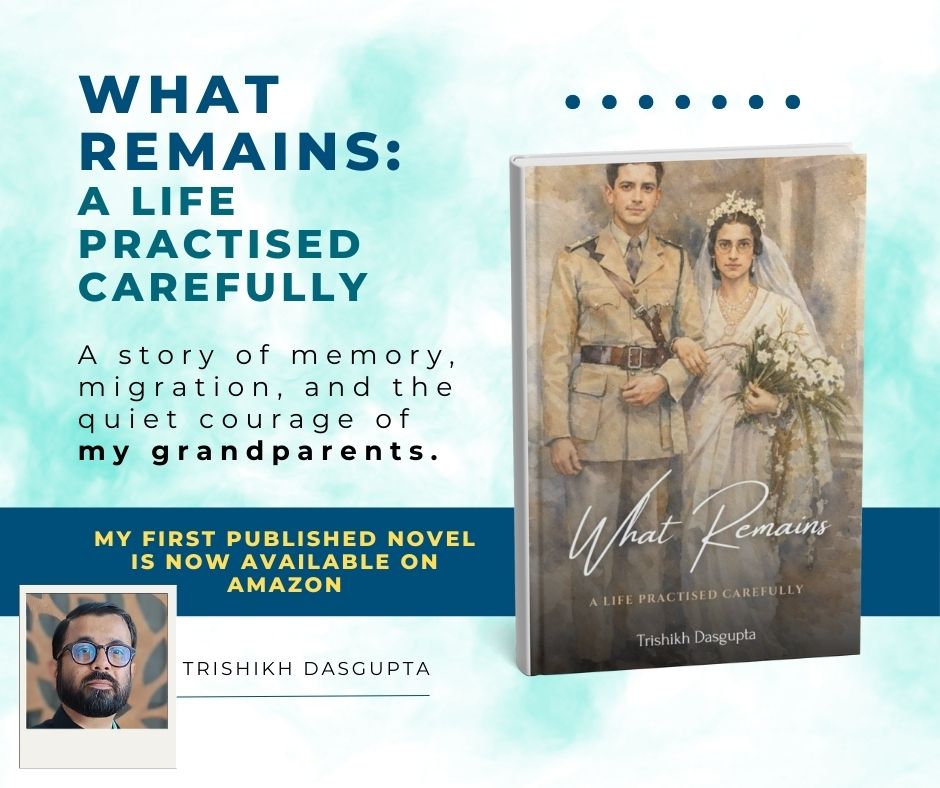
You may also like to read my1st Published novel now available on Kindle and Paperback versions.
 Weekend Stories by Trishikh
Dear Ned, thank you so much for promoting my story in your website. Your constant likes, comments, support, and encouragement over the years has really helped me a lot to write these short stories. I treasure your friendship.
Just observed, that my entire story came in your page. I would very much like only a snippet to appear in your website, like it always did, whereby people can click land to my page to read the entire story. No issues for now, just see if you can do this in the future.
With lots of respect and admiration.
LikeLiked by 1 person
Great literature with history recorded, good work sir!
LikeLiked by 2 people
Thank you so much. Always a pleasure to share a story with you.
LikeLiked by 2 people
Great story, thanks.
LikeLiked by 3 people
Thank you so much Ned. Always a treat to receive your appreciation.
LikeLiked by 2 people
This piece shines because it transforms a forgotten schoolboy rugby match into something far greater — a living parable of identity, struggle, and survival. Through masterful weaving of history and sport, it gives the Armenian boys of Kolkata not just names on a team sheet, but lives heavy with hardship, hope, and heritage. The sensory detail — the winter air sharp as breath, the scent of roasted peanuts, the taste of blood and mud — pulls the reader into the city itself, making Kolkata a character as vital as any player. And by carrying the story beyond the final whistle, into Davit’s adulthood and the cracked rugby ball on his shelf, the narrative elevates a fleeting victory into immortality. It is eloquent, universal, and unforgettable — a testament that even a single muddy afternoon can hold the weight of centuries and the roar of a vanishing people.
LikeLiked by 5 people
Your comment brings me joys that I cannot express. You have analysed my story so thoughtfully, that it leaves me spellbound. My aim is always to go beyond the story, beyond the history, and beyond the geography, and to ultimately touch the human heart – and your comment makes me feel that I have been able to do that with this story.
LikeLiked by 1 person
Thank you for the story of the match and the history of the Armenians in the city.
LikeLiked by 2 people
Dear Magda, you are most welcome. So happy that you liked the story. Nothing gives me more joy than a bit of appreciation.
LikeLiked by 2 people
🙏
Aum Shanti
LikeLiked by 1 person
Thank you so much.
LikeLiked by 1 person
Thank you so much, dear Trishikh, for another wonderfully interesting story, which is written with talented hand of the philosopher and acute observer of the world. This isn’t only a history lesson of the events in the city you love, but a tale resonating with those who changed the countries and have only memories to connect them with their homeland. The wise guide in your tale are the words that some memories need to be tangible to live in our hearts and souls, and to be pass on to younger generation to cherish. Your desire, Trishikh, to leave your footprints on the sands of time is happening with every story written, and it will make your name immortal.
Joanna
LikeLiked by 3 people
Dear Joanna, may your words really come true. There is nothing else that I desire stronger than people from all over the world reading my stories and coming to know a bit more about my country and its people.
I am so thankful to you for supporting my writing efforts for many years now.
I am glad too, the way this story turned out. Now whenever someone wishes to know a bit about the Armenians in Kolkata, perhaps my story would shed a bit of light, or peak a little interest.
LikeLiked by 1 person
Thank you, dear Trishikh, for your heartfelt and beautiful reply! As always, you are more than welcome!
Joanna
LikeLiked by 2 people
What a brilliant story! You’ve made the smell of roasted peanuts and the echo of cleats so vivid, it feels as if one is right there. I especially love how you’ve woven together sport, history, and community. Victories on the field can carry meaning far beyond the scoreboard. Congratulations!
LikeLiked by 2 people
You are so right “Victories on the field can carry meaning far beyond the scoreboard,” could not have said it better. So happy that you liked this story. This was my first story based on sports. Hopefully someday more sports theme ones to come in the future.
LikeLiked by 2 people
A touching, wonderful story, Trishikh. I was aware that Christians had been living in India for a long time, but I had no idea that some of them were Armenians. For diversity, it is a bit of a pity that some minorities dwindle, is it not? Good that you keep their memory alive with your stories, which are always an enjoyment to read both, for the language they are written in, the story itself and the historical facts (that’s three things … ).
LikeLiked by 3 people
Dear Stella, first of all thank you for liking this story so much. Yes, Christian from many corners of the world have been historically living in India. Old communities dwindling is a sad reality, I try my best to honour their contributions and existence through my stories, and thanks to readers like you, they find fruition.
Yes you got it absolutely right, the language, the story, and the history is absolutely critical for me in any of my short stories.
LikeLiked by 2 people
Your way of writing is a pleasure to read in itself. And then you describe the atmosphere and locations so vividly that I get the feeling that I am there with them. That is why I always wait for a quiet moment to read your stories. 🙂
LikeLiked by 2 people
This is a compliment that I shall carry for life. Can’t thank you enough for giving me such encouragement. Wishing you a great weekend.
LikeLiked by 2 people
Thank you, the same to you and your family!
LikeLiked by 1 person
That was a really enthralling read… you make your tales come alive.. you’re very talented.. much love to you ❤️
LikeLiked by 2 people
Dear Fiona, thank you so much. In my school days I used to play rugby, and had some iconic matches in the CCFC field. This is inspired from my memory of rugby playing days.
LikeLiked by 2 people
Dear Trishikh
While watching the most wonderful 4k Czech channels, I turned my head, read your wonderful post & muted.
Thanks for liking my post, Technology 😍❤️🙏
LikeLiked by 2 people
Dear Raj, I treasure your comments and likes. So glad that you enjoyed my latest story.
LikeLiked by 2 people
Excellent piece of writing with a touch of history and enjoyed reading.
LikeLiked by 2 people
Dear Savitha, thank you so much for liking this story of mine. So glad that it appealed to you. Yes, history is always a big part of my stories.
LikeLiked by 1 person
Rugby!! Love this.
LikeLiked by 3 people
Thank you Tina, so glad that you loved the story.
LikeLiked by 1 person
I completely agree with you, Trishikh, when you say that we have to fight, if we want to turn hope into victory. Your post is full of models for which I thank you very much. Best regards Martina
LikeLiked by 2 people
Just to refine this thought a bit let me say – we need to act, if we want to turn hope into victory. Proactive action is always necessary. Thank you for liking my story.
LikeLiked by 1 person
:):)
LikeLiked by 2 people
So much history in this story. Your stories are a treasure-house of information.
LikeLiked by 2 people
Thank you so much Sumita. So glad that you liked the story. Yes, sharing a bit of history is one of my aims in any of my stories.
LikeLiked by 2 people
The collection iof your authored stories a really good one
LikeLiked by 2 people
Thank you. I shall do my best to grow this collection.
LikeLiked by 2 people
Wishing you the best.
LikeLiked by 1 person
So interesting. I wasn’t aware of the Armenian presence in Kolkata (I’m an American, forgive me). I’ve been fascinated with the Armenians and their history, so this provided another branch of their story to look into–thank you for that. What a brilliant story and excellent piece of writing. I notice you use “Calcutta” at some points and “Kolkata” at others–I’m curious, culturally, are the two names wholly interchangeable, or is the use of “Calcutta” still merely a holdover or vestige in certain circumstances? I apologize again for my ignorance.
LikeLiked by 3 people
Dear friend, a comment like yours makes writing these stories worthwhile. I want to peak my readers interest in certain subjects through my stories. Glad that my story gives you a new angle to research on the Armenian’s history.
Calcutta was a name given by the Britishers, when they had colonized India for 300 years. Later on, the names of many places, streets, buildings, states, and cities were changed back to the colloquial tongue. “Kolkata” is the new official name, for many years now. But people nostalgically call the city as Calcutta also. The population has mixed resentment, so some call in Kolkata and some Calcutta. Though officially the city is now known as Kolkata.
LikeLiked by 1 person
thanks for another great story❤️🌹
LikeLiked by 3 people
Thank you so much. Always a pleasure to share a story.
LikeLiked by 2 people
& it’s always a pleasure to read those stories! i am grateful🙏🏼🌹
LikeLiked by 2 people
Thank you so much for promoting my story in your blog. Now so many more people would be able to read my story.
LikeLiked by 1 person
Again and again I am impressed by your ability to touch my sensual core and raise my emotions.In addition, your stories slowly building a picture in my mind of Calcutta’s present and historical characteristics, its make up of its tribes and tribulations.
LikeLiked by 2 people
If my stories are gradually building an image of Calcutta/ Kolkata past and present, then I am so honoured. It feels like my purpose for writing these tales are being met.
I am so happy that my stories can connect with you on a deep emotional level.
Nothing can be more satisfying for a writer.
LikeLiked by 2 people
It was very nice of you to like my post, ” Isaiah Chapters 33-36;” thank you very much.
LikeLiked by 2 people
It was my pleasure to do so thank you.
LikeLiked by 2 people
Thank you very much.
LikeLiked by 2 people
Beautiful story yes that day they not only won the match but they won fragments of eternity. Your all stories are related to Kolkata that makes me happy 😊 well shared 💐
LikeLiked by 3 people
Dear Priti, thank you so much for your appreciation. I think you have missed some of my stories in the last few months. Do read them whenever you feel like. Many of them are related to Kolkata. You are bound to love them.
LikeLiked by 2 people
Ok 👌🏼 sure . The half yearly exam was going on in my school. So paper checking 😁 pressure 😁 so I didn’t get time to visit wordpress properly . Now Puja holidays are coming. Let’s see.
LikeLiked by 2 people
Yes best wishes for the Puja holidays. Happy Mahalaya to you.
LikeLiked by 2 people
Thank you 😊 happy Mahalaya to you too. 🙏🏼
LikeLiked by 2 people
This story is a powerful reflection on the idea of home and identity, especially for a community whose presence is fading!!🌹What a wonderful way to explore the idea that some memories are not meant to be kept in the mind alone, but passed on through tangible objects, like that patched and cracked rugby ball. It’s a beautiful reminder that history is not just a series of events but a living, breathing thing that we carry with us, and sometimes, pass on to the next generation. It makes me wonder, what other everyday objects hold a secret history?
LikeLiked by 4 people
Dear Aparna, that’s a very interesting thought, “what other everyday objects hold a secret history.” I personally am always seeking relics of the past, they give me a lot of joy, like old typewriters, straight razors, watches. Though I am not a collector of any kind. I think stories are also so precious, what someone wrote many many years ago, still gives us joy to read today. Similarly what we pen down today will bring smile to someone’s face many years down the line.
Am so thankful to you for your beautiful comment. So happy that you liked my story. Do visit my website again. I write and publish a short story every Friday. I am sure that you would enjoy many of my stories.
LikeLiked by 2 people
I can’t wait! It’s an interest my college-age daughter and I share.
May this Durga Puja bring you and your family immense joy, peace, and prosperity. Subho Sharadiya!🌻🙏
LikeLiked by 2 people
Happy Durga Puja to you too. Praying that this natural calamity of flooding thaws down. Our area is completely water logged. I live in the ground floor and the water had come inside our house this morning, thankfully it has receded. Thought the street outside is still heavily water logged.
LikeLiked by 2 people
Thank you for the warm wishes, and a very happy Durga Puja to you too.
I have to admit, my heart sank when I read what you’re going through with the flooding. To have water come inside your own home—that’s a whole other level of terrifying, and I can’t even begin to imagine the helplessness you must have felt. I’m so relieved that the water has receded, but I know the street is still a mess. Please take care of yourself. I’m thinking of you and sending my best wishes that this difficult situation clears up as quickly as possible.🙂
LikeLiked by 2 people
It was not very terrifying as we are in the city. But it certainly was very tiring, cleaning everything up. Only praying that may the water clear from the streets soon, then we can go out of the house. My car is also under water, starting and servicing it will be another challenge.
LikeLiked by 2 people
A relative in Kolkata sent me a heartbreaking photo of the floods. From her balcony, you can see all the cars on the street half-submerged in water, as if they were desperately gasping for air.😕
LikeLiked by 2 people
Yes, that is what has happened. Some people have even lost their life to electrocution in the city. The water in our street is yet to recede completely.
LikeLiked by 2 people
That’s a truly devastating consequence of the flooding.
Please stay safe.
LikeLiked by 2 people
Will stay safe. Thank you so much for your prayers and best wishes.
LikeLiked by 2 people
Another wonderful story Trishikh! With all going on in the world and my country spiriling down into Totalitarianism, I enjoy reading your uplifting posts.
I read a memoir years ago, a funny kind of travel memoir detailing all the vast number of religions in India. But I had no idea there are people from so many countries there.
Happy almost Equinox!
LikeLiked by 2 people
Dear Katelon, yes India is truly a very diversified country, with many races, religions, people of other countries living for generations. However, there is also tension among communities and religions, which I think are made and fueled by the powerful for personal gains.
LikeLiked by 1 person
That is true in most countries. In essence we are all one but those in power don’t want its citizens realizing it is those in power screwing them. So, they create this us against them scenario so their citizens will fight each other instead.
LikeLiked by 2 people
This is a really sad reality. Though humans are evolving and growing and developing in various aspects, but are becoming less human.
LikeLiked by 2 people
Trishikh — many thanks! I have enjoyed all the stories by you I have read, but this one is a particular favourite. Fascinating to get a glimpse into the historic world of Armenians in Kolkata: their culture, their faith, their philanthropic legacy and even their involvement in rugby. Thank you.
LikeLiked by 3 people
Dear Andrew, it really makes my day to know that is your favourite story of mine. So glad to have been able to share about the Armenian history in the city of Kolkata.
LikeLiked by 1 person
Another superb story! Such vivid description I felt like I was there. And interesting historical notes as well.
LikeLiked by 2 people
It really makes my day when my story is loved and appreciated. Thank you so much for always liking my stories. Am glad that you liked the vivid description and the historical notes in this story.
LikeLiked by 2 people
I always wanted to know about the Armenians living in Kolkata. You’ve done a great job here.
LikeLiked by 2 people
I am so happy that my little story could provide this intellectual input to you. My stories are intended to relay a little bit of information about the history, geography, society, culture, religion, and like from different regions in India.
LikeLiked by 2 people
Yes, I know. That is why the stories are so engrossing
LikeLiked by 2 people
So happy that you found my stories, and my stories found you.
LikeLiked by 2 people
Resilience — that’s the word that lingers after reading your story, Trishikh. You’ve carried not just a rugby match but the pulse of a community into memory, weaving struggle, hope, and belonging into something unforgettable.
LikeLiked by 2 people
Dear Livora, so happy that the word “resilience” lingers in your mind from this story of mine. And truly resilience it really is. Thank you for liking my story so much. Nothing makes my day any better than a bit of appreciation.
LikeLiked by 1 person
Dear Trishikh, resilience shines through your story in such a natural yet powerful way. I’m grateful for the chance to read it and carry that word forward. Your writing leaves a hopeful mark—thank you for sharing it.
LikeLiked by 1 person
It is my great honour and pleasure to share these stories with the world. Glad that I found such an encouraging and appreciative fan of my writing such as you.
LikeLiked by 1 person
Impressive
LikeLiked by 2 people
Thank you so much.
LikeLike
The power of your reverent presence in the beauty of your opening paragraph prepared me for a journey through time that would remind me of what a life lived well really is. Thank you for sharing your awesome gifts to touch hearts with compassion and wisdom once again, Trishikh. 💜
LikeLiked by 1 person
Dear Carol, it is I who must thank you too for appreciating my story writing skills so eloquently. For me an opening paragraph to any story is very important, after all it is the hook, which reels in the reader, and am so glad that you liked the beginning of this tale. Always treasure your appreciation and encouragement.
LikeLiked by 1 person
👏👏👏
LikeLiked by 1 person
🙏 Thank You 🙏
LikeLiked by 1 person
You’re so welcome! Linda 🙂
LikeLiked by 1 person
Beautifully captured as usual ! I could feel the mud and the sweat ! Any Armenian reading this will be proud of that long forgotten day !
LikeLiked by 2 people
Dear Vinod, so glad that you liked this story of mine, especially felt the mud and the sweat. Am grateful to you for thinking that “Any Armenian reading this will be proud of that long forgotten day!”
LikeLike
Thank you sir for liking my post
LikeLiked by 1 person
You are most welcome. It is my pleasure to do so.
LikeLike
Wow! What an awesome story! Being Armenian i felt like all the characters were really there and the details anout the Armenian traditions including the khatchapuri was so nice to read 🤗 the inscence part reminds me of the ancient churches we have in Armenia that still burn the lovely traditonal smells… great story about the Armenian team and the characters that you bought to life 🙂
LikeLiked by 2 people
Wow, it is so amazing that my story found an Armenian reader. My writing is derived from my occasional experience with the Armenian Rugby Team, when I used to play Rugby in school and at college. At college there were some Armenian batchmates too. However, I never had an Armenian friend as such. So my knowledge about Armenians was always limited, however, when I decided to write this story, I did a lot of research (usually I do a lot of research on related topics when I write a story), and that’s how I came to know a little about Armenian culture and life.
Thank you so much for your heartfelt comment. It gives my story much meaning, and makes it worth writing.
LikeLike
A truly fantastic read. Your writing style is both engaging and informative.
LikeLiked by 1 person
Thank you, glad that you like it.
LikeLike
This was incredibly helpful and easy to understand. I’ve learned a lot.
LikeLiked by 1 person
Thank you.
LikeLike
A truly fantastic read. Your writing style is both engaging and informative.
LikeLiked by 1 person
Thank you.
LikeLike
I found this article quite helpful. Looking forward to more content like this.
LikeLiked by 1 person
Thank you.
LikeLike
Excellent article! Your points are well-articulated and persuasive.
LikeLiked by 3 people
Thank you.
LikeLike