The moon was a pale lantern over Ichamati that night, its silver light spilled across the rippling waters, trembling on the floats of sculpted clay that drifted downstream. The river smelled of wet mud, moss, and the faint, sweet burn of marigolds. Somewhere upstream, women’s laughter mixed with the deep drum of a dhak; somewhere further down, the last incense flickered into amber smoke, and somewhere on the ghats the cracks and sparks from a fading funeral pyre blinked like fireflies in the dark.
The Ichamati was no ordinary river. It was a line on a map, a sigh in history, and a scar across two Bengals. On one side lies Taki in West Bengal, India; on the other, Satkhira in Bangladesh. The waters between were at once barrier and bridge, wound and healing. Every year, when the goddess Durga returned to her celestial abode, the river became a stage for one of Bengal’s strangest, most tender dramas. On the day of Visarjan or holy immersion, idols from both sides of the border rowed out, lamps flickering on boats, festive electric lights adorning the ghats, fireworks lighting the skies, drums thundering on banks, loudspeakers blaring chants, songs and music, and mothers crying as their goddess sank beneath the waters. For a moment, India and Bangladesh blurred. The river, which divided, remembered how to unite.
Gongapodo had never known his parents. He was found in a woollen wrap outside the Taki Rajbari temple gate, on a winter dusk when the sky smelled of smoke and dying leaves. Pondit Mohadeb Proshad, the celibate priest, scooped him up, and from then on the boy belonged not to a family but to the riverbank community. He grew lean and dark, his shoulders hardened by hauling wood, his palms scarred by lifting earthen pots, his hair always smelling faintly of wet clay. On the ghats of Taki, he did everything, mixing straw and clay for idol makers in the kumortuli lanes, stringing garlands with the flower-women, ferrying brass pitchers for temple pujas, scrubbing soot off blackened altars, even cutting logs for the cremation ground, and kindling funeral pyres. But his greatest love was the river itself.
The boy could swim like no one else. On Visarjan evenings, when hundreds of idols were lowered into the Ichamati, he would dive after them. Sometimes to salvage wood, sometimes to retrieve coins or bangles, sometimes only to touch the goddess in her watery descent. He knew the ritual of retrieval well. After the immersion, groups of men would wait until midnight, then plunge into the river, tying ropes around fragments of the idol to haul them ashore. Clay was broken down, ornaments collected, and wood dried for reuse. It was not theft, it was tradition, it was survival. In those broken remains, many families found their year’s bread. For Gongapodo, though, diving was something more. Each plunge was an embrace of the goddess, each emergence from the dark water a small resurrection.
Taki was unique. Here, unlike anywhere else, Visarjan was historically a shared act between people living on both sides of a river. Long before the formation of the two countries, the fences and patrol boats, people from both sides crossed freely on immersion day. Traders from Satkhira came selling honey, coconuts, even goats; Taki’s people went over with mustard oil, saris, and sweets. Young men teased young women across boats, and sometimes marriages were even arranged after such rendezvous. The river was not a border then, but a courtyard.
In the onslaught of Partition in 1947, families woke up to find cousins across a line they could no longer cross. Later, the 1971 war carved the wound deeper, creating Bangladesh, leaving towns like Taki scarred but stubborn. India began fencing in 1989, but rivers cannot be fenced. The Ichamati remained porous. Smugglers slipped by with cattle, rice, and saris. BSF watchtowers rose on stilts, floating posts anchored midstream, yet the river mocked them all with its thousand currents. And yet, once a year, during Goddess Durga’s farewell, the border softened. Boats from both sides rowed to the midstream, idols raised high, dhak drums beating like thunder. Devotees waved at each other across the “zero line,” shouting: “Aschhe bochor abar hobe!” Next year it will happen again. It was not just farewell to the Goddess, it was a promise that two Bengals still belonged to each other.
One year, a Bangladeshi zamindar family commissioned the grandest idol ever seen in the region. Taller than the rest, adorned with silver anklets, glass beads, and heavy ornaments. The goddess gleamed under diya lights as she was rowed into the midstream. Among the men on the boat was Aditto, the zamindar’s teenage son. Proud and restless, he wanted to steady the idol for immersion; however, fate was sly. A rope slid under his foot as the idol tilted. With a splash that silenced the crowd, Aditto was suddenly dragged into the depths, tied to the Goddess’s descent.
The boatmen cried out. Some leaned to dive, but the idol was too heavy, the waters too dark. Fear held them back. At that fateful moment, Gongapodo happened to be on a boat with his salvage friends nearby. He saw the chaos, and he knew the river’s moods; he had tasted its darkness. Without thought, he stripped his shirt and dove into the turbulent depths. The water closed around him like a fist. He felt the tug of the rope, the boy’s flailing body, the crushing pull of the idol. His calf scraped against something; a sudden pain sliced into him, hot and sharp. He ignored it, wrestling with knots, tugging Aditto free. His lungs screamed. The idol’s crown grazed his shoulder, sinking deeper. At last, with a desperate kick, Gongapodo pushed upward, dragging the drowning boy.
Both of them burst into the air, coughing, choking, gasps tearing from the crowd. Hands reached from the boats, pulling Aditto in. Gongapodo clung to the gunwale, blood running from his leg into the black water. The zamindar’s son lived, the orphan got wounded, and the goddess sank.
Finally, that dreadful night was over; gradually, the hangover of the festive week ebbed, and slowly the season changed. Life moved on, both sides of the river. Then, many years later, Aditto returned to the ghats of Taki as a man. Guilty of not returning sooner to thank the boy who had saved him. Life, its commitments, and other priorities had not made it possible. The border was harsher now: boats were checked, the BSF and BGB were watching, and fences gleamed with barbed wire. Yet he came, carrying memory heavier than wealth. After all, he wanted to personally meet and thank the boy who had saved his life many years back. He asked the kumors, the flower-women, the boatmen: “Do you know the boy who had saved a Bangladeshi Zamindar’s son’s life many years back on a Visharjan night?” Many shook their heads from left to right, till an old idol-maker shook his nob up and down, “Go to the Rajbari Temple. What you seek is perhaps there.”
Aditto finally found his way to the temple. The air smelled of incense and sandalwood smoke. On the ghat outside, a frail and old priest sat, watching the crack and spark of a dying funeral pyre, its gasping flames licking the night.
“Pondit’ji, do you know of a young boy who had saved another’s life many years ago on an immersion night?” anxiously asked Aditto. The feeble old man shifted his gaze from the glowing ashes, perhaps for the first time that night, and his eyes glistened as he looked up at the man seeking some answers.
Pondit Mohadeb Proshad pressed something into Aditto’s hand. A small clay amulet, with a mirror shard and a silver clasp, and said, “he made this for you. He said, If the boy I saved ever returns, give him this. So he remembers not me, but the river that bound us.”
That cut on Gongapodo’s leg had festered. The Ichamati’s water, beloved though it was, infected it. Fever came. The Pondit had begged him to rest, but Gongapodo worked still, retrieving, salvaging, and carrying. Slowly, his body thinned. His dives grew shorter, his breath weaker. Yet he never complained. “If I could save one life,” he told Pondit Mohadeb, “then the river gave me purpose.” The boy who had saved another gradually became a shadow on the ghats. And one misty dawn, when smoke from pyres mingled with morning fog, he was gone at last.
“The boy you seek,” the old man whispered, “saved your life. But the wound he got that night never healed. He lived quietly, nobly, always helping, always diving. This morning, he left us. That pyre,” the priest pointed to the smouldering heap of ash, with sparks rising to the stars, “is his.”
Aditto’s heart clenched. The boy who had saved him had gone before they could meet again. He fell to his knees. The river lapped against the steps, as if listening. He pressed the amulet to his forehead. Tears spilled, unashamed. Before him, smoke curled from the consumed pyre into the night sky, drifting eastward, westward, across both banks. On the opposite shore, unseen in the dark, another immersion took place. An idol slipped into the Ichamati with a splash, and voices cried out: Aschhe bochor abar hobe! Next year it will happen again. The promise rose across the waters, mingling with the smoke from Gongapodo’s pyre. In that mingling of ashes, prayers, and tears, the two Bengals for a fleeting moment were one again.
Aditto returned to Satkhira with the amulet. He established a small scholarship in Gongapodo’s name for riverbank artisans’ children, on both sides of the border. Each Dashami, when idols sank into the Ichamati, he lit a lamp and set it afloat, whispering, “Aschhe bochor abar hobe!” Next year, it will happen again. For the river remembers. And so must we.
Copyright © 2025 TRISHIKH DASGUPTA
This work of fiction, written by Trishikh Dasgupta is the author’s sole intellectual property. Some characters, incidents, places, and facts may be real while some fictitious. All rights are reserved. No part of this story may be reproduced, distributed, or transmitted in any form or by any means, including printing, photocopying, recording, or other electronic or mechanical methods, without the prior written permission of the author, except in the case of brief quotations embodied in critical reviews and certain other noncommercial uses permitted by copyright law. For permission requests, send an email to the author at trishikh@gmail.com or get in touch with Trishikh on the CONTACT page of this website.
ABOUT THE AUTHOR
Trishikh Dasgupta
Adventurer, philosopher, writer, painter, photographer, craftsman, innovator, or just a momentary speck in the universe flickering to leave behind a footprint on the sands of time... READ MORE
These stories are Free and if you have found something here that stayed with you, some of my other books are now available in print and digital editions. They gather longer journeys, quieter questions, and stories that continue beyond this page.
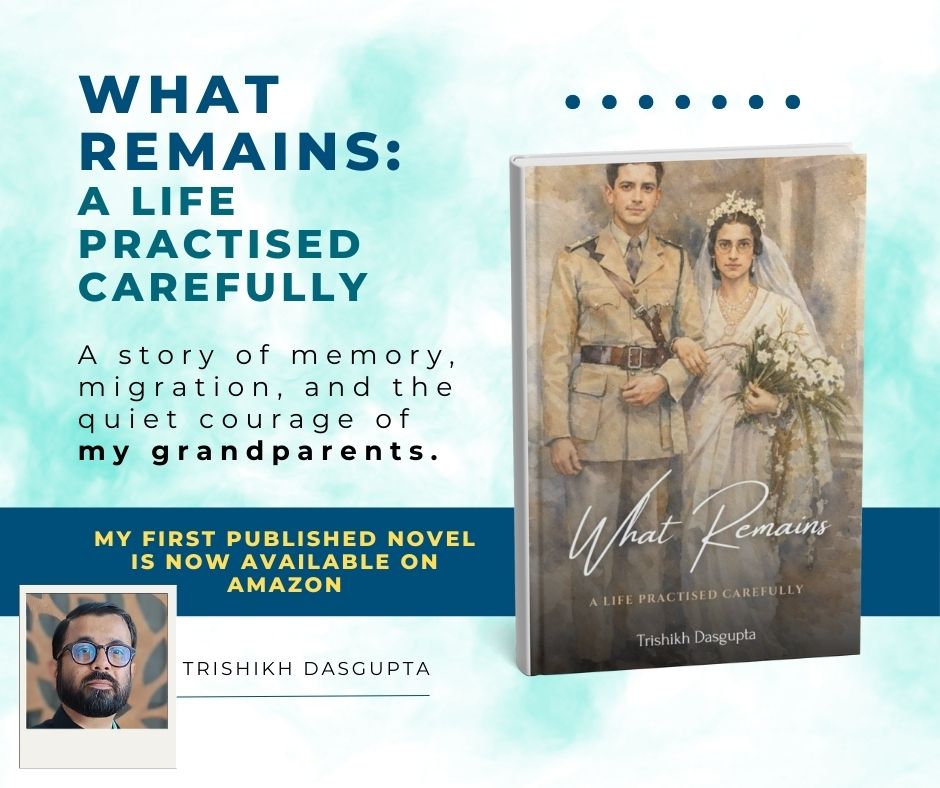
You may also like to read my1st Published novel now available on Kindle and Paperback versions.
 Weekend Stories by Trishikh
Touching. Amazing read.
Happy Navaratri and Vijaya Dashami.
Also a Big Durga Pooja feast for you and all around there.
LikeLiked by 3 people
Thank you so much. Happy Durga Puja to you and your family too. So happy that you liked this story of mine, centred around the Durga Puja.
LikeLiked by 2 people
It’s amazing , I always enjoy your story telling way and wait for the next one. Happy week end 🎇
LikeLiked by 3 people
I am blessed to have an admirer of my stories such as you. I hope to write many good ones in the weeks and years to come.
LikeLiked by 2 people
Wish you more of everything my friend. I always look forward for the week end feast of tales. Cheers.
LikeLiked by 3 people
Thank you so much friend.
LikeLiked by 2 people
🌿🍀 🙏 🍀 🌿
LikeLiked by 3 people
Dear Ned, it’s such a treat to see my story published on your website. I treasure your constant support and appreciation for my short stories. So glad that you liked my latest one too.
LikeLiked by 1 person
What an engaging story Thrishikh. You are amazing story write. Every details from smell of wet clay to the river banks that divide India and Bangladesh perfectly described. Salute to such an inspiring writer. Thanks for sharing 🙏
LikeLiked by 3 people
Dear Mukund, nothing gives me more joy, than when someone sincerely enjoys one of my stories. Your comment has made my day and writing this story worthwhile. I am so happy that the visual details resonated with you so well.
LikeLiked by 2 people
Dear Trishikh , I am your fan. You are consistent in publishing stories and the stories are feast for the readers like me. God bless you dear 😊
LikeLiked by 2 people
Thank you so much Mukund.
LikeLiked by 2 people
Goodness, Trishikh, what a moving tale! It is another one after the story of the fruitcake earlier, and we are obviously blessed today on the 5th day of the celebrations of Ma-Durga. The second one is heart-touchingly beautiful and memorable, which I will remember forever. I do hope that you give thanks to the Divine who bestowed the writing talent upon you, as it will one day make you worldwide famous.
Joanna
LikeLiked by 2 people
Dear Joanna, I thank God everyday for blessing me with this gift and constantly pray to him that he may continue to grant me with the capacity to churn out these stories. I truly yearn to publish my stories someday, but without publishing also, I know that many still will read and enjoy them.
Thank you for your constant appreciation and support.
LikeLiked by 1 person
I will always read your wonderful writing, and one day you will be published, Trishikh!
Joanna
LikeLiked by 2 people
Thank you so much Joanna.
LikeLiked by 1 person
You are more than welcome, Trishikh!
Joanna
LikeLiked by 2 people
Heart-rending. I love HEA endings, and this, in its own way, fulfills that.
LikeLiked by 2 people
Dear Jacqui, so glad that you liked the story, especially the ending. Am always thankful to you for your constant appreciation and encouragement. They help me much to keep on writing these stories.
LikeLiked by 2 people
What a beautiful and touching story.
LikeLiked by 3 people
Thank you so much. So happy that you liked it.
LikeLiked by 3 people
What an interesting tale.. thank you for a wonderful read.. ❤️
LikeLiked by 2 people
Dear Fiona, you are most welcome. Glad to have been able to bring forth this tale.
LikeLiked by 2 people
Wonderful, touching story. BTW, Taki is my father’s Mamabari.
LikeLiked by 2 people
Thank you Indrajit. Also so good to hear that you have attachment with Taki. I visited the Ichamati to witness and photograph Durga’mas bhashan many years back. It was a lifetime of experience.
LikeLiked by 2 people
Ok, Unfortunately, there is nothing lefty except my childhood nostalgia. They were Taki’s sadar zamindar with hige properties and chandimandap etc. But my cousin was the only heir and he died at an early age. His wife sold off the properties there and returned to her maternal place near Bongaon. We are from Basirhat. There is also a festive bisarjan on Ichhamati in Basirhat. I am a probasi, of course. 🙂
LikeLiked by 2 people
There is so much history all around us, it just mesmerises me. Your connection to Taki, sounds like a story brewing in my mind.
LikeLiked by 2 people
Waiting for the next weekend story on Taki.
LikeLiked by 2 people
Well there will be another story next weekend, but not so soon on Taki again. The subject and place will be different. That is one of my traits, to give a very different story every weekend.
LikeLiked by 2 people
Well waiting for it down the line, when it appears here.
LikeLiked by 2 people
Yes, let’s keep our fingers crossed.
LikeLiked by 2 people
Beautifully written… gave me goosebumps !! 🙏
LikeLiked by 3 people
Thank you so much. So glad that my story touched your heart.
LikeLiked by 1 person
Such a touching story. 🙏
LikeLiked by 2 people
Thank you so much. So happy that you liked the story.
LikeLiked by 2 people
😊🙏
LikeLiked by 1 person
🙏
Aum Shanti
LikeLiked by 1 person
Thank you for liking my story.
LikeLiked by 1 person
I’ve read this beautiful story from A to Z, and I can add a punch line: if people today were more like Aditto (class differences aside), there wouldn’t be so much hatred in the world. This also proves the old saying: better late than never. Best regards.
LikeLiked by 2 people
Dear Alicia, you are absolutely right with both your analysis, I too believe in them – man’s thankful nature irrespective of class differentiation, and doing the right thing no matter how late, can really make a beautiful world.
LikeLiked by 1 person
Ethereal perspective
LikeLiked by 1 person
Thank you so much.
LikeLike
“Your story flows like the Ichamati itself—layered with memory, history, and sacrifice. Gongapodo embodies love beyond borders, while Aditto brings gratitude. Together, they remind us humanity outlasts boundaries, wars, and time’s passing currents.” 🌊✨
LikeLiked by 2 people
That is such a nice thing to say, it’s a great thought – love and gratitude from both the main characters in the story. Layers of memory, history, and sacrifice, I could not have said it better. Thank you so much for liking my story. I always treasure a sincere appreciation.
LikeLiked by 1 person
Your story truly carries those layers of memory and sacrifice with grace. I’m grateful you shared it—such depth makes it resonate beyond the page. Thank you for valuing our exchange.
LikeLiked by 1 person
The pleasure is equally mine. I treasure this friendship. Looking forward to writing many more great stories in the weeks, months, and years to come.
Do read some of my older stories also. I am sure that you would love many of them.
LikeLiked by 1 person
The pleasure is equally mine, Trishikh. I treasure this friendship. I will definitely read your other articles as you suggested—I can’t wait to open this treasure chest of priceless stories. Looking forward to writing many more great stories in the weeks, months, and years to come.
LikeLiked by 1 person
Will continue writing these short stories.
LikeLiked by 1 person
Beautiful and engaging piece of writing, as always!
Happy Durga Puja to you.
LikeLiked by 2 people
Dear Chitrangada, thank you so much for always appreciating my stories. I really treasure your constant support. Happy Durga Pujo to you and your family too.
LikeLiked by 1 person
Sad the divisions we humans have made; blessed are those who try to heal them
LikeLiked by 1 person
Very true, no matter how deep the divisions we make, those amongst us who try to heal are the real heroes.
LikeLike
Aah! I finished reading this with a heavy heart. For a person who has roots in both the Bengals this is more than a story. Thank you so much.
LikeLiked by 1 person
I knew you would like this story. I too have roots in both the Bengals. In fact I think most of Bengalis have connections in both West Bengal of India and Bangladesh.
So glad that you liked this tale.
LikeLiked by 1 person
Wish you a very happy Durga Pujo
LikeLiked by 1 person
A happy Durga Pujo to you and your family too.
LikeLiked by 1 person
Another beautiful story. I long for a world without borders. We truly are ONE.
blessings Trishikh
katelon
LikeLiked by 1 person
Thank you Katelon for appreciating this story of mine. Yes “a world without borders,” I sometimes wonder if it ever existed in the entire span of human history, right from the days of the caveman. If achieved it will perhaps be one of the greatest steps in human evolution.
LikeLike
A well crafted story; and thank for once more giving us a detailed description of the many traditional customs of your country. Altruism can come along in many forms, but is most convincing when left unrecognised.
LikeLiked by 1 person
Am so glad that you liked my latest tale and. I cannot thank you enough for being a constant fan of my short stories. I am glad to be able to share the many traditions and customs of my country, and am thankful to readers like you, who find great interest in them.
LikeLiked by 1 person
lovely story and enjoyed reading as always.
LikeLiked by 1 person
Dear Savitha, thank you so much for liking my latest short story. I am so thankful to you for being a constant admirer of my stories.
LikeLiked by 1 person
its like being in a cinema, just words, no picture until you read this and then your mind ventures into reality, nice post.
LikeLiked by 1 person
Dear William, so happy that my story feels like a movie to you. Thank you so much for this beautiful comment.
LikeLiked by 1 person
keep up the good work pal, look forward to visiting again.
LikeLiked by 1 person
Will try my best to keep this going by the grace of God. Yes, do certainly visit again.
LikeLike
Another exceptional story! It is an excellent reminder that we are all related; borders mean nothing to good people.
LikeLiked by 1 person
So true, “borders mean nothing,” sometimes I wish it was once again like the days before the passports when people could freely move around. It seems that as we have evolved, we have become more protective.
LikeLiked by 1 person
As with the previous story, you’ve perfectly blended culture, history, and emotion to not only satisfy but motivate me to learn and read more. Fantastic story, Trishikh. Truly happy to have come across your page and writing.
LikeLiked by 1 person
Thank you so much for enjoying my story so much. So glad that you liked the blend of culture, history, and emotion.
LikeLike
Brilliant heartwarming story. Thanks and keep on writing.
LikeLiked by 1 person
Thank you so much dear. Treasure your constant love and support.
LikeLike
What an absolutely breathtaking story! 🌊✨ you weave history, culture, and human emotion into a tapestry so vivid that you can almost feel the rippling waters of the Ichamati, hear the dhak drums, and smell the incense and marigolds. The narrative balances the intimacy of Gongapodo’s life—the orphaned boy who becomes the river’s quiet guardian—with the sweeping backdrop of Bengal’s history and the porous, living border between India and Bangladesh.
I deeply admire how the story honors courage, selflessness, and devotion. Gongapodo’s dives into the river, his silent sacrifices, and his unwavering connection to both the goddess and the community evoke profound reverence. The climax, where life, death, and memory converge with the ritual of Visarjan, is emotionally powerful, leaving the reader with both awe and tears.
LikeLiked by 3 people
Dear Verma’ji, your beautifully thought words bring tears of joy and accomplishments as a writer to my eyes.
You have so aptly identified the four elements of honour, courage, selflessness, and devotion in the story. I too think that they are the cornerstones of this little tale.
You have analysed the climax so meaningfully – “where life, death, and memory converge with the ritual of Visarjan, is emotionally powerful, leaving the readers with both awesome and tears.”
LikeLiked by 2 people
Dear friend,
Your heartfelt words truly touch me. 🙏 To know that my reflections resonated with you in such a deep and moving way is the greatest reward of writing. I feel humbled that you found the essence of honour, courage, selflessness, and devotion mirrored in the story—these are values that uplift every narrative and every life.
LikeLiked by 1 person
Dear Verma’ji, I am really blessed to have an admirer and encouraging friend like you. I treasure every bit of it.
LikeLiked by 2 people
Love It!
LikeLiked by 1 person
Thank you so much Chris. So glad that you loved the story.
LikeLiked by 1 person
What a beautiful, heart-wrenching, and utterly Bengali story.
You’ve managed to capture the entire geopolitical history of the subcontinent in the life of one orphan and a simple nylon rope—oops, wrong hero, sorry, that was the tiger story! This story’s hero got a much more poetic (and tragically septic) end.
It sounds like Gongapodo was the quintessential action hero: saves the rich kid, gets a dramatic wound, refuses medical advice, and sacrifices himself for the metaphor. Talk about commitment to a theme! He didn’t just save a life; he became a Tragedy-with-a-Capital-T to unite two nations. Uff!!!
The promise, “Aschhe bochor abar hobe!” ringing out over the pyre smoke is the ultimate promise of hope and stubborn memory.
This tale of sacrifice, memory, and an overdue apology is absolutely …. (Finding the apt word).
Now, if you’ll excuse me, I need to go find a packet of marigold-scented tissues. 💔
LikeLiked by 1 person
Dear Aparna, my eyes are filled with tears, as I read your heartfelt comment. It seems like you have really enjoyed and deeply felt my story, immersing yourself completely in the depths of this tale of two nations that were, are, and will always be one. Your analysis is bang on. Thank you for always liking my stories to such profound levels. Am happy to be able to share them.
LikeLiked by 1 person
I’m having such a fan moment right now! 🤩
I told you it’s me and my daughter who both read, dissect, analyze, and interpret your posts before we comment.
It’s more like we are learning how to weave from a master weaver—a weaver of something far more precious than jewels. ✨
LikeLiked by 1 person
Dear Aparna, I am deeply honoured. Nothing gives me more joy than teaching, and if my knowledge and skill can benefit the next generation (someone like your daughter), then it is a great reward for me. Keep on enjoying the tales.
LikeLiked by 1 person
Obliged to the core!!!
Prayers for your writing to be guided by Maa Saraswati🪷
LikeLiked by 1 person
Beautiful .
LikeLiked by 1 person
Thank you so much.
LikeLiked by 1 person
Always welcome my dear Trishikh.
LikeLiked by 1 person
Thank you.
LikeLiked by 1 person
Sir, can you tell me what is the meaning of your name?
LikeLiked by 1 person
My father was a Hindu, and my mother, a Christian. Trishikh represents Bramha, Vishnu, and Maheshwar and also the Trishul of Shiva in Hinduism and the Holy Trinity in Christianity. Hence is is the joining of both the religions. It basically means 3. Further one of Ravana’s 100 sons was a great sage by the name of Trishikh.
LikeLiked by 1 person
Wow, the meaning of your name is absolutely amazing. Seeing your faith in both religions, I salute you, Sir. 🫡🫡. This country needs good people like you very much..😇😇
LikeLiked by 1 person
Thank you Praveen, though a practicing Christian I believe in the goodness of all religions and like to study all religions. There is so much to learn from every religion.
LikeLiked by 1 person
I also respect every religion. I have complete faith in Hinduism. I have learned to show mercy to everyone and help everyone.
LikeLiked by 1 person
Dear Praveen, that is so nice to hear. Humans need to be tolerant and respectful towards each other.
LikeLiked by 1 person
It’s crucial to apply the good values our parents instilled in us for the benefit of society. No one should suffer because of us.
LikeLiked by 1 person
Absolutely true.
LikeLiked by 1 person
A truly gripping story, Trishikh, and heart warming. I know I am repeating myself, but I felt that I was there when the immersing took place. It mus be an incredible experience.
Let us hope that many people will not let themselves be stopped by borders to show compassion and gratitude, just like the two boys in your story. It is a great example of humanity being more important than politics.
LikeLiked by 1 person
Dear Stella, no amount of appreciation can ever be enough, the more the merrier, and I treasure every bit of it. So glad that the story transcended you to the place. You are right about borders, they certainly do divide. Don’t know whether human beings would ever evolve beyond them.
LikeLike
Between the river’s sigh and the ritual’s flame lies the memory of all that still unites us — love flowing where borders cannot.
LikeLiked by 1 person
Some lines, from a story resonate with us for a long time. Perhaps even long after when we have forgotten the story.
LikeLiked by 1 person
Yes, some lines outlive the stories that birthed them — like whispers that time can’t quite erase. 🌾
LikeLiked by 1 person
Your story weaves with amazing poignancy the essence of human connections with each other and Nature despite the many walls that threaten to separate us.
LikeLiked by 1 person
Dear Kajol, so glad that you liked my story so much. Nothing gives me greater happiness than when someone appreciates one of my stories.
Yes, you have rightly said “the essence of human connection with each other and nature,” I think it can be the key to solve all the problems and evils of this world.
LikeLiked by 1 person
What a masterpiece this is — tender, layered, and hauntingly beautiful. Your words don’t just narrate a story; they breathe life into the river, the rituals, and the people who inhabit its banks. The Ichamati, in your telling, becomes both witness and participant like a living entity that divides and unites, wounds and heals, forgets and remembers.
Your detailing is so good, every sight, sound, and scent seems to rise from the words. I could almost hear the dhak rolling across the water, even glimpse the flicker of diyas, and feel the ache of separation softened by faith. In your story beyond the sensory richness lies a deep humanity, the story of Gongapodo, the nameless boy who found purpose in sacrifice, and of Aditto, whose gratitude transcended borders and time.
You have turned a local legend into a universal parable of compassion, memory, and belongingness.
The ending moved me deeply, the mingling of ashes and prayers across two nations is perhaps one of the most powerful metaphors I’ve read in recent times.
Keep writing, stay blessed.
LikeLiked by 1 person
Dear Ravindra, I am not sure how to thank you for this beautiful and thoughtful analysis of my story. Your words of appreciation bring tears of rewarding joys in my eyes.
When we write, most of the time we are not sure how a story would turn, how the characters would manifest, how the emotions would flow, how the words would paint a picture of the time and place, but one thing I know for sure is that we should never give up on a story. And when someone enjoys a story as much as you have done, there can be no greater reward.
Thank you dear friend for making my day. Your words have given my writing engine lots of fuel.
Keep an eye out for my next story to be released tomorrow. I write and publish one story every Friday.
LikeLiked by 1 person
Thanks for acknowledging and glad to note my comment made you happy.
I thank Him that I stumbled on to your Blog and shall await your next one.
Being in Kolkata for over 70 years now, stories of Ma Durga, immersion etc seem to attract automatically. Stay blessed, keep writing.
LikeLiked by 3 people
Dear Ravindra, there are many more stories in my blog based on West Bengal, Kolkta, the region’s history, geography, culture, customs, and beliefs. Do read some of my older stories, I am sure that you would love them. Also do share my website with like minded friends, so that they can enjoy the sights, sounds, and smells of Kolkata thorough good old short stories.
LikeLiked by 1 person
Thanks for introducing the world with our vibrant Bengali culture. This felt like a distant dream. I have heard once upon a time my ancestors lived in West Bengal. Heard so many stories of that time. Your stories remind me of that. I hope to go there someday. However, how do you spell your name in Bengali? Is it “ত্রিশিখ”? Such a unique name!
LikeLiked by 3 people
Dear Raisa, when someone with connection to Kolkata, Bengal, or India reads my stories and remembers the place or rekindles a long lost connection to the place, that is a great fruition for writing these stories. I want to immortalise the everyday tales, sights, sounds, smell, history, geography, and culture of the region through my stories. So grateful to God to have found a meaningful and serious reader and admirer of my stories such as you. Do visit my website and read more of my stories, every story is a lesson and an enjoyment, I am sure that you would love many of them. Share my stories with friends and relatives, encourage others to read as well. It will give me great joy.
You have spelt my name correctly in Bengali. The name has a few meanings. One of Ravana’s 100 sons was Trishikh a great and learned sage. My father was a Hindu and my mother a Christian, and my father believed that a child should follow the religion of its mother hence I was raised baptised and confirmed as a Christian in a Hindu family. Trishikh is the Holy Trinity of Christianity and the Trishul or Lord Shiva or the Brahma, Vishnu, and Maheshwar of Hind religion.
LikeLiked by 1 person
I felt the connection because I am a Bengali too. I will read all of your stories whenever I get some time. I enjoy reading fictions so much and passionate about literature and spirituality. And it’s nice to know about the spiritual background of your name. May God bless you. May I know if you write books too?
LikeLiked by 1 person
Dear Raisa, so happy that you found my site. Spirituality and philosophy are an integral part of my writing. No I have not written any books till date, my true calling is writing short stories. Some day I want to publish these. Maybe one day I will write a book too, but for now I want to promote reading and writing short stories. I want to do this because in India I have seen, the importance of short stories gradually decreasing from children’s lives.
LikeLiked by 1 person
Integrating spirituality, philosophy, history and atmospheric elements in a short story is a skillful thing to do. And yes, short story is fading as a genre from literature, it’s good to see you are saving this genre through your works. Best of luck for your journey, sir.
LikeLiked by 1 person
Thank you so much. I think short stories are one of our first introduction to literature. Every child needs to read them. Short stories of O. Henry, Rabindranath, Shelly, Charles Dickens, Anton Chekhov, R. K. Narayan and so many others had so much influence on my generations formative years. What we read in Short stories have the power to be remembered for a very long time.
LikeLiked by 1 person
Right! I think I need to read more short stories. Thanks for the great authors’ list. Writing short story is more difficult than writing a novel or play. You have to build a whole new world and show the characters’ psychological development within a very short space. Yet you need to put this much effort that it can leave a mark on the readers’ mind and they crave to read more. As Kobiguru Rabindranath Tagore said, “সাঙ্গ করি মনে হবে, শেষ হইয়াও হইলোনা শেষ।”
I think I’m talking too much today, I’m sorry. I usually don’t find people to discuss all these things.
LikeLiked by 1 person
Dear Raisa, yes you are absolutely right. I too find writing a novel much easier, as there is no limitation of space, but writing a short story on the other hand is very challenging, I always fight with how much information, emotion, etc to give within the desired word limit.
LikeLiked by 1 person
Exactly, this is your skillful dexterity.
LikeLiked by 1 person