The monsoon had just lifted above the Calcutta sky of 1896, leaving behind a smell that was half ink, half sweat, and half the ghosts of mangoes gone to rot. Inside a narrow room of the Anthropometric Bureau, located in the British colonial Writer’s Building, ceiling fans creaked like lazy sentinels, and the light from high windows fell upon an empire of paper, smudged, stamped, and indexed into obedience. Here, where every human became a number and every number a name, two men bent over a table of prints, creating history that would perhaps go on to form the fundamental step in solving a crime all over the world.
Hem Chandra Bose, his hair already flecked with the first salt of age, had the calm of a scholar and the patience of a potter. His fingertips were perpetually stained, not by crime, but by ink. Beside him sat the younger Qazi Azizul Haque, eyes bright with mathematical fire, his mind always drawing invisible grids upon the world. Between them lay a stack of cards, loops, whorls, arches, ridges, a landscape of human skin reduced to pattern.
They worked under the supervision of a man the British world revered, Edward Richard Henry, Inspector-General of Police, Bengal. Henry, efficient and exacting, had brought with him the anthropometric methods from Paris, measuring noses and forearms, foreheads and ankles, in pursuit of “scientific” identification. Yet even he knew that these measurements failed too often. Men lied; bodies changed. But the skin at the tips of the fingers, that remained constant, mysterious as divine signatures. And so, Henry turned to his two Indian assistants, Haque, the mathematician, and Bose, the methodical classifier, to bring just order to criminal chaos.
The work was endless. Every day, from jails across Bengal, new prints arrived, taken on coarse cards by half-trained constables. Some smudged, some half-wiped, some with the sweat of fear still upon them. Haque spread them on the table, studying the ridges as though they were celestial constellations.
“How,” asked Henry one evening, “do we file one hundred thousand prints, Haque? The eye alone cannot do it. The French tried and failed.” Haque smiled faintly. “Sir, the eye cannot, but mathematics might.” Henry frowned. “Mathematics?”
Haque drew a square of sixteen boxes on the paper, then extended it to thirty-two. “Each finger has a pattern – loop, whorl, arch. If we assign them numbers, we can create a code. Thirty-two by thirty-two combinations. One thousand and twenty-four pigeonholes. Every person, unique, findable.”
Henry’s pen stilled. “A mathematical index…” Bose, who had been listening quietly, added, “And if we refine it further, sub-classifications, we can make retrieval faster. A telegraphic code, perhaps, for distant offices.” Henry looked at them both. Two brown men in sweat-stained shirts, eyes gleaming with unclaimed brilliance. He nodded. “Gentlemen, let us try your mathematics.”
For the weeks ahead, the Bureau became a temple of numbers. Haque’s equations ran like monsoon rivulets across notebooks, while Bose created tables, columns, rows, testing every category against actual prints. They argued in low, rapid Bengali when Henry was away, about which patterns could be confounded, how smudges could mislead, how classification must serve both science and mercy.
One afternoon, a constable arrived breathless, carrying a set of prints and a note. “A case from Midnapore, sir. Urgent.” A villager named Haripada Saha stood accused of theft. A silver idol was missing from a temple. Two witnesses swore he had been seen near the sanctum. The magistrate demanded fingerprint confirmation. The new method was to be tried. The prints of Haripada were compared with those found on the idol’s base. The local officer declared them a “match” and sent the poor man to Calcutta for trial.
When the cards reached the Bureau, Bose examined them under the gas lamp. The ridges were faint; the ink had bled. Something troubled him. “The whorl here,” he murmured, “it is not concentric. See this bifurcation line. It does not match.” Haque leaned over. “The local officer classified it wrongly. He took a tented arch for a loop. Haripada is innocent.” “But if we overturn a British magistrate’s order,” Bose said quietly, “we risk ridicule. The system is untested.” Haque’s jaw tightened. “Then let it be tested with truth.”
They re-classified both prints using the code they had devised – a string of numbers, elegant and precise. The index pointed to different pigeonholes. Two different identities. At the trial, Henry himself attended, curious to see his Bureau’s experiment in action. Haque stood before the court, calm but trembling slightly at the edges. He presented the mathematical tables, the coded charts, and the ridges magnified under glass. “My lord,” he said softly, “these two prints are not the same. The accused is innocent.”
There was silence. Then the magistrate leaned forward. “And who says so?” Haque met his eyes. “Mathematics, my lord. And God, who wrote it on our skin.” The court acquitted Haripada.
When they returned to the Bureau that night, the monsoon thundered again over the city. Henry raised a glass of brandy. “Gentlemen,” he said, “today we have seen the future. You have done India proud.” Haque smiled. “Then let it be a future of fairness.” Henry nodded, and for a moment, three men stood equal under the flicker of oil lamps, in a dark room of the iconic Writer’s Building, in the backdrop of lightning and rain on Calcutta’s colonial skyline.
In 1897, the committee recommended fingerprints for criminal classification, and the Calcutta Anthropometric Bureau became the world’s first Fingerprint Bureau. The system was formally named the Henry Classification System.
The world applauded Henry. London journals hailed his genius; conferences invited him to speak. Haque and Bose continued their quiet work, refining, expanding, building the sub-classifications, the telegraphic codes, the single-digit system that would make fingerprinting a global science. They received honoraria, polite thanks, letters of mild acknowledgement, but the fame that might have been theirs floated westward, carried on the ships that left the Hooghly.
Bose returned each evening to his modest home, teaching neighbourhood boys algebra by lamplight. Haque walked the lanes of Calcutta, head bowed, still scribbling equations on scraps of paper, his name a whisper beneath Henry’s shadow. Yet both men knew: the truth of their work was not inked in headlines, but in every ridge pattern that found its rightful owner, in every innocent freed, and every wrong record corrected. Their mathematics had become a morality.
Years later, after the empire had changed its stripes but not its spine, Qazi Azizul Haque petitioned the British government for recognition and fair compensation for his contribution to fingerprint classification. Letters passed across desks, stamped, delayed, and almost forgotten. Then came one bearing Edward Henry’s own signature.
Henry, older now, weary and reflective, publicly acknowledged that it was Haque’s mathematical formula and Bose’s systematic refinements that had made the Henry Classification System possible. In later correspondence, he extended the same recognition to Hem Chandra Bose, crediting their intellectual and moral labour. It was a little late for recognition, but not too late for truth.
In the archives of Scotland Yard, their names began to appear beside his, small, unadorned, but indelible. And somewhere in the stillness of Calcutta’s Police Museum today, you can still see the old cards, brittle, yellowed, whispering with the breath of forgotten fingers. The ridges rise faintly from the paper like riverbeds in drought. Each line, once a crime, once a confession, is now a hymn to two men who read the skin of humanity and found, beneath its chaos, a pattern of justice. The unseen lines that bore their names, finally seen.
By the early 21st century, the fingerprints that Haque and Bose once inked by hand had multiplied across the globe: databases holding tens of millions of prints, hundreds of thousands of crime-scene matches, many lives judged by ridge and loop and arch. In the UK alone, nearly 9 million individuals’ fingerprint forms were in the IDENT1; in the US, more than 160 million records in the FBI’s NGI system. Though we may never know the full count of convictions secured by those prints, the proof lies in how often justice looks to skin’s deepest templates. Haque’s formula rippling through every match, and Bose’s classification ordering every guilty and innocent alike. And justice all over the world will forever owe a debt to two Bengali police officers from Calcutta of 1896, for unravelling the science of fingerprints.
Copyright © 2025 TRISHIKH DASGUPTA
This work of fiction, written by Trishikh Dasgupta is the author’s sole intellectual property. Some characters, incidents, places, and facts may be real while some fictitious. All rights are reserved. No part of this story may be reproduced, distributed, or transmitted in any form or by any means, including printing, photocopying, recording, or other electronic or mechanical methods, without the prior written permission of the author, except in the case of brief quotations embodied in critical reviews and certain other noncommercial uses permitted by copyright law. For permission requests, send an email to the author at trishikh@gmail.com or get in touch with Trishikh on the CONTACT page of this website.
ABOUT THE AUTHOR
Trishikh Dasgupta
Adventurer, philosopher, writer, painter, photographer, craftsman, innovator, or just a momentary speck in the universe flickering to leave behind a footprint on the sands of time... READ MORE
These stories are Free and if you have found something here that stayed with you, some of my other books are now available in print and digital editions. They gather longer journeys, quieter questions, and stories that continue beyond this page.
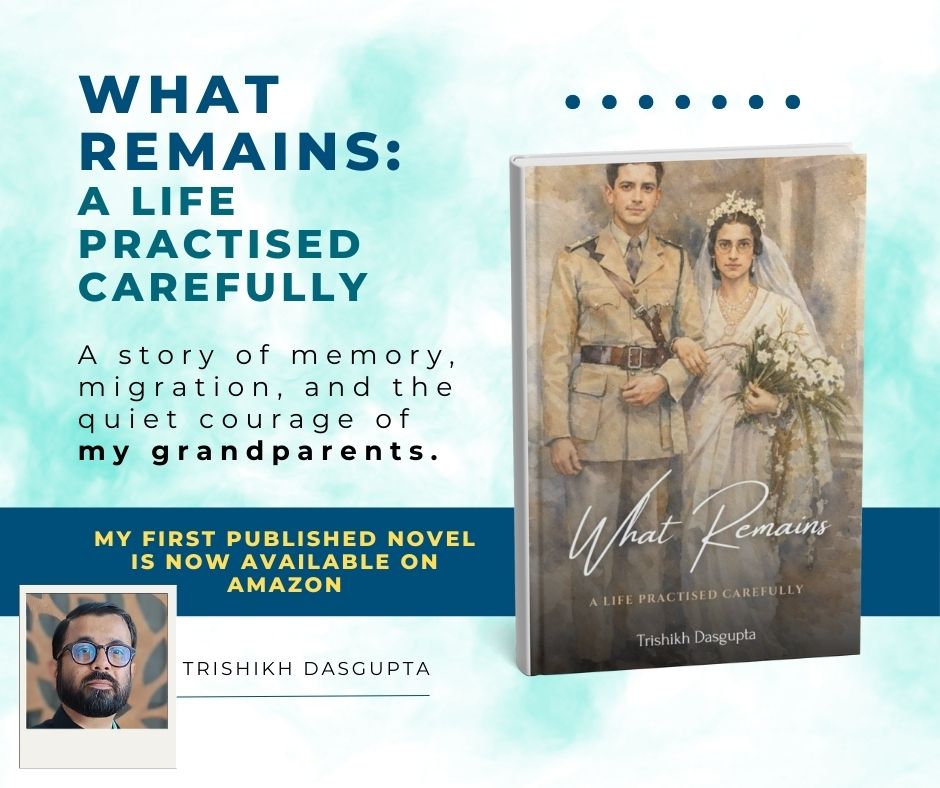
You may also like to read my1st Published novel now available on Kindle and Paperback versions.
 Weekend Stories by Trishikh
Yet another, superbly written, gripping story. Is there any truth to it? It would be great to give credit to India for the science behind fingerprinting!!
LikeLiked by 4 people
Thank you for being the first one to comment. The first comment is always special. So happy that you liked my latest short story. Always treasure your constant appreciation.
LikeLiked by 2 people
Supposed to be “superbly written” not “spiberbly”. My comment was written under very difficult circumstances from which reading your story helped me escape a bit.
LikeLiked by 5 people
Yes, I have made the change.
LikeLiked by 3 people
Very interesting that fingerprinting technology started in India and so long ago.
I’m glad to two men finally got the recognition they deserved.
LikeLiked by 5 people
Dear Katelon, before writing this story, I too did not know that fingerprint was made a workable science invented in Kolkata by a Bengali Hindu, and a Bengali Muslim man, under a British Christian supervisor.
Thank you for liking this story of mine. Always treasure your comments and constant encouragement.
LikeLiked by 2 people
Dear Ned, you are one of my oldest fans, and I always treasure your constant support and appreciation from my stories. Thank you for sharing my story on your website. Now so many more people would be able to read it.
LikeLiked by 1 person
What a brilliant piece, Trishikh! 👏
The story is a beautifully inked tragedy of colonial-era genius—a potent blend of the “half ink, half sweat” world of 1896 Calcutta. You’ve managed to capture the ghosts of mangoes gone to rot alongside the gleaming fire of Haque’s mathematical mind and Bose’s methodical patience. The final image of the yellowed cards in the museum, a “hymn to two men,” leaves a profound impression. You made the ridges of a fingerprint feel like the very lines of history and justice. Truly superb storytelling!❤️🌷
A quiet, witty observation: It seems the Henry Classification System was perhaps the first time in history a colonial officer was truly indexed by the brilliance of his subordinates. What a paradox!
If you were to continue this story, what might be one of the algebra lessons Hem Chandra Bose taught to those neighborhood boys? 🤔
LikeLiked by 5 people
Dear Aparna, first of all I must thank you for this beautiful and brilliantly thought review of my latest short story. I am ever grateful to you for your constant appreciation and encouragement. They really work wonders for my writing engine.
I am so glad that you liked the way I captured 1896 in Calcutta and a colonial event of massive global consequence.
Yes, it seems like a paradox indeed – a colonial officer of great rank being indexed by two subordinate brown men.
Ha, ha, mathematics is not one of my good talents, algebra, however always interested me. I too wonder, what algebra lesson, Bose taught to those neighbourhood boys.
LikeLiked by 3 people
Brilliant story. Can we assume that this one is true and not a fiction?
LikeLiked by 4 people
Dear Kajoli, yes Hem Chandra Bose and Azizul Haque under Edward Richard Henry did invent the Henry Classification System for fingerprints. The Calcutta Anthropometric Bureau became the world’s first Fingerprint Bureau. The case of Haripada is fictitious, apart from that most of the other things are true.
LikeLiked by 2 people
What a beautiful story! The two men The Haque and Bose really were excellent 👌🏼 . Loved it 😊
LikeLiked by 4 people
Dear Priti, thank you for loving the story. Yes, the two men were excellent indeed.
LikeLiked by 2 people
😊👌🏼
LikeLiked by 3 people
Brilliant story. Can we assume that it is factual?
LikeLiked by 3 people
Yes Kajoli, most of it is true, only Haripada’s case is fictitious.
LikeLiked by 2 people
I just reread the story. Reflecting upon it in the light of intellectual property …
LikeLiked by 2 people
I am so glad that the story interests you so much.
LikeLiked by 2 people
It’s interesting the trio were all from different religions.
LikeLiked by 2 people
Yes, that also stood out to me, but I did not mention it in the story.
LikeLiked by 1 person
What a beautifully written piece! The atmosphere of 1896 Calcutta comes alive in your words. Hem Chandra Bose and Qazi Azizul Haque truly deserve this recognition. Thank you for telling their story with such grace and depth.
LikeLiked by 5 people
Thank you so much for appreciating this story so much. Yes, many of us don’t know about such people who have contributed to worldwide human development. I hope that through my story, everyone who reads it now will remember the names of Hem Chandra Bose and Quazi Azizul Haque, whenever they see or give a fingerprint.
LikeLiked by 1 person
🙏
Aum Shanti
LikeLiked by 2 people
Thank you so much.
LikeLiked by 2 people
Can’t wait to read this one
LikeLiked by 3 people
Do read it when you can comfortably can. I always appreciate your appreciation for my stories.
LikeLiked by 2 people
Thank you my friend. I always appreciate your stories in general. They are well written and the plots are always good.
LikeLiked by 3 people
It’s my pleasure to be able to write these stories. I am thankful to God for blessing me with this ability.
LikeLiked by 2 people
🙏
LikeLiked by 2 people
You take good stories and make them so much better with your writing skills.
LikeLiked by 4 people
Dear Geoff, so glad that you liked my stories. Yes, I try to make these stories better known to the world in a format that’s easier to perhaps enjoy and retain.
LikeLiked by 2 people
Thank you so much, Trishikh, for the brilliantly written history of the discovery of the use of the fingerprints, by two gifted Indian men, Haque and Bose. Your story, as always, is so interesting that has to be read twice!
Joanna
LikeLiked by 3 people
Dear Joanna, your words of appreciation mean a lot to me. You are one of my oldest fans. I treasure your comments so much. So happy that you re-read my stories and love them so much.
LikeLiked by 1 person
Thank you, Trishikh, for your beautiful reply! As always, you are more than welcome!
Joanna
LikeLiked by 2 people
Wonderful story and weaving of history.
LikeLiked by 3 people
Thank you so much. So happy that you liked my story so much, especially the weaving of history.
LikeLiked by 2 people
It’s hard not to take this as truth, or at the least, creative nonfiction.
LikeLiked by 4 people
No the story is true, Haque, Bose, and Henry did invent the fingerprint science in Kolkata, and the Calcutta Anthropometric Bureau became the World’s first fingerprint bureau. Haripada’s case is fictitious though.
LikeLiked by 4 people
now this is my subject, history, this was enthralling friend.
LikeLiked by 2 people
Dear William, so happy to have been able to bring this story out.
LikeLiked by 2 people
I loved it…
LikeLiked by 3 people
And nothing gives me greater than such appreciation.
LikeLiked by 2 people
superb, have a nice day friend..
LikeLiked by 2 people
A great day and an awesome weekend to you too dear friend.
LikeLiked by 2 people
Hugely enjoyable
LikeLiked by 3 people
Thank you so much Michael. Such a pleasure to share a good story.
LikeLiked by 1 person
What an interesting story, Trishikh, concerning the development of the science of fingerprints! Many thanks.
LikeLiked by 4 people
Dear Martina, thank you so much for liking it. Glad to have been able to bring this story forward. Always treasure your appreciation.
LikeLiked by 2 people
Yet another interesting tale.. thank you, Fiona 💙🩵💙
LikeLiked by 4 people
Dear Fiona, thank you so much for liking my latest short story. Always a pleasure to share a great tale.
LikeLiked by 2 people
Your story is an important reminder, a tip of an iceberg of the unrecognised contributions the colonised made to the cultural advances of the colonisers, and stretching back for centuries.
LikeLiked by 3 people
That is so true. The colonies and their men and women contributed immensely to the wealth, riches, and advancements of the colonisers. The advanced nations should recognise such contributions whenever possible.
LikeLiked by 2 people
sorry for that mishap, but something is wrong with my e-mail
LikeLiked by 3 people
Ya I received your comment 3 times. Approved one and deleted the other two.
LikeLiked by 2 people
Fascinating, amazing, and a story of global unity, which I love.
LikeLiked by 4 people
That is so true, this event did have a global impact.
LikeLiked by 2 people
Captivating writing… great storyline, Trishikh.
LikeLiked by 2 people
Thank you so much. So happy that you liked this story of mine so much.
LikeLiked by 2 people
You’re welcome. Enjoy your day!
LikeLiked by 2 people
BUON WEEK-END
LikeLiked by 2 people
A great weekend to you too friend.
LikeLiked by 1 person
A wonderful story again. Did not know the facts behind the story.
LikeLiked by 5 people
I too was unaware of this before I started researching about this subject. Thank you for liking the story so much. It’s always a great pleasure to receive your appreciation.
LikeLiked by 3 people
Dear Trishikh
Your posts are as vibrant as Diwali festival, festival of lights. I greet you on Diwali & thank you for liking my post ‘Poem3’ 🌷🌷🌹
LikeLiked by 5 people
Dear Raj, a very happy Diwali to you and your family too. Thank you too for always liking my stories. It’s my pleasure to like your posts too.
LikeLiked by 2 people
Who would have thought that a story about fingerprints could be so fascinating? That is, of course, due to your fabulous writing!
It is to typical that Henry would take all the honour, is it not? At least he acknowledged in the end that the idea was their’s, if a bit too late. It should be the Haque-Bose system, no doubt about it.
Thank you for another captivating story on too little known historical facts.
LikeLiked by 5 people
Dear Stella, it’s my pleasure to bring forth this beautiful and less known history. When I first read and researched about it, I too was greatly fascinated.
Thank you so much for liking the story so much. I always treasure your appreciation and encouragement.
LikeLiked by 4 people
An interesting and excellent story, Trishikh, thank you!
LikeLiked by 2 people
You are most welcome. It is I who must thank you for liking my story so much.
LikeLiked by 2 people
Love the wording
LikeLiked by 1 person
Thank you so much. So happy that you liked the way I word my stories.
LikeLiked by 1 person
Good
LikeLiked by 1 person
Thank you so much. Nothing gives me more joy than reading a little bit of appreciation at the start of the day. Today is Friday, so releasing my next story in the next hour. Keep an eye out.
LikeLiked by 1 person
Nice 👍
LikeLiked by 1 person
Thank you.
LikeLiked by 1 person
Genius writing and elated with the ending that they received the well-earned and deserved acknowledgments! Such a fascinating subject, relevant to today, and I love the title! Tremendous ~ 😀
LikeLiked by 2 people
Yes, this is a really relevant and fascinating subject. I too did not know its connection to the city of Kolkata. So glad that you liked the story story so much.
LikeLike
Elated to read that the two Bengalis were finally recognized for their brilliant work !
LikeLiked by 3 people
Yes, that is something really good that came out of this story. We must also thank Henry for finally acknowledging Haque and Bose’s contribution. Now their names are eternally immortalized. Thank you so much for liking the story and sharing this beautiful message of encouragement.
LikeLike
This is such an interesting information. You are doing a great service by spreading such uniquie information through your stories.
LikeLiked by 3 people
Dear Sumita, yes, I thought that too. This was such an interesting information. Fingerprint technology was born in Kolkata, and hardly anyone I know, knew this, including me. So I thought this information must be immortalised through a good old short story.
So happy that you liked the tale.
LikeLiked by 1 person
I do wish all this information will be passed on to the next generation. This is indeed a thing to feel proud about.
LikeLiked by 1 person
Thanks for insight information
LikeLiked by 4 people
You are most welcome.
LikeLike
Well written, I like it.
LikeLiked by 1 person
Thank you so much. It really makes my day when someone enjoys one of my sttories.
LikeLike
አማርኛ
LikeLiked by 3 people
Thank you.
LikeLike
This is a comment by one of my very favourite school teacher Mr. Michael Dias. Who played a strong part in my formative years. He commented through a personal message on Facebook, so sharing it here as comment from him.
Trishikh,
I thoroughly enjoyed reading “Unseen Lines the Haque & Bose Story.” The smooth continuous literary flow was impressive and so I literally went along for a very enjoyable ride safely to the end.
I couldn’t help but feel sad for and upset with Henry, but what else should I have expected. And for the two unsung heroes an immense feeling of pride for so many reasons, not only for their achievements but for the persons they were through this entire journey.
With a highlighter pen I would have …
1.) “And so, Henry turned to his two Indian assistants, to bring just order to criminal chaos.”
2.) “Two brown men in sweat-stained shirts, eyes gleaming with unclaimed brilliance.”
3.) “…and for a moment, three men stood equal under the flicker of oil lamps…”
4.) “Haque and Bose continued their quiet work…
5.) “but the fame that might have been theirs floated westward, carried on the ships that left the Hooghly.”
6.) “…It was a little late for recognition, but not too late for truth.”
7.) “Each line… beneath its chaos, a pattern of justice… that bore their names, finally seen.”
LikeLiked by 5 people
nice information
Visit SocialClip.pro
LikeLiked by 1 person
Thank you so much for liking the story. I however only allow links in the comment, which are directly related to the story, or the line of conversation.
LikeLiked by 1 person
Very nice history on the invention of fingerprint reading. Thanks for bringing forth the labour of 2 Indian gentlemen who were actual heroes of this invention.
LikeLiked by 2 people
Thank you so much Amit. So glad that you liked the story. Yes this is something everyone associated with the city of Kolkata should know.
LikeLike
💙👈
LikeLiked by 1 person
Thank you.
LikeLike
Wow, I honestly had no idea about Haque and Bose’s story. It’s amazing how their work on fingerprints has shaped justice all over the world. I love how you shared the history and also made it feel so alive, like we were right there with them in Calcutta. Really inspiring. Visit my blog SocialClip.pro
LikeLiked by 2 people
Thank you so much. Much appreciate you visiting my site, liking my story, and commenting on it.
LikeLiked by 1 person
Appreciate the effort put into this. It’s always good to see quality content.
LikeLiked by 1 person
Thank you.
LikeLike
I found this article quite helpful. Looking forward to more content like this.
LikeLiked by 3 people
Thank you.
LikeLike
Quietly powerful and beautifully imagined. This piece restores long-overdue dignity to Haque and Bose, showing how justice can be born not from authority, but from intellect, patience, and moral courage. History, science, and humanity meet here with rare grace.
LikeLiked by 5 people
Thank you, Anjali. Your words mean a great deal. Haque and Bose worked in silence, with no certainty that history would ever speak their names aloud, and I wanted the story to honour that quiet courage — where intellect becomes an act of justice, and patience a form of resistance. I’m deeply grateful that the meeting of history, science, and humanity resonated with you.
LikeLiked by 2 people
Most welcome Sir, I just tried to be a part of your comment box and writing journey.
LikeLiked by 1 person
The imagery of ridges, ink, and paper becoming a global system of justice is unforgettable.
LikeLiked by 1 person
That is very true.
LikeLike