It was a smouldering dawn in May over a battlefield strewn with thunder and ruin, 326 years before the birth of Christ on the banks of the river Jhelum, which the Greeks called Hydaspes. The plain was littered with shattered armour and half-buried bodies, the metallic stench of blood heavy in the humid air. In one corner, a war-elephant lay fallen on its side, its great tusks broken, its trunk curled like a dying serpent. All around, the sky glowed dull with the reflection of the crimsoned river, once the scene of bloodshed, now glistening in the hazy morning light, as though indifferent to the carnage. Soldiers moaned, some crawling, others merely whispering their prayers into the dust. The cracked shields and shattered spears lay like the skeletons of a storm passed, and vultures circled overhead, drawn by the scent of defeat and despair.
At the edge of the blood-soaked earth and the scarlet river, stood Alexander the Great, his crimson cloak now darkened with mud and dust. His eyes, once bright with triumph, were now clouded by the weight of what had happened, the churning of men and beasts, the roar of elephants and horses, the clash of steel, and the desperate cries of the fallen. He questioned his resolve and wondered how deep the Greeks would sow their seeds in this mystical peninsula of unfathomable kingdoms. Following the battle, he founded the cities of Boukephala and Nikaia and continued his quest, marching eastwards.
Two months later, in July 326 BCE, he stood at the boundary of another mighty kingdom, at the edge of another river, the Beas, which the Greeks called Hyphasis. He approached, Phegeus, a good soldier and a great scholar, now scarred and weary but still standing firm, and asked, in a voice that trembled both with exhaustion and a lingering fire, “Phegeus, what lies beyond the boundary of King Porus’s kingdom, now that the storm of war has rolled through his lands?”
Phegeus, brushing sweat and dust from his brow, his voice low as though even speaking might stir ghosts of the slain, replied, “Alexander, beyond this river, this kingdom of Porus, lies a desert, a barren, punishing land of heat and wind. Beyond that desert, you will find the river Ganges, thirty-two stadia wide and the deepest in India, its waters dark and mysterious. And beyond the Ganges in the mighty land called Gangaridai lies the Nanda Empire, whose people are ferocious warriors and whose king, Xandrames, commands an immense army, among them four thousand war-elephants.”
Alexander gazed into the distance, the landscape stretching out like an unwritten map of his ambition. He felt the heat of the plains, the scent of dust rising in the hot wind, and the hum of insects already gathering at the edges of the wet riverbank. And in that moment, he understood, even as he had vanquished Porus, the horizon still teemed with challenge, and planting the Greek seed in the Indian soil was a dream still far-fetched.
Phegeus’ description of what lay beyond, and the whisper of mutiny among his own troops, weary after years of campaign, countless miles marched, and infinite nights spent under foreign skies, finally halted his onward march. For though he stood victorious, his men stood exhausted, the plains behind them already filled with memory and blood, and ahead lay unknown deserts and rivers and armies unimaginable. At the edge of the river Beas, his soldiers baulked, the weight of years pressing on their shoulders, and the push eastwards stopped.
Historians of later times note the mention of Gangaridai in the works of Greek writers like Diodorus Siculus and Megasthenes, a realm in the region of modern-day Bengal, marking that this land of elephants and warriors lay beyond the boundary of Alexander’s West-to-East dreamworld.
Two millennia later, in the year 1770, the sea roared as if in remembrance of that old battlefield’s thunder. A ship, battered by the Bay of Bengal’s cruel winds and salt-laced spray, pitched and groaned. On board was the Greek trader Panagiotes Alexandros Argyres of Philippoupolis, his heart pounding like a drum in his chest. With him was Captain Thornhill, his interpreter, his steady link to the world of trade and wind-blown contracts. The ship creaked under the assault of waves as high as houses; the sailors shouted over the lashes of rain; ropes snapped; the deck was slick with sweat and sea; the smell of tar, wood, salt, and fear filled the cramped hull. Argyres’ cloak was soaked through, his boots filled with icy water, and the wind had plastered his hair to his forehead.
When the vessel listed sharply, tossing them as though they were rag-dolls, Argyres fell to his knees, gripping the wet wooden railing, the chill of the sea water spattering his face, and prayed in the ancient Greek tongue: “If I come safely to the shores, I will build a church, a sanctuary, a place of faith and home for my dwindling people.” His voice rang out over the howl of the storm, small but fierce, as though the promise itself fought the tempest. And then, in an almost miraculous turn, morning broke. The winds slackened; the sails flapped limply; the sea lay bruised but quiet. They limped into the harbour, the ship battered but afloat. Argyres exhaled, tears in his eyes, the smell of salt and relief mingling. And now he had to keep his promise, build a Greek Church in the city of Calcutta.
So began the next chapter of the Greek story in India. After the age of conquest by Alexander, the Greek world and the Indian sub-continent remained distant yet linked in memory and trade, in scholarship and myth. Later in 302 BCE, when the historian Megasthenes ventured to India as ambassador to the Mauryan court, he recorded India’s wonders, its great rivers, among them the Ganges, and the unnamed armies of elephants that checked even Alexander’s march. Greek merchants, sailors and settlers followed the currents of trade: from the Aegean islands, through the Red Sea, across the Arabian Sea, into Bengal’s rivers and cisterns. In the colonial era, the city of Calcutta became a hub of commerce for Greek families whose names once rang in shipping registers, jute and spice warehouses.
Argyres arrived in this vibrant city, its docks filled with teak planks, jute bales smelling of river-gum and old sails; the air heavy with curry spices, Bengali dialects rising and falling in the traffic, the clang of horseshoes on cobbled streets, and the river Hooghly reflecting the orange-pink of dawn. He saw, in that swirl of East and West, possibility.
The winds that carried Argyres to India were also stirred by distant wars. In Europe, the long and bitter conflicts between Russia and the Ottoman Empire had displaced many Greeks from their ancestral homes. Merchants, sailors, and priests fled the turmoil, their livelihoods shattered, their faith seeking safer shores. Some sailed east, not toward the familiar ports of the Mediterranean, but toward the rising British colonies. Thus, a handful found refuge in Bengal, bringing with them fragments of the Aegean, language, icons, and memory, which would quietly take root in the humid air of colonial Calcutta.
The first Greek Orthodox Church of Kolkata came up in 1752, in Canning Street, but was soon abandoned. And later, when Argyres arrived, he knew it was his divine calling and responsibility to build the church. He secured land in the Amratollah Street area, where earlier Greeks had settled and built a small community, a home church, and a cemetery. He wrote letters to the colonial authorities, arranged funds, and negotiated with British officials, though his heart, in that moment of landing, still carried the memory of the storm, the salt, and the promise. In his mind, he built the blueprint of the church: Doric columns rising like pillars of faith, a triangular pediment carved with Greek inscriptions, the door flanked by saints from the old world and the new, the smell of incense drifting into the Bengal dusk where children played in the alleys and rickshaws clattered by.
In quiet hours, Argyres walked the cobbled lanes by the river, the light softening at dusk, the wooden construction scaffoldings overhead silhouetted, and the smell of river-mud and wood-smoke drifting from small boats moored alongside. He thought of Alexander’s march, of Phegeus’ warning, of the elephants of Gangaridai unseen yet real in memory. He knew that the Greek seed had finally been planted in India. A Greek community, small but steadfast, now far from home, had rooted in the port city. He imagined weekday services, the sound of Greek hymns mixing with Bengali choruses, and the scent of fresh flowers and candle-wax in the air.
Construction began. Stones were laid. The workers, Indian masons, Greek donors, British contractors, murmured in three tongues. Argyres stood overseeing the work: the foundations deep amid Bengal’s clay, the columns rising taller than he expected. One afternoon, as monsoon clouds gathered and thunder grumbled overhead, he walked inside the incomplete nave. Water leaks dripped from the roof; the smell of wet timber filled the space; the murmur of rain hitting scaffolding echoed like distant drums. He paused and placed his hand on a column, cool, firm, and wondered, would this church stand long after his storm-tossed voyage, long after the Greek names faded from Calcutta’s lanes, a beacon of memory and faith.
Then, finally, the church was opened to the public in 1781, four years after the present and sole surviving Greek cemetery was built in the Phoolbagan area of the city in 1777. Argyres watched children from the Greek community gather, elders in frock-coats and flat caps, Bengali converts, sailors from the Aegean looking at the icons in a foreign land and feeling a familiar warmth. And yet he seemed bittersweet; although the Greek community prospered, he felt that their roots in the land would perhaps not spread. He watched young Greek merchants marry into other communities; their children calling Calcutta home and Greece a memory across the sea.
In one halcyon dusk, Argyres sat outside the church, smelling jasmine from a nearby courtyard, hearing the carriages jingle, the shout of boatmen on the Hooghly, the wind carrying the cry of a gull. He thought of that storm, of tears and salt, of his promise. He thought of Alexander’s halted march and that far-away desert and Ganges river and war elephants. He reflected how conquest and commerce, that brutal thunder and the soft hush of faith, meet in this city of many tongues.
Argyres, now aged, watched from his pew how the congregants were fewer, how the Greek tongue was spoken less, how the promise of his storm-born vow felt weightier. But he remained steadfast. On a rainy morning, he climbed to the roof of his church and looked out across Kolkata. Mist shrouded the stony lanes; the river lay grey. He whispered: “My voyage, my promise, will you endure.” The monsoon wind tugged at his coat, and a pigeon cooed. Somewhere below, a child laughed. And for a moment, just a moment, he felt the presence of the elephants of Gangaridai, vast and silent, guarding 2000-year-old Greek memories beyond the horizon.
As the years passed, and as fast as time seemed to fly, so did the decline. The roaring jute trade, which had boomed for the Greeks, quieted; the shipping lines moved; the younger Greeks left for Europe or America; and Argyres’ church in Amratollah Street, sadly, could not withstand the sands of time. It was sold in 1920 due to the declining Greek population. However, the proceeds from the sale were used to purchase land in Kalighat for a new church. The tombstones from Amratollah Street were moved to the Phoolbagan cemetery. The new church, inaugurated in 1924, with its classical Doric-column façade, marked the final home of the Greek people’s faith in the city of Calcutta.
Sadly, with the further decline of the community in the city, the Greek Orthodox Church in Kalighat closed its gates in 1972. Divine intervention, however, seemed to rekindle their flame in the city once again, and 19 years after being closed down, the church was reopened under the initiative of the Greek embassy and Father Ignatios, a Greek priest, after which it has been continuously functioning. And today, the only Greek national still settled in Kolkata is perhaps a lone sister, tending to the legacy, running orphanages, keeping alive the flame of a once-vibrant community. And the only visible footprints of that Greek presence in Kolkata, the cemetery in Phulbagan, the Panioty Fountain besides Raj Bhavan, and the Greek Orthodox Church near Kalighat, stand out quietly in the city of rickshaws, trams, river-boats and dusk-filled skies.
When you walk past the church today, you might feel the echo of the sea, the rattle of hooves on a battlefield, the trumpets of elephants in memory, the lament of merchants leaving home, the prayer of a man on the verge of sinking. And you might sense that underneath all this, beneath the dust and the salt and the blood and the commerce, there lies the enduring human longing for home, for memory, for a pillar of faith in a place far from birth.
Copyright © 2025 TRISHIKH DASGUPTA
This work of fiction, written by Trishikh Dasgupta is the author’s sole intellectual property. Some characters, incidents, places, and facts may be real while some fictitious. All rights are reserved. No part of this story may be reproduced, distributed, or transmitted in any form or by any means, including printing, photocopying, recording, or other electronic or mechanical methods, without the prior written permission of the author, except in the case of brief quotations embodied in critical reviews and certain other noncommercial uses permitted by copyright law. For permission requests, send an email to the author at trishikh@gmail.com or get in touch with Trishikh on the CONTACT page of this website.
ABOUT THE AUTHOR

Trishikh Dasgupta
Adventurer, philosopher, writer, painter, photographer, craftsman, innovator, or just a momentary speck in the universe flickering to leave behind a footprint on the sands of time... READ MORE
These stories are Free and if you have found something here that stayed with you, some of my other books are now available in print and digital editions. They gather longer journeys, quieter questions, and stories that continue beyond this page.
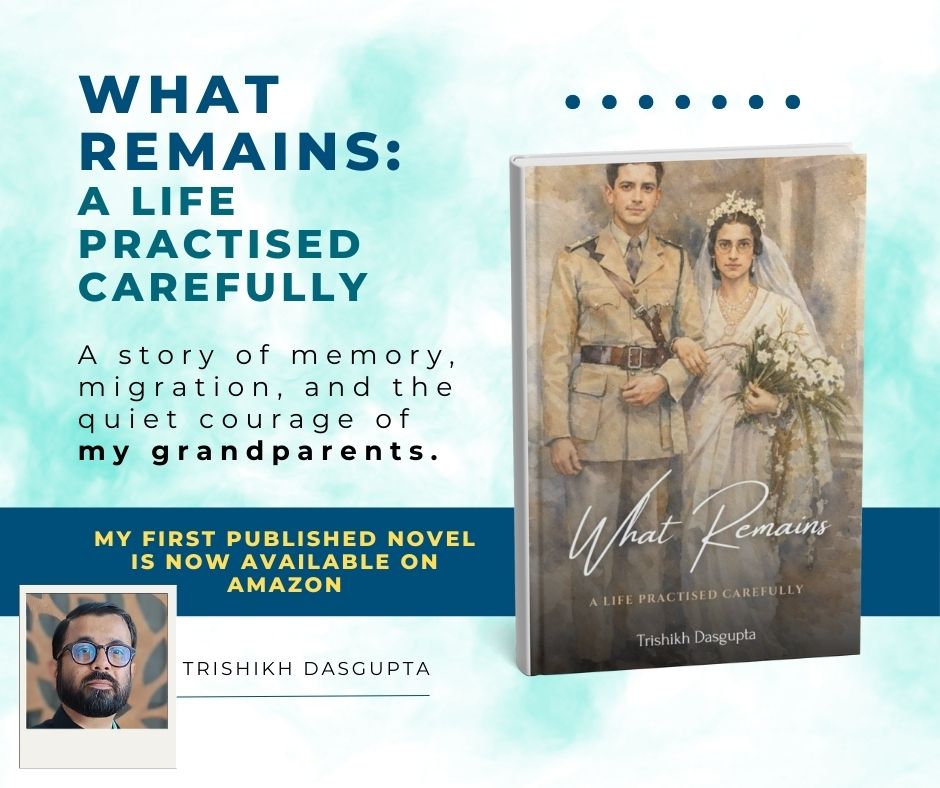
You may also like to read my1st Published novel now available on Kindle and Paperback versions.
 Weekend Stories by Trishikh
What a fascinating story my friend. I learned a lot from this, Historical beauty.
LikeLiked by 2 people
Dear William. So happy that you liked the story. I knew you would love it, being a history buff. Always a pleasure to be able to share knowledge of such events from the past for future generations to carry the stories forward.
LikeLiked by 1 person
I loved it, you should publish your stories, they are amazing. have a lovely day/night.
LikeLiked by 1 person
That is also a big dream to publish my stories. I am sure that it will happen in God’s time. Thank you for your constant support. Treasure every bit of it.
LikeLiked by 1 person
cant wait till you do, such imagination and skill.. take care.
LikeLiked by 1 person
Thank you Bill. I too am very eager.
LikeLiked by 1 person
dreams can come true… if you have patience…
LikeLiked by 1 person
That is so true, with patience anything can be achieved. I believe and try to practice it too.
LikeLike
Patience is different from procrastination…
LikeLiked by 1 person
That is for sure. I think patience is being calculative and moving thoughtfully towards achieving a goal, and not being erratic and spoiling the chance to succeed.
LikeLike
Just took me back to the times and enjoyed every bit of it. Thanks for the history too.
LikeLiked by 2 people
So happy that my post transcended you to historic eras. Always treasure your comments.
By the way, when you comment once, don’t worry, it will show after I approve it. This might take some time. So you need not comment twice.
LikeLike
Dear Ned, thank you so much for liking and sharing my latest story on yours website.
LikeLike
🙏
Aum Shanti
LikeLiked by 2 people
Thank you.
LikeLiked by 1 person
Beautiful story, I didn’t know the fact behind the Greek church , I think you have written it mixing with imagination and true factor. Well written ☺️
LikeLiked by 1 person
Dear Priti, the story about the Greek Church, its formation, growth, decline, and resurrection in the city of Kolkata is absolutely true. I have fictionised the scenes to present the history is a readable story format.
LikeLiked by 1 person
Wow that’s awesome
LikeLiked by 1 person
🙏
LikeLike
Goodness, Trishikh, today’s story is well beyond wonderful! It is not only a fascinating and erudite history lesson, written by a hugely talented writer whose words paint the world across the millennia in such an extraordinary detail that we can smell the scene of a battle, the sea voyage, and every spice of a big city, but also feel what the people in his tale feel, and be moved by their emotions, dreams and longings. This God given talent, Trishikh, will be your destiny and immortal legacy. Thank you for starting my day in such a memorable way!
Joanna
LikeLiked by 2 people
Dear Joanna, as always your thought appreciation for my story brings tears of joy to my eyes. The history, sights, sounds, smell, and emotions in the story finds meaning when it is enjoyed to the level in which you enjoy my stories. I am thankful to God for your constant appreciation and encouragement.
I too dream of these stories becoming my legacy, resonating through future generations long after I am gone.
LikeLike
Thank you, Trishikh, for your beautiful reply! You certainly deserve all the praise bestowed on you! I think your dream is a reality any time soon, and I don’t mean your passing!
Joanna
LikeLiked by 1 person
I too pray for it.
LikeLike
I keep my fingers crossed, and my thoughts about…
Joanna
LikeLiked by 1 person
Yet another fascinating take.. you brought it all together really well.. thank you ❤️
LikeLiked by 1 person
Dear Fiona, thank you so much. It’s always a pleasure to share a great story. I am ever grateful to you for always liking my stories so much.
LikeLiked by 1 person
You have traversed thousands of years to craft an amazing tale of man’s quest for home even as conquest, curiosity and commerce makes him a wanderer.
LikeLiked by 1 person
Dear Kajoli, that is such a nice way to explain this story. So glad that you liked the tale. Always a pleasure to receive your appreciation.
LikeLike
You write very well!
LikeLiked by 1 person
Thank you so much. You are too kind with your appreciation.
LikeLike
Another engaging story weaving history and sentiment.
LikeLiked by 1 person
Thank you so much. So happy that you liked the way I weaved history and sentiment.
LikeLiked by 1 person
An epic traveled with you, Trishikh … I feel such a connection with elephants and the history came to life! Brilliant writing and transformative read! Well done & Thank you!
LikeLiked by 2 people
Thank you so much for liking this story so much. I am glad that my story was able to make such a deep connection with elephants and history in your mind.
LikeLike
Many thanks, Thrishikh, for this great stories across centuries, which gives me, however, the feeling of being also very actuel because of the storms, tears, salt and the big desire to find a home and produce roots in the country to which many people emigrate to! Often time, I think, this is just an illusion.
LikeLiked by 2 people
Dear Martina, thank you for liking the story so much. Yes, truth at times does seem like illusion. Often it is so hard to believe.
LikeLiked by 1 person
once again, you have given us a wonderful story to enjoy & learn from! 😊thank you🙏🏼❤️🙏🏼
LikeLiked by 2 people
You are most welcome. Your appreciation and encouragement, I really treasure. Keep on enjoying my stories.
LikeLiked by 1 person
i certainly shall👍🏼😊🥰
LikeLiked by 1 person
Thanks. I learn more about India in every story you post.
LikeLiked by 3 people
Dear Katelon, that is one of my goals, that through my stories may many know more about my country, its people, culture, customs, history, geography, sights, sounds,and smell. Thank you for always enjoying my stories so much. It means a lot to me.
LikeLike
Balanced insight, gracefully shared
LikeLiked by 2 people
Thank you, so glad that you liked the story.
LikeLike
Excellent – I enjoyed reading this.
LikeLiked by 3 people
Thank you, so glad that you liked it.
LikeLike
Beautiful. So much history. If I ever go to Kolkata again I shall try to see all the places that you mention in your heartwarming stories.
LikeLiked by 2 people
I wish you all the best. If God will, you will certainly get a chance to visit Kolkata. I am so glad that in the meanwhile, my stories keep you connected to the city.
LikeLiked by 1 person
What a stunning and evocative piece of writing! It beautifully weaves together the threads of conquest, commerce, and faith, showing how they all led the Greeks to India.
It’s amazing to think that the same geographical barrier that stopped Alexander the Great—the river Beas and the distant might of the Nanda Empire with its war-elephants—later became a hub for a tiny Greek community rooted in trade and devotion.
Panagiotes Argyres’ storm-born promise to build the church is such a powerful counterpoint to Alexander’s campaign. It shows that even when grand ambitions of empire halt, the quiet, persistent human need for a sense of home and faith can take root, leaving behind silent but enduring footprints like the Kalighat Church and the Phoolbagan cemetery.
It’s truly a moving legacy—a small, steadfast flame tended today by a single sister, two millennia after a king’s march was halted by the whisper of a distant, mighty kingdom.
Brilliant 🙌✌️
LikeLiked by 1 person
Dear Aparna, once again your power of deep analysis of a story far exceeds the skills of many professional critique.
You have so eloquently spotted that what kings and armies were unable to attain, the faith of a single man achieved.
Thank you for always being so supportive of my stories. I really treasure your feedback, they work wonders for my writing engine.
LikeLike
Bravo! I read this to Ariel & Alice. Your posts always teach them history, geography, and vocabulary.
LikeLiked by 3 people
So happy that Ariel and Alice got to listen to my story. This is such a great reward for a writer to have younger minds enjoy his work.
LikeLiked by 1 person
In your story, you masterfully tied up the ancient spread of Hellenism, with Greek culturally influences during colonial times and the presents. It can be assumed, there is hardly any port that does not feature a display of their seafaring influences. One can only speculate, how the Indian culture of today would turn out, if Alexander had continued; or maybe his empire would find his end on the battlefield in India?
LikeLiked by 2 people
That is very true, there is perhaps no great port city, that does not bear a bit of their presence in architecture, or food, or even culture, and so many other things.
And yes, if Alexander would have conquered parts of India, or lost in the Indian soil, history would perhaps be very different.
I am so elated that you liked the story so much. It really makes my day when someone enjoys my stories to such deep and profound levels.
LikeLiked by 1 person
I love the beautiful art displays on your posts. They tie so well with your powerful storytelling.
LikeLiked by 2 people
Dear Hannah, thank you for liking the artwork in my stories, previously I used to illustrate them in Adobe Illustrator or Corel Draw and Photoshop, nowadays I generate them through AI and edit a little wherever necessary.
LikeLiked by 1 person
Dear Trishikh
My spirits are up after reading your post. Thanks for liking my post One. ❤️❤️🌷
LikeLiked by 1 person
Dear Raj, my pleasure in doing so. I always appreciate your constant support.
LikeLiked by 1 person
Dear Trishkish, it’s always such a great pleasure reading your work. We couldn’t agree more with William Sinclair Manson (Billy) — your writing truly deserves to be published. Every piece you create is thoughtful, enriching, and a joy to read. Thank you for sharing it with us. 🪷
LikeLiked by 1 person
Yes, now I am seriously thinking about publishing. Let’s hope I get a good publisher.
LikeLiked by 1 person
That’s wonderful news, Trishikh! Your storytelling truly deserves a much wider audience. Wishing you all the best in finding the right publisher — one who recognizes the depth and heart in your work. ☀️
LikeLiked by 1 person
Yes, that is the challenge I am facing. That’s the challenge any writer faces – finding a publisher who believes in the work of the writer.
LikeLiked by 1 person
Dear Trishikh, I sincerely apologize for misspelling your name. Thank you for your understanding. ☺️
LikeLiked by 1 person
Not an issue dear friend. I value our interactions and your comments.
LikeLiked by 1 person
Thank you! We feel the same — it’s always a true pleasure connecting with you, and we deeply appreciate your kind support of our blog.
LikeLiked by 1 person
It’s my pleasure to visit your blog and like the posts.
LikeLiked by 1 person
It’s cool how it shows that history and people leave their marks even thousands of miles and years later, and how faith and memory can survive through all the hardships.
LikeLiked by 1 person
That is a very apt analysis of my story. Thank you for liking the story so much. Treasure your appreciation.
LikeLike
Hi! Do you know any sites that are hiring Bloggers or Writers I apply? Sorry I’m asking.
LikeLiked by 1 person
Sorry, I am not aware of any such sites, but am sure that you can search and fiind out a site that works for you.
LikeLike
Wonderful Post my Friend…
LikeLiked by 1 person
Thank you so much Willie for always enjoying my stories.
LikeLiked by 1 person
You are very welcome. I don’t get a chance to comment all the time, but I do truly enjoy your blog and post.
Be Safe, Be Well and Be Blessed
LikeLiked by 1 person
I understand Willie, you enjoying my stories is reward enough. Safety and blessings to you and your family as well.
LikeLiked by 1 person
Nice post
LikeLiked by 1 person
Thank you so much.
LikeLike
A beautifully written and deeply evocative piece. The way history, faith, and memory intertwine through Alexander’s legacy to the Greek Church in Kolkata is truly mesmerizing. Every line feels alive with imagery and emotion. Brilliant storytelling, Trishikh!
LikeLiked by 1 person
Thank you so much for feeling this story to such depths of understanding. I am really happy the the tale of the Greek’s presence in India, Bengal, and especially Kolkata is reaching many eyes, ears, and hearts through my little tale.
LikeLike
Very captivating story. Thanks for sharing 👍 😊
LikeLiked by 1 person
You are most welcome Yusif. So happy that you liked the story.
LikeLike
You think, and write, so beautifully. Be well.
LikeLiked by 1 person
Dear Cindy, thank you so much. I treasure your appreciation.
LikeLike
A very intense story, Trishikh, I could feel the blood, sweat and tears. I wonder what drives men like Alexander to continue conquering new lands. I mean, the larger the empire, the harder to administrate it is. And all the large empires fall to pieces sooner or later.
It seems to have been the fate of minorities to leave for other shores after many generations. But I guess that is life, everything is in flow all the time.
I hope you will publish your wonderful stories in a book at a point!
LikeLiked by 4 people
Thank you so much. I am so happy that you find the story so intense.
Yes that’s a very old and mysterious question – Why do humans want to dominate other humans. I think it is something ingrained in our DNA. And in the case of men like Alexander, the trait was seen at its peak. But one thing is sure, as you rightly say, nothing and no one lasts forever. All empires and beings eventually falls, but how they are remembered is perhaps what makes the difference.
Minorities always suffer, that too is sadly another dark side of us humans. I only pray that it reduces over time as we evolve more.
I am searching for a good publisher, who would treasure my work and publish a collection of my short stories. Am yet to find such a publisher. Let’s hope for the best. I hope one day I will find the right publisher. I too really want to publish my stories in a book.
LikeLiked by 1 person
Alexander left a trace of death and mayhem, but they still call him “the Great”. Humans are weird. 🙂
LikeLiked by 1 person
That is so true, I never thought of this. Now I come to realise, so many kings have been bestowed with such titles and praiseworthy suffixes, when they have committed so many atrocities themselves.
LikeLike
As always, a wonderful story, very skillfully written. Awesome!
Thank you for all the “likes” on my blog. I am honored. I am subscribed to your blog but don’t always get the posts when you publish. Will check again.
Thank you for visiting my blog!
LikeLiked by 1 person
Thank you so much for always enjoying my stories. I am so happy that my stories are able to spread a bit of literary joy.
I publish a story every Friday. Don’t know why you are not getting the email or notification when I publish a story. Maybe some technical issues.
Do visit my site again, I am sure that there are some stories which you have missed. Do read them whenever you feel like. I am certain that you would enjoy them.
LikeLiked by 1 person
I will do just that. Visit your site and read some stories. Looking forward to it. Thank you!🙏🏽
LikeLiked by 5 people
You are most welcome. Always a pleasure to have you visit my site and enjoy a short story.
LikeLiked by 1 person
Beautifully written and deeply evocative. The way centuries of Greek history in India are woven together through memory, faith, and loss is powerful. It reminds us that while empires fade, human longing and cultural traces quietly endure.
LikeLiked by 1 person
Thank you, Anjali. Your words feel like a gentle lamp left burning beside the story. If the piece could carry the ache of fading empires yet hold on to the quiet endurance of memory, faith, and longing, then it has found a reader it was waiting for. I’m grateful you listened so closely to its silences.
LikeLiked by 1 person
Your story always good, I really appreciate that. Have a sweet dreams.
LikeLiked by 2 people
Thank you ☺️
LikeLiked by 2 people