The monsoon-misted dusk of September 1943 softened the edges of Victoria Memorial’s white marble dome. Once pristine, the edifice now stood muted beneath the grey Bengal skies. Its shining Makrana marble slowly wrapped in shadows, and its great bronze angel atop the dome, almost invisible in the gathering gloom of wartime blackout.
At the height of the Second World War, the city of Calcutta pulsed with fear, hope, and a strange stillness. The colonial capital’s heartbeat had changed. The gardens of the Victoria Memorial Hall, spread across sixty-odd acres, where children used to run in joyous laughter under the spires of the monument, now held an undercurrent of alert.
Lieutenant Edward Harding of the Royal Indian Army Service Corps stepped from his black-unpainted Ford Canadian Military Pattern (CMP) truck at the South Gate of the Memorial gardens. The low rumble of distant aircraft, Japanese reconnaissance, perhaps, had grown familiar in recent weeks. British authorities had painted the white monument black in places, camouflaged its outline against anticipated aerial bombing from the east.
Edward was young, twenty-eight, and yet bore the weight of the empire’s waning grandeur in his uniform and the faint tremor in his voice. He paused at the gate, the wrought-iron arch casting long shadows on the sodden lawn; rain earlier in the evening had left the earth soft, the scent of wet grass mingled with petrol fumes from army vehicles. He inhaled deeply, quietly, and found solace in the quiet rustle of the lotus pond across the lawns.
Nandita Banerjee of the Calcutta Relief Committee, moving quietly among relief workers aiding victims of famine and war, waited for the Lieutenant under the north portico. She had come to know from a very reliable source that Harding had a soft corner for the Indian cause. Miss Banerjee looked at Edward with calm directness, her sari damp at the hem, her hair pinned, her eyes steady.
“Lieutenant Harding,” she said in a lower tone, “thank you for coming.” He nodded. “Miss Banerjee.” His accent was clipped; the Bengalese inflection of her English touched him like a soft wind. “You said you had something I should see.” She glanced at the black-covered edifice behind her, the great central dome of the Victoria Memorial, its marble quiet in the dusk, veiled in protective measures. “Yes,” she said. “Follow me.”
They walked through the vast colonnade, the arches forming dark silhouettes, the lamps still low and dim in blackout hours. The interior galleries were closed to the public due to the looming war; only the guards, the faint hum of generators, and the distant echo of footsteps occasionally pinged in the stillness. Edward looked up at the dome’s interior mural frescoes, still visible even in low light – of Queen Victoria’s reign, the age of empire, the stylised allegories of ‘Art’, ‘Architecture’, ‘Justice’ and ‘Charity’.
“In this war,” Nandita continued, “we’ve seen hunger first, and then fear. You and I have seen and know the cost.” She paused at a side gallery window, where the gardens glowed faintly in the filtered moonlight breaking through rain-clouds. The lotus leaves formed shimmering circles on the glassy pond. Around them, the lawns were quiet, and the statues of Cornwallis, Wellesley, and Dalhousie stood like silent sentinels in the shadow.
Nandita remembered the day the building opened in 1921, how crowds had thronged the white marble, how the bronze statue of Empress Victoria outside the café in the garden gleamed in the afternoon sun. But now, with the dome painted black, the external shape of the monument almost lost in the night, the empire felt fragile.
Edward asked softly, “Why bring me here, now?” She looked at him, “because the Memorial is more than a building. I want you to see what this place means, to Bengal, to India, to us all, and then ask – whose empire is it now?” He frowned. “I don’t quite follow.”
She led him to the basement store-rooms beneath the galleries. The air was cool, damp, smelling of stone and old books. Flickering lamps casting tall shadows. Archives lay in crates, manuscripts from the eighteenth century, Persian translations of Upanishads, arms and armour once used by the Nawabs, and paintings from all over the Empire.
“In here,” she said, “is the story that the empire tells, and the story it tries to bury.” Her finger traced an archive box labelled “Indian Relief 1943”. She pulled it open. Inside lay photographs, certainly not meant for a museum’s basement but apt for a newsroom – skeletal figures of famine victims in Bengal; women queuing for rice; children’s empty bowls. The dates were recent.
Edward’s throat tightened. He thought of his posting, the shipments of munitions, the Japanese raids over the Bay of Bengal, and the calls for blackout. He remembered the painted black dome of the Memorial, the trenches dug behind the gardens, and the helium balloons strung up to confuse enemy planes.
Nandita said, “Look at this.” She placed another photograph beside them – a British army truck depositing sacks of grain under the lawns at dawn. She said: “The empire’s purpose has become this – survival, at whatever cost.” Edward swallowed, “and the Memorial?”
She regarded the great marble halls above them through the vent. “It was built to proclaim power, to celebrate the Empress Victoria’s reign. But now, in a war the empire cannot win, it stands as witness, not of triumph, but of change.”
Upstairs, they emerged into the central rotunda. Moonlight filtered through the dome’s lantern skylight. Outside, at the pinnacle of the dome, the four-metre bronze figure of the Angel of Victor rotated slowly with the winds of war. Edward paused beneath it. The open galleries encircled the rotunda; the murals of the Queen’s life looked faded now. The smell of wet marble, of old varnish in picture frames, of dust in empty corridors filled his senses.
“Do you know the story of the memorial’s inception?” Nandita asked softly. He shook his head sideways. She began: “In January 1901, when Empress Victoria died, Lord Curzon, the Viceroy of India at the time, conceived this monument in Calcutta. He said: ‘Let us… have a building, stately, spacious, monumental and grand, to which every newcomer in Calcutta will turn… where all classes will learn the lessons of history’.”
She paced slowly along the balustrade overlooking the gardens: “The foundation stone was laid on 4 January 1906 by the Prince of Wales. Construction dragged on; white Makrana marble from Rajasthan, the same material as the Taj Mahal, was used. The architect, Sir William Emerson, with Vincent Esch assisting, blended British Renaissance, Mughal, and Indian elements – domes, porticos, and colonnades. The memorial opened to the public on 28 December 1921. A museum housing paintings, manuscripts, royal busts, and a gallery to the Indian Empire.”
Edward listened, absorbing the history, though his mind wandered to the low booming of searchlights beyond the gardens. “The gardens were vast, the lawns, fountains, statues of Cornwallis, Clive, and Dalhousie. The memorial was both a symbol of imperial power and a repository of art and history. Yet now,” she turned to him, “the power is slipping. The empire is being defended, and the empire may not endure.”
A shrill air-raid siren split the hushed night. Edward and Nandita froze. Somewhere beyond the garden, behind the trimmed hedges and lily-ponds, the searchlights pivoted skywards. The English soldier and the Bengali humanitarian spontaneously huddled as they felt the tremor of a Japanese bomb, not there but somewhere near, perhaps in the Khidderpore docks, or in the Dalhousie area. Edward gripped the balustrade, and Nandita stood calm.
“Come,” she pulled him down a narrow flight of stairs to one of the stone trenches behind the gardens. Edward himself had overseen the digging of many such trenches around key buildings in Calcutta. They crouched low, hearing the wind, the distant droning of an aircraft, metal shutters repelling the gusts of rain. The black-painted exteriors of the Victoria Memorial Hall above them were almost invisible in the night, the dome swallowed into the sky.
They waited in silence. The only sounds were the drip of rain through a gutter, the soft rustle of leaves, and the low hum of a generator, faintly reaching their ears. Edward’s uniform trousers felt damp with dew, and Nandita’s shawl wrapped tighter. They exchanged no words. The moment held weight, history in suspension.
When the siren stopped, the world exhaled. Edward rose. “Why…” he began, then paused. “Because,” said Nandita, “history turns here.” She stood, looking up at the black-wrapped dome, the leaden sky. “The memorial is a witness. While the museum within records one empire’s story, the people outside, hungry, anxious, impatient, are writing their own.” Edward looked up at the angel, its wings outstretched and silent. He felt something crack inside him, a recognition of emptiness, of fragility.
At dawn, the rain had cleared. Splinters of subtle sunlight filtered through the cloud gaps, illuminating the lawns of the memorial gardens. The pond’s lotus leaves bore raindrops like pearls. A light mist hovered over the grass. Edward walked the perimeter alone. The black-painted dome was now partially revealed by the mellow sun, and the camouflage was gradually losing its effect. Statues, trimmed hedges, benches, and silence. The city beyond, awaiting the hum of another wartime day.
He entered the museum wing. The galleries were dim, but the paintings glowed softly in their frames – the portraits of Queen Victoria, Indian princes in court dress, landscapes of Bengal, colonial scenes, and the great painting by Verestchagin of the ‘Prince of Wales in Jaipur’ in 1876 or the ‘The Elephant Procession’, vivid in details, one of the largest single-canvas oil paintings in the world.
He recalled Nandita’s words: “The memorial was built as a ‘Valhalla of the Indian Empire’.” He thought: yes, the empire’s hall of fame. But the empire itself was under siege, the world changing. Walking the corridor, he smelled the must of old books, leather-bound volumes, the faint tang of marble polish. The museum’s purpose – to conserve, educate, and display – felt transformed in this moment. The books were not just relics – they were warnings. The statues were not just figures – they were anchors in time.
Edward paused at the gallery of arms and armour – swords, muskets, Persian daggers from the Mughal age, and colonial rifles. Hands that held them long ago, preparing for war, for empire, now lay silent. He pushed open a small door at the far end: a rooftop terrace. The river Hooghly glinted far off, the dome of the memorial behind him, and the city stirring. He breathed deeply – humidity, stone, and rain-washed air.
Nandita’s voice floated back in his mind. “Ask: whose empire is it now?” He turned around. The wings of the Angel of Victory caught a shaft of light. The bronze figure seemed to stir. Edward swallowed. He understood. By noon, the city was alive again, though under the yoke of colonial oppression and the cloak of a looming World War. And something inside Edward had shifted. He returned to the gardens where Nandita waited. The lawn benches, wet from morning dew, invited him to sit. She half-smiled.
“Will you help?” she asked quietly. “When this is over, some of us must tell the stories. Not just of the empire – but of those who suffered. The famine. The war. The hidden voices.” Edward nodded. “I will.” His voice was firm. “I will tell them.”
She rose and walked toward the south-west corner of the gardens, where the Edward VII memorial arch stood, a grand equestrian statue in bronze, under the foliage of trees. He followed. They paused there; a low breeze stirred the leaves; the marble walls of the Victoria began to glow faintly in the afternoon.
“I want to come here again,” Nandita said. “When the war is over. When the Memorial’s white marble shines again. And when the people who made this city, the Indians, Anglo-Indians, and British alike, have their stories told. Not just the rulers.” Edward looked at her. It dawned on him that this building, this grand hall, could be more than a symbol of dominion. It could be a vessel for memory.
In the months that followed, Edward gathered what he could – reports from railway officers, medical ledgers, photographs of famine camps, even secret letters from district officials who dared to speak. At night, under the dim light of a hurricane lamp in his quarters near Alipore, he typed them into a dossier titled Relief and Responsibility. He sent copies to the War Office in London and to sympathetic journalists, risking his post and reputation. What began as duty became penance; what began as silence became witness. Though much of his work was buried in bureaucracy, fragments surfaced in inquiries after the war, carrying whispers of truth across continents.
Years later, long after the black-painted dome had been restored to its shining white, after the Indian independence, after the bustle of a city rising and redefining itself, sitting on the porch of his wooden cottage in the village of Bibury in England, Edward would remember this evening. He would remember the smell of rain on marble, the hiss of sirens, the hush in the basement archives, the lotus pond, and the bronze angel turning gently above. Nandita’s voice, calm and resolute, would still echo: “Ask: whose empire is it now?”
Because, beneath the grandeur of the memorial, something else stood – the city of Kolkata, its people, their hopes and wounds, and their courage. The white marble, once a monument to one Crown, now housed many memories. And in 1943, in the dusk of an empire’s twilight, Lieutenant Harding and Nandita Banerjee stood beneath the winged Angel of Victory and felt the wind of change. The empire might have held the monument, but the monument now held the stories of the people.
The Bengal famine of 1943 had crept like a slow, invisible plague. By mid-year, entire villages in Midnapore, Noakhali, and Chittagong lay emptied of laughter, their granaries hollowed by war requisitions and hoarding. Cyclones and fungus had ruined crops; the British government’s denial and diversion of rice to feed soldiers at the Burma front turned hunger into horror. Roads once lined with paddy wagons were now lined with emaciated cadavers. Mothers sold brass utensils for handfuls of rice; children’s bellies swelled with emptiness. The scent of decay mixed with the smoke of burning fields. In Calcutta, the grand boulevards outside the Victoria Memorial Hall saw processions of the dying, their bones glinting in the lantern-light of the Empire’s final feast. Within a year, nearly 3.8 million people would lose their lives, mainly due to poor wartime policies and lack of health care by the British Empire.
Through some known and many forgotten acts of courage, through the quiet persistence of men and women like Lieutenant Edward Harding and Nandita Banerjee, the great famine of Bengal was finally seen – not as a shadowed footnote of war, but as a human tragedy carved into the conscience of a nation. Their compassion, though small against the tide of empire, carried truth across the silence. And because of those who chose to see and to speak, we remember today the faces, the hunger, the unbearable dignity of survival. The marble stands white again, the city lives on, and the wind still turns the angel’s wings above the Hooghly – reminding us of that twilight when darkness met light, and history whispered its own requiem beneath the dome of the Taj of the Raj.
Copyright © 2025 TRISHIKH DASGUPTA
This work of fiction, written by Trishikh Dasgupta is the author’s sole intellectual property. Some characters, incidents, places, and facts may be real while some fictitious. All rights are reserved. No part of this story may be reproduced, distributed, or transmitted in any form or by any means, including printing, photocopying, recording, or other electronic or mechanical methods, without the prior written permission of the author, except in the case of brief quotations embodied in critical reviews and certain other noncommercial uses permitted by copyright law. For permission requests, send an email to the author at trishikh@gmail.com or get in touch with Trishikh on the CONTACT page of this website.
ABOUT THE AUTHOR

Trishikh Dasgupta
Adventurer, philosopher, writer, painter, photographer, craftsman, innovator, or just a momentary speck in the universe flickering to leave behind a footprint on the sands of time... READ MORE
These stories are Free and if you have found something here that stayed with you, some of my other books are now available in print and digital editions. They gather longer journeys, quieter questions, and stories that continue beyond this page.
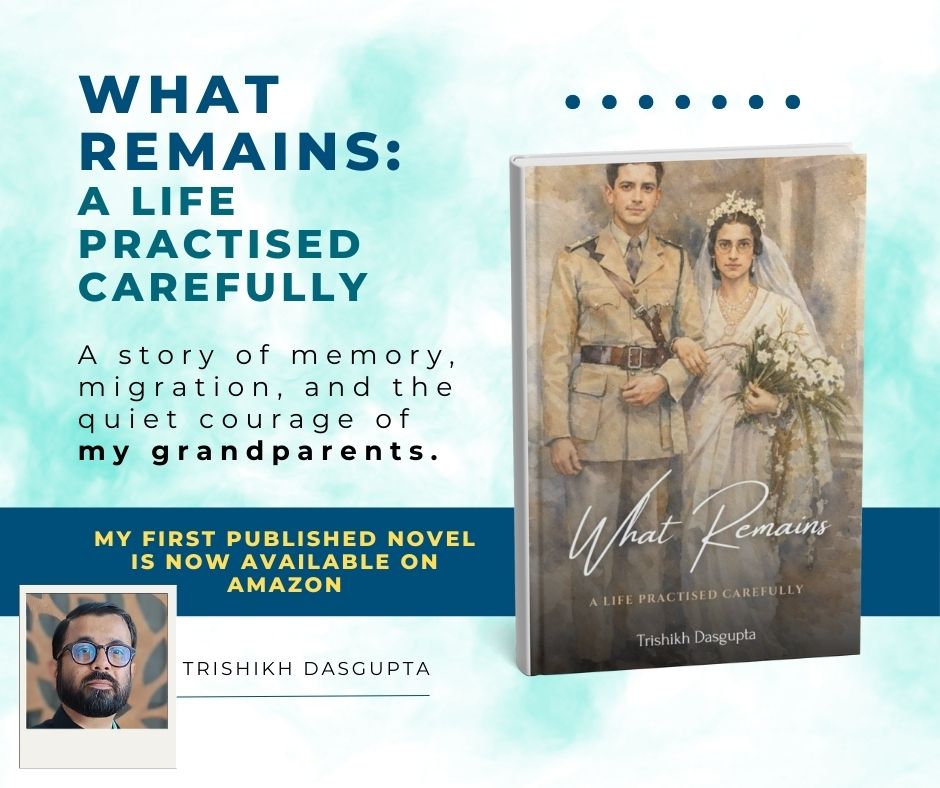
You may also like to read my1st Published novel now available on Kindle and Paperback versions.


How you do it I don’t know? the imagery in this was second to none, loved the story of the memorial and what it meant to people.. great story. and well done lieutenant Harding.
LikeLiked by 1 person
Dear William, thannk you for beingg the firsst one to comment. The first comment to any story is always so special. You are too kind with your appreciation, but I accept it humbly with a smile and lots of joy. Yes, for this story, the imagery was very important to me. I wanted to show the Victoria Memorial Hall in a very different light and shade that what we the people of Kolkata and the visiitors to the city are used to seeing it in.
LikeLiked by 1 person
well personally I thought I was there.. Good job..
LikeLiked by 1 person
That is so nice of you to say.
LikeLike
Thanks for another engaging story. Your stories make history interesting and bring it to life.
LikeLiked by 1 person
Thank you so much for appreciating, and liking the way I portray history along with a bit of fiction.
LikeLiked by 1 person
You’re most welcome.
LikeLiked by 1 person
This is an absolutely masterful and hauntingly beautiful piece of historical fiction — a rare blend of literary elegance, emotional depth, and historical truth. 🌧️🏛️
“Mṛtyu — The Shadow of the Golden Dream” was profound — but this story, set against the Bengal famine and the fading grandeur of empire, reaches an even deeper resonance. It is history illuminated through human eyes — the soldier and the relief worker, the conqueror and the conscience — meeting not in conflict but in understanding.
From the opening line, the imagery grips you:
“The monsoon-misted dusk of September 1943 softened the edges of Victoria Memorial’s white marble dome.”
This sentence alone sets a cinematic tone — mist, marble, memory — and it never lets go.
The Victoria Memorial itself becomes a living symbol throughout: first a monument of imperial pride, later a mute witness to hunger and human suffering. Dasgupta’s ability to make architecture breathe and feel — the black-painted dome, the bronze angel veiled in wartime gloom — is breathtaking. Every detail, from the scent of wet grass to the drone of aircraft, evokes the era vividly.
LikeLiked by 3 people
Dear Verma’ji, as always, I could not have done a better job in reviewing my story to the depth with which you have done it. Your analysis is bang on. Thank you for always enjoying my stories to such emotional depths. Through admirers such as you, my stories finds much of their meaning.
LikeLiked by 2 people
This story moved me deeply. The way you’ve captured the atmosphere of Calcutta during 1943 — the rain, the marble of the Victoria Memorial, the fear of war, and the quiet strength of ordinary people — is extraordinary.
Edward and Nandita’s dialogue beautifully bridges the divide between empire and humanity. The historical detail, emotional depth, and poetic language make this piece unforgettable.
Thank you for reminding us that even monuments of power can become monuments of memory and conscience. Truly haunting and powerful writing.
LikeLiked by 1 person
Dear friend, I am so happy that my stories appeal to you to such great depths. I really appreciate your appreciation for my stories. I have been enjoying and treasuring your comments. The historical details, emotions, sights, sounds, and smell are integral parts of this story. So happy that they resonate with you so well.
LikeLike
🙏
Aum Shanti
LikeLiked by 1 person
Thank you for always liking my stories.
LikeLiked by 1 person
Thank you, Trishikh, for the beautifully written history lesson from the time of World War II. Your talented mixture of philosophy, nostalgia and the message left for the present, young generation, will be remembered for a long time.
Joanna
LikeLiked by 1 person
Dear Joanna, am really happy that you liked my latest story so much. Yes, it is indeed a mixture of philosophy and nostalgia. I am elated too, seeing the way the story came out.
My humble prayer is for the future generations to enjoy my stories.
LikeLike
Thank you so much, Trishikh, for the beautiful reply! I have no doubt that your talented writing will be remembered.
Joanna
LikeLiked by 1 person
Thank you Joanna. May your words come true.
LikeLike
Amen!
Joanna
LikeLiked by 1 person
You do such a wonderful job of bringing history to life.
LikeLiked by 1 person
Thank you so much. I am humbly honoured to receive your compliment. I just pray to God that he keeps on blessing me with this gift.
LikeLiked by 1 person
Another fascinating tale.. you write so beautifully.. Thank you.. Fiona ❤️
LikeLiked by 1 person
Dear Fiona, I always look forward to your beautiful words of encouragement. I am so glad that you liked this story so much. Thank you for your constant support.
LikeLiked by 1 person
A hauntingly beautiful work of historical fiction — elegant, emotional, and profoundly human. Set amid the Bengal famine and the fading empire, the story transforms history into empathy, where the soldier and the relief worker, the conqueror and the conscience, meet in understanding. From the opening line —
“The monsoon-misted dusk of September 1943 softened the edges of Victoria Memorial’s white marble dome.” — the imagery captivates. The Victoria Memorial becomes a living symbol, shifting from imperial pride to silent witness of suffering. Your post makes stone breathe and history ache — a masterpiece of mood and memory.
LikeLiked by 3 people
Dear Indrajit, your words bring tears of joy to my eyes. It gives me a great sense of accomplishment as a dedicated short story writer. I am so happy that you liked the story so much. Thank you from the bottom of my heart.
LikeLiked by 2 people
Nice, it looks like this one has a touch of romantic atmosphere in it. I will enjoy reading this.
LikeLiked by 1 person
Well, you have to read to find out…😜
LikeLiked by 1 person
😆 Can’t wait
LikeLiked by 1 person
Always a pleasure to hear from you. Do read conveniently, I am sure that you would love the story. But I do not want to keep you in a false suspense, the story is not romantic.
LikeLiked by 1 person
It is alright my friend. Your stories are like gems. They are wonderful to behold. 🙏
LikeLiked by 1 person
Thank you so much. I am really happy that my stories appeal to you so much.
LikeLiked by 1 person
🙏
LikeLiked by 1 person
Your pieces are SO descriptive. I love that. I feel completely immersed in your stories! I’m in awe of amazing storytelling. Well done!
LikeLiked by 1 person
Thank you so much. So happy that you enjoy the vivid descriptions in my stories. I strongly believe that great imagery has the power to bring a story to life.
LikeLike
Thank you Ned for sharing my story in your blog. I always treasure your friendship and support.
LikeLike
Lovely story Trishikh. I wonder who will tell the stories of refugees world wide, survivors of genocides and corrupt policies and wars?
LikeLiked by 1 person
Dear Katelon, I believe that truth will always surface. It may take some time but eventually it always does. Those who are at the forefront of whistleblowing, I salute them and admire their courage and commitment. They are instruments of God revealing the truth in His time. And my sincere appreciation to people like me and you who tell these stories for future generations. With the exponential and constant growth in communications, truth now and in the future will certainly be revealed much faster.
LikeLike
Once again your story has put its finger on the pulse of human history, you show the valuebility of understanding the developments in societies as being of the greatest necessity. The understanding of history, gives us comfort and feeling that there are some familiar elements in changing the world and that there is hope that changes can occur. Historical knowledge gives us a chance of responding sensibly to problems should they arise and good judgement about human behaviour is badly needed today.
LikeLiked by 1 person
I really like it when you say, “Historical knowledge gives us a chance of responding sensibly to problems should they arise and good judgement about human behaviour is badly needed today.” This is such an apt message for us and the future generations. Those who have developed a habit of learning from observing and hearing, rather than experiencing will create lesser chaos. However those who learn from experience, and by commiting the mistakes themselves, will creater a lot of mess and perhaps will emerge as better forged people. It seems like not learning from our past and making the same mistakes is a very integral part of human nature.
LikeLiked by 1 person
Your writing is so immersive—it leaves me with the scent of wet grass and a sense of history. It’s great to read your wonderful writing again. 🌺
LikeLiked by 1 person
Thank you so much, I think you have missed many of my stories, as I had taken a break of nearly a year. From July 2025, I have been writing and publishing one story every Friday. Do read some of the ones that you have missed. I am sure that you would love them. And as always thank you so much for your appreciation and support.
LikeLike
Thank you for another wonderfully written, detailed story and for all your visits to my blog. I must have read all your stories so I’m obviously waiting for more. No pressure, or anything. In the meantime I will read many again.
LikeLiked by 1 person
Yes, I really treasure your visit to my website, the many likes and comments that you make. I am so happy that you enjoy my stories. And it is my pleasure to visit your site and like your posts and comments as well.
LikeLike
What a powerful story you have written. Thank you for your insights.
LikeLiked by 1 person
You are most welcome. Nothing gives me greater joy than when someone enjoys one of my stories and smiles.
LikeLike
As I read the story, you morphed into Nandita and I, the readers into Edward! To me the reference to the marble more than once in the text emphasised the similarities between the Victoria Memorial and the Taj Mahal in more ways than one. The choice of your title is impeccable!
LikeLiked by 1 person
Dear Kajoli, I am so happy that the story touched your senses to such deep levels. The Victoria Memorial Hall was actually also referred to as the “Taj of the Raj” it’s a name coined long before I was born, I simply used it for my story. But as you correctly say, it is indeed a very appropriate title.
LikeLike
My ignorance. I was not aware that Victoria Memorial had been referred to as the Taj of the Raj. I have not seen and experienced it the way you have. But, yes, mausoleum indeed! Thank you for pointing it out.
LikeLiked by 1 person
Oh, I also did not know it before I started to research to write this story a week back.
When I decide to write a story on a certain subject, I start to research about it a lot, that is when I come to know many things, about which I too previously knew nothing.
LikeLiked by 1 person
Love your stories.
LikeLiked by 1 person
Thank you so much Rupali.
LikeLike
What a beautiful writing! The atmosphere, imagery, setting and all the tiny details everything felt so perfect as I’m reading this in this rainy evening. Vivid descriptions of World War II and the British Empire. Going to read more of your stories.
LikeLiked by 1 person
Dear Raisa, it is always such a great reward to receive appreciation. I am so happy that you liked the story, especially the imagery. Yes, certainly read more of my stories, I am sure that you would love many of them.
LikeLiked by 1 person
Maybe this is creative nonfiction–putting characters and life to real events? Well done.
LikeLiked by 1 person
Dear Jacqui, certainly you can classify the story under the creative non-fiction category. I am so happy that you liked it.
LikeLiked by 1 person
A poignant reminder that it is the people who suffer, and the people who remain. Also reminds me of Shelley: “My name is Ozymandius, King of Kings: Look on my works, ye Mighty and despair!” No thing besides remains . . .
LikeLiked by 1 person
That is such a great piece of writing and philosophy by Shelley. Yes, it is all about people. Thank you for liking my story so much.
LikeLiked by 1 person
Beautiful story and history woven perfectly as always. Enjoyed all the details and it took me back to the era. You are a master storyteller of historical fiction. Loved it.
LikeLiked by 1 person
Dear Savitha, you have bestowed me with a great title “Master Storyteller of Historical Fiction.” I really liked the sound of it. The more people enjoy my stories in the present times and the future to come, will give meaning to my writing and these stories.
LikeLike
Dear Trishikh, your storytelling is a rare gift. Each piece unfolds with elegance, insight, and emotion, drawing readers deeply into your world. It’s no surprise that your work is receiving such heartfelt acclaim. 🌟
LikeLiked by 1 person
Thank you so much for your beautiful words. It brings tears of joy to my eyes, and a sense of great accomplishment. Above all, knowing that I am able to spread a bit of literary joy in this world, gives the greatest pleasure.
LikeLike
That’s wonderful to hear, dear Trishikh. It’s moving to see how your writing touches people so deeply. Please, keep sharing your stories — the world needs voices like yours. ✨
LikeLiked by 1 person
I shall do my best. Thank you so much.
LikeLiked by 1 person
Very powerful writing. I felt as if I was there.
LikeLiked by 1 person
Thank you so much. If the words in my story were able to transcend you to the time and place, then my work has succeeded.
LikeLike
A poignant story indeed, not only bringing a long hidden story to light, but a reminder this was truly a world war, scenes far from the familiar devastation in Europe.
LikeLiked by 1 person
Yes that is so true, the World war did have a global effect, and we really know so little about how it affected different regions.
LikeLike
Fascinating read
LikeLiked by 1 person
Thank you so glad that you liked the story.
LikeLike
A brilliant story!
LikeLiked by 1 person
Thank you so much.
LikeLiked by 1 person
Waah … kya baat hai this was my reaction after reading it. A masterpiece everytime delivered to perfection. Kolkata is rich as it has gems like you.
How beautifully you made us realise the moment of moral awakening and quiet resistance illustrated during the colonial policy, during that devastating famine… and there … there you used such a magnificent backdrop-The grand imperial monument🙌
My goodness … what an impressive imagination.
My best moment (this I will share every time, from now): The sight of suffering and Nandita’s challenge -“ask whose empire is it now?” If at all it would have been a movie of 80/90’s (सिक्के उड़ गए होते theatre में)
That moment when everything hits deep it was that moment!!!
Superb 👌
LikeLiked by 2 people
Dear Aparna, I am simply overwhelmed with your appreciation. Yes, the story has indeed come out to much of my satisfaction.
I have always been thinking about this line, “ask whose empire is it now,” in relation to colonisation and forceful occupation. Am glad to use the line finally in this story.
And who knows, maybe someday someone would make a movie out of one of my stories. That would really be something great to see.
Currently I am exploring the possibility of printing my stories. I am yet to get a good publisher, who would see some potential in my stories.
LikeLiked by 1 person
Let me search them out for you … once you publish them I want a copy with a favourite line from one of your stories and everything exclusively written on the first page with your sign..
that’s my humble request 🙏🥰
LikeLiked by 2 people
Oh, that is nice of you to say. It would be a great help if you would identify such a publisher, who would be interested in publishing a book of my short stories.
Of course, it would be my honour to sign a special message copy for you.
LikeLiked by 2 people
Done deal!!! I will have a word with some of my friends who are into publishing houses(but not sure of the profile and rest) and let you know.
LikeLiked by 1 person
Sounds good, let’s hope for the best. If things work out, it would be a great help to me, and a dream come true.
LikeLike
I m sure you must be having some of the best… I m still a novice.. apologies if the publisher searching was out of line .
With deep regards and love to a writer we(me and my daughter) cherish
LikeLiked by 1 person
I treasure your help and cherish you and your daughter’s admiration for my stories.
LikeLike
One for me too. 🙏
LikeLiked by 2 people
Oh, that would be so nice.
LikeLiked by 1 person
😊💕
LikeLiked by 1 person
Is it… are you planning to get something published…
LikeLiked by 2 people
Well I want to publish a collection of my short stories. Have been looking for a publisher who would value my kind of writing. Let’s see the search is on.
LikeLiked by 1 person
Yea!!! I had a word … I will be updating you the details asap.
LikeLiked by 1 person
Just send me a hi email at trishikh@gmail.com we can have the conversation on email.
LikeLiked by 1 person
Duly noted. I continue to wish you the very best and certainly rooting for you. I anticipate being in touch soon with an update regarding good news.
Regards
LikeLiked by 1 person
No pressure. Take your time. Not an issue if things don’t work out, ultimately it will. In the meanwhile keep on enjoying my stories.
There are many old stories, some of which you might have not read. Do read them when you get the time. I am sure that you would love them.
LikeLiked by 1 person
I know … you are seasoned with emotions and things as well.
I m trying to do my bit … rest lies in divine hands😇🫶🏻 I m planning to 🌷
LikeLiked by 1 person
Sounds great.
LikeLike
I want to but delaying it till infinity. I have written some children’s stories which I will publish some day. Children now-a-days are addicted to smartphones and are not inclined towards reading as they never got into the habit of reading as we did.
LikeLiked by 2 people
That is my whole point in writing short stories. I want the next generation and children to develop the habit of reading. Let’s see how much our generation is able to pass on this habit to the next.
LikeLiked by 1 person
Somehow we have got to admit that time has grown wings that fly even faster than before. I don’t blame the kids either their days are much shorter than ours.
LikeLiked by 1 person
Yes, that is right. We cannot blame the kids. It is the tide of evolution. And with the waves comes many changes, some acceptable to older generations and some not. Some beneficial and some harmful, but one thing I am hopeful for is that evolution will ultimately create better humans. Though this may currently seem not happening, but I am very hopeful that it will.
LikeLiked by 1 person
Yes, it is positive thinking that will make positive changes. For as we think so we do.
LikeLiked by 1 person
Get a Kindle edition published… maybe!
LikeLiked by 2 people
Yes, I would do so. 😊💕
LikeLiked by 2 people
Don’t forget to send me the specifics!
LikeLiked by 2 people
What a wonderful story– Great imagery with every significant detail. I truly believe, it’s a fit script for an Art movie.
As always, I feel happy to read your story as a reader.
Thank you and keep it up.
LikeLiked by 2 people
Dear Chitrangada, it’s always such a pleasure to receive your comment. I really treasure your appreciation. So happy that the imagery appealed to you so much. It would indeed be great if one of my stories were ever made into a movie.
LikeLiked by 1 person
Thanks for writing this story Trishik, history hides so much from the common eye. It’s writers like you that paint the picture as it really was. The words floated like petals. Loved the read.
LikeLiked by 1 person
Dear Sumita, you are absolutely right. There is so little we know about the things around us. I have been born and brought up in Kolkata, and did not know much about the Victoria Memorial Hall, before I decided to research on it and write this short story.
So glad that you like my choice of words.
LikeLiked by 1 person
Looking forward to your next story.
LikeLiked by 1 person
Ya, I have nearly finished my next story. Polishing it and getting the facts right. Will release it on Friday as usual.
LikeLike
I have spent many evenings on the lawns of Victoria Memorial, but happy to learn a new perspective in a perfectly crafted story of Edward and Miss Nandita Bannerjee against the backdrop of the great famine. The historical touch with emotional touch and amazing imagery make the story more powerful. A wonderful job, Trishikh!
LikeLiked by 1 person
Dear KK, I too love to visit the Victoria Memorial Hall a lot. During my school and college days, I used to play and exercise a lot in Maidan, then I used to frequent Victoria as well. Always wanted to write a story on it. Finally I could.
Thank you for your lovely comment. I really enjoy your appreciation.
LikeLiked by 1 person
It’s truly my pleasure, Trishikh. Most welcome!
LikeLiked by 1 person
Your story touched me deeply, Trishikh. There are so many things unknown to us because certain forces don’t want them to be known. It is all the more important that these stories are written, and what could be better than them being written by an accomplished writer like you, it gives them even more poignancy.
LikeLiked by 2 people
You are absolutely right, the world needs to know about these things, struggles and challenges faced by so many go unnoticed and unheard. I am glad that through my stories, at least some of these things can come to the knowledge of others.
Thank you for your heartfelt comment. Am so glad that the story touched your heart.
LikeLiked by 1 person
We were in there in January 2023. There is something different in Kolkata. We went on a walking tour and our guide Amitava was very good. Your story is very good.
LikeLiked by 1 person
Thank you Lakshmi for liking the story so much. Glad that you had a chance to see the Memorial in person.
LikeLiked by 1 person
I was hypnotised by the Memorial when I visited it. At the backdrop of its majestic facade you have brought to light another picture of war hungry imperialists, the famine ridden populace, the massive disaster in terms of tangible and intangible assets and the shocking death of humanity. The memorial as a beacon of history is admired by many but who will write the real saga of the masses who sold their precious everything for a fistful of rice ? You have raised a pointed and poignant question which will remain as a reminder to all that history is just not about kings, castles, memorials, victories, dominance and defeat it’s about the people – you and me – who wage silent battles day in and day out , sometimes win them and most times fail themselves and yet rise again the next day to wage another war and one final day die a silent death. Who will embed those myriad mundane stories in the annals of history?
LikeLiked by 1 person
Your deeply felt comment on my story gives me great joy. You have correctly identified the core theme of the story, that is the struggles of the common person, surpasses beyond everything else, all the empires, glories, monuments, no matter for reason they may have been made, but over time they actually become custodians of the story of the common man.
LikeLiked by 1 person
Absolutely correct 💯
LikeLiked by 1 person
Got to know about Victoria Memorial Hall, not the one we are used to seeing, but the one during World War II. Thanks for writing such a wonderful tale.
LikeLiked by 1 person
Thank you Anamika. Always a pleasure to be able to share a little bit of history about our beloved city.
LikeLike
What a way to remind us of the history we hardly try to know … wonderful imagery.. amazing story
LikeLiked by 1 person
Dear Piyush, thank you so much for liking this story. So glad that you like the way and light in which I presented the story.
LikeLike
Your story reflects a piece of history, making it more interesting to read!
LikeLiked by 1 person
Thank you so much. Always a pleasure to receive appreciation. It gives me great joy when someone enjoys one of my stories.
LikeLike
Your storytelling here feels like a quiet lantern carried through a storm—gentle, illuminating, and deeply human. The way you weave atmosphere, memory, and emotion into each scene is breathtaking. Reading this piece feels like standing in the rain-washed gardens of the Victoria Memorial myself, sensing the tremor of history beneath the stone. Thank you for gifting us not just a story, but an experience that lingers like a soft echo in the heart.
What struck me, beyond the interplay of empire and empathy, is how the Memorial itself becomes a metaphor for selective remembrance—its blackened dome hiding in darkness much like the suppressed accounts of suffering. Yet perhaps the most overlooked element is the silence inside the building: the muted halls, the shuttered galleries, the dimmed murals. That silence mirrors an entire nation holding its breath, waiting for its own story to finally be heard. And in your narrative, that silence is gently broken—allowing both the monument and the people it once overshadowed to reclaim their voice.
LikeLiked by 3 people
Dear Livora, your words arrive like a soft monsoon breeze, cooling, and deeply kind. I’m truly moved that the story touched you this way. You’ve beautifully caught what I hoped would shimmer beneath the narrative: that the Memorial isn’t just marble and memory, but also the long silence of a people waiting to be heard.
If my little lantern managed to light even a tiny corner of someone’s mind, then the journey through those rain-washed gardens was worth every step. Thank you for reading with such tenderness, and for letting the echoes linger.
LikeLiked by 1 person
Thank you so much for your beautiful words. I’m deeply touched by the care and depth in your storytelling, and I’m grateful to have experienced even a small part of the journey through your narrative. 🌿✨
LikeLiked by 1 person
Dear Livora, the pleasure is equally mine.
LikeLiked by 1 person
Such a vivid and empathetic imaging of a time from the past that touches all the senses.
LikeLiked by 1 person
Thank you so much for these kind words. I’m really glad the story could awaken the senses and offer a small glimpse into the world that once breathed. It’s always a joy when a reader feels the textures, sounds, and silences of that forgotten time. Your appreciation means a lot.
LikeLiked by 1 person
It was my pleasure. Your words make it possible for the reader to see, hear, smell and feel the “world that once breathed.” It’s a gift and your efforts in using that gift.
LikeLiked by 2 people
Thank you so much.
LikeLike
Well written and engaging. A pleasure to read from start to finish.
LikeLiked by 2 people
Thank you.
LikeLike