The dawn fog of 1850 clung to the Imphal valley like a half-remembered dream when Lieutenant Joseph Ford Sherer first heard the thunder of hooves. It came faint at first, like a heartbeat rising through the mist, then nearer, stronger, until the ground itself seemed to breathe beneath him. He drew rein, his mare snorting at the scent of wet grass, and turned his ear to the east.
There it was again, the rolling percussion of hooves in full gallop. Sherer’s pulse leapt. He was young then, long before the stars of rank found his shoulders, a man whose life had been measured by the cadence of horses. That morning, amid the chill mist of Manipur, he felt something ancient stirring, as if the valley itself was calling through the hooves of its children.
“Robert,” he called softly to his companion, Captain Robert Stewart, who followed a few yards behind. “Do you hear that?” Stewart nodded, squinting through the vapour. “Sounds like a charge.” “Or a song,” Sherer murmured, spurring forward.
They rode down toward the plain, and what met their eyes was unlike anything either had seen in all their years of soldiering. A cluster of riders – barefoot, bare-headed, clad in bright sashes – thundered across the meadow on small, sturdy ponies. Each man wielded a long bamboo stick curved at one end; in the blur of motion, the sticks rose and fell, striking something that flew low across the field like a bolt of lightning.
The air smelled of crushed grass and pony sweat, of river mud and wood smoke. Women watched from the slopes, their voices carried by the wind. Children ran along the edges, shouting names. The valley was alive – not with war, but with rhythm.
The two British officers dismounted and stood, spellbound. The riders turned, charged, scattered, and formed again, their ponies nimble as shadows. Seven men to a side, Sherer counted, fascinated. The ball skittered past his boots once, light as a seedpod.
When the game ended, one of the older Manipuri riders approached, his face lined like the hills. Sherer, through a local interpreter, asked, “What is this you play?” The old man smiled, teeth gleaming in the sun now breaking through the fog. “It is called Sagol Kangjei,” he said. “The Game of the Pony. We play to honour our gods, to test our courage, and to keep our hearts light.” Sherer knelt beside one of the ponies – compact, fine-boned, eyes bright as amber, and stroked its neck. “And these magnificent creatures?” “Our Manipuri ponies. They know no fear.”
That evening, under a flame-lit sky, the villagers held a small feast. Sherer and Stewart sat cross-legged beside the elders, eating rice and smoked fish while songs drifted over the reflective river. The riders showed them their mallets, carved from local cane; the ball, made of bamboo root, still warm from the day’s play.
Sherer turned it over in his hands, awed. “There is something here, Robert, something we mustn’t lose.” Stewart nodded. “We should carry it with us. Let others see what we’ve seen.” Sherer’s eyes glimmered. “Not as curiosity, but as a game of men and horses. A brotherhood born of speed and skill.” And in that quiet moment, the decision was made.
Months later, the valley was behind them, but its echoes travelled with them through the humid nights of Cachar, down the winding roads of Bengal, until at last the wide plains of Calcutta opened before them.
The city was a living organism, sweating, fragrant, and chaotic. The smell of jute and molasses in the air, carriages and bells, rattling, and clanging, and the Hooghly breathing against the banks. Within its European quarter, the Maidan stretched like a sea in green. Cavalry horses drilled there by morning, cricket balls flew by afternoon, and in the twilight, the Empire itself seemed to pause and listen.
Sherer could not shake the memory of that valley. The sound of fourteen ponies galloping in unison haunted his dreams. He began telling his fellow officers about it over whisky and pipe smoke. “A game on horseback,” he’d say, “played with sticks and a ball. It teaches more about courage and control than any parade.”
Most laughed. “Native playthings,” one sneered. “We have hunting, races, and cricket. What need have we for pony games?” But Sherer’s conviction burned steadily. Stewart joined him, lending weight and vision. Together, they persuaded their regiment to finally witness a demonstration.
They borrowed a few Manipuri ponies from traders, fashioned mallets from cane, and marked a rough field on the Maidan. When the first strike echoed through the humid air, heads turned. By the end of the exhibition, what began as curiosity had turned to admiration. The rhythm of hooves and mallets had bewitched the Empire’s soldiers.
As the idea spread, Sherer began digging into history. Late at night, in his barracks near Fort William, by the flicker of an oil lamp, he read what he could find of a far older game. A sport that had once thundered across the plains of Persia. It was called Chogān then, the royal game of kings and cavalry, when it was more of a miniature battle than a sport, used for cavalry training, with matches sometimes involving as many as 100 riders per side. In ancient Iran, centuries before Christ, riders had struck wooden balls with long-handled sticks to train their horses for war. Shahs and princes played before crowds of courtiers.
From Persia, the game journeyed eastward, through the courts of Byzantium and the sands of Arabia, across the Turkic steppes, and into the palatial gardens of India, where Mughal emperors kept manicured fields beside their marble halls for nobles to display skill and daring. Yet the echo of hooves did not stop there; it rode further still along the ancient arteries of the Silk Road until it reached the celestial capital of Chang’an in Tang-dynasty China. There, amid moon-white pavilions and fragrant courtyards, the game took root with an elegance all its own. It was not only the nobles and generals who played; even women of the imperial court joined in, donning the riding garb of men to master the gallop. Terracotta figures unearthed from Tang tombs still bear witness to their grace – women astride ponies, mallets poised mid-swing, their laughter caught forever in clay.
Sherer traced the lineage in wonder: from the royal gardens of Isfahan to the mist-drenched valleys of Manipur, where the game had survived not in palaces, but in hearts. It was as if the spirit of Chogān had wandered the world for centuries, waiting for the right hands to guide it home again. That realisation filled the Lieutenant with purpose.
By 1861, he and Stewart were ready. They petitioned the local command for permission to formalise the game and to form a club devoted to the sport of horse and mallet. They set to work like men possessed. Sherer drafted the first rulebook – neat handwriting on thick paper: Each side shall consist of four players, not seven as the Manipuri version; each chukker or round eight minutes; field three hundred yards long; goal posts eight yards apart. Stewart oversaw the ponies – their feeding, training, and care. They hired grooms, laid the turf, and painted the goal lines. The Maidan, once a casual grazing ground, began to shimmer with anticipation.
On the morning of the inaugural match, a warm wind blew off the river. The field smelled of cut grass and damp earth. Officers arrived in carriages, their wives in muslin dresses beneath parasols. Children perched on fences. The ponies pawed the ground, restless. Sherer felt his chest tighten with the same thrill he had felt that morning in the valley more than a decade ago.
The ball was placed in the centre. A hush fell. Sherer raised his mallet. The bamboo glinted in sunlight and struck. The ball soared forward like a comet. Hooves followed. The field erupted in motion. Sherer leaned low, wind cutting through his hair, Stewart galloping beside him. The mallets clicked, ponies surged, and suddenly the Maidan was no longer Calcutta; it was Imphal reborn. The cries of soldiers became the shouts of Manipuri villagers, and for an instant the centuries folded into one another: Persia’s kings, India’s riders, Britain’s cavalry – all joined in a single, pounding rhythm.
When the final whistle blew, dust hung in golden light. Applause broke out, hats were tossed, and voices cheered. Sherer reined in, laughing, heart hammering. Stewart reached over and clapped his shoulder. “You’ve done it, Joe. You’ve brought the valley to the plains.” Sherer smiled. “No, Robert. The valley brought itself. We only listened.” In 1862, thus, the modern version of the game of ‘Polo’ or ‘pulu’ (meaning ‘ball’ in the Tibetan Balti language) was born through the inception of the Calcutta Polo Club, the first of its kind in the world, still operational today. It was achieved through the vision, initiative, and hard work of Captain Robert Stewart and Major General Joe Sherer, the father of modern Polo.
Years later, when the Calcutta Polo Club had become legend, when word of the sport galloped from India to England, to Malta, to Argentina, the two men returned once more to Manipur. The journey took weeks. The same mist rolled down the slopes, the same ponies still ran, their manes catching the morning light. Yet as Sherer stood upon that sacred ground, he felt the weight of centuries pressing through the soil beneath his boots.
For this valley had always known the song of hooves. Long before the Empire, long before even memory, kings had played here, their contests recorded in Cheitharol Kumbaba, the royal chronicle dating back to 33 AD. The Imphal Polo Ground, the oldest in the world, had witnessed the dance of horse and rider for nearly two thousand years, the breath of ancient monarchs still whispering in its dust.
An old rider recognised them, his hair now white. “Ah, the Sahibs who played with us!” he laughed. “Your game has gone far, I hear.” Sherer dismounted, ankle in mud, hand upon a pony’s neck. “Far,” he said softly, “but never away.” The game began again before them, seven riders per side, just as before. Sherer closed his eyes. The hooves thundered once more across the heart of the valley, echoing through time. When he opened them, the mist had lifted, and he felt the world itself galloping. From Persia’s plains to Manipur’s meadows to the Maidan’s emerald stretch. Bound together by rhythm, courage, and the eternal language of horse and man. And thus, in the valley of thundering hooves, the game of kings was born again.
And today, if you happen to be in the post-colonial, nostalgic city of Kolkata, and pass by the Calcutta Polo Club on Chowringhee Road, near the hallowed sweep of the Maidan and the looming grandeur of the Victoria Memorial Hall, remember: you are looking at something you will find nowhere else. The world’s oldest still-operational polo club, a portal from the mist-washed valleys of Manipur to the global arenas of the tycoons and millionaires, of nouveau royals. And as you stand on its turf, feeling the whisper of hoof-beats in the soil, know that the city of joy, this glorious, chaotic, and tender Kolkata, rebirthed, nurtured, and gave the world the present version of the game, holding its pulse even today.
Copyright © 2025 TRISHIKH DASGUPTA
This work of fiction, written by Trishikh Dasgupta is the author’s sole intellectual property. Some characters, incidents, places, and facts may be real while some fictitious. All rights are reserved. No part of this story may be reproduced, distributed, or transmitted in any form or by any means, including printing, photocopying, recording, or other electronic or mechanical methods, without the prior written permission of the author, except in the case of brief quotations embodied in critical reviews and certain other noncommercial uses permitted by copyright law. For permission requests, send an email to the author at trishikh@gmail.com or get in touch with Trishikh on the CONTACT page of this website.
ABOUT THE AUTHOR
Trishikh Dasgupta
Adventurer, philosopher, writer, painter, photographer, craftsman, innovator, or just a momentary speck in the universe flickering to leave behind a footprint on the sands of time... READ MORE
These stories are Free and if you have found something here that stayed with you, some of my other books are now available in print and digital editions. They gather longer journeys, quieter questions, and stories that continue beyond this page.
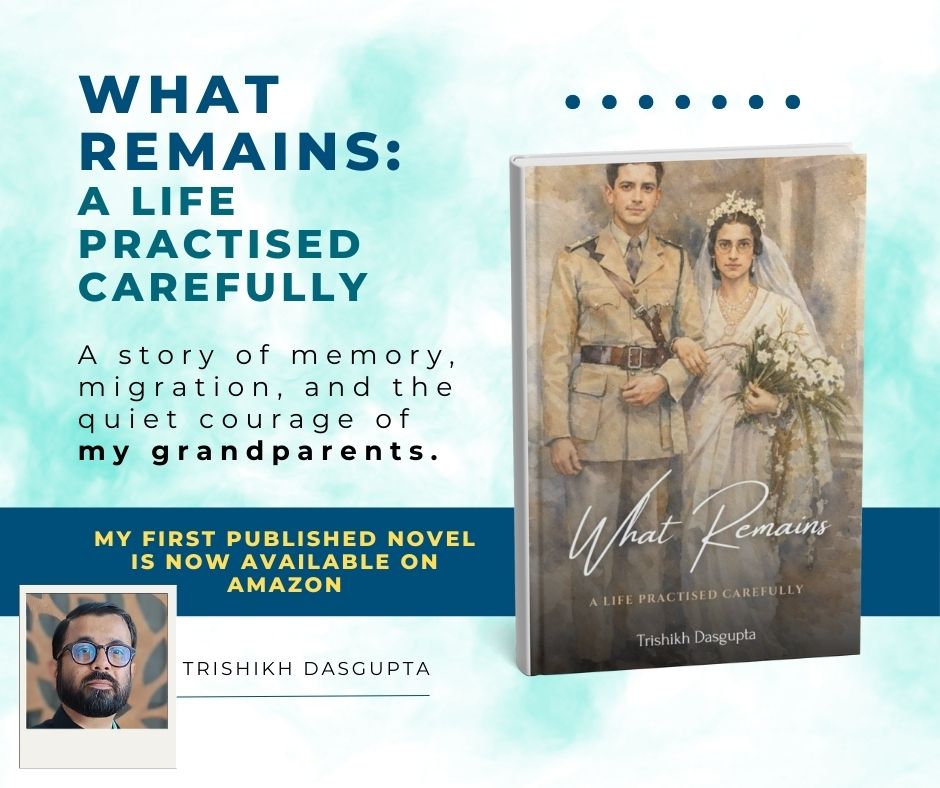
You may also like to read my1st Published novel now available on Kindle and Paperback versions.
 Weekend Stories by Trishikh
That was like reading a movie script, but your interpretation was better, what a fascinating story..
LikeLiked by 5 people
Dear William, thank you so much for liking the story and being the first person to comment. So glad that the story felt like a movie to you. There could be no better reward than when someone really enjoys one of my stories. Have a great weekend.
LikeLiked by 2 people
I love all your stories but this one was special, same to you friend.
LikeLiked by 4 people
Dear William, thank you so much. I always look forward to writing and sharing a good story.
LikeLiked by 1 person
Thank you Ned for liking my story and sharing it on your website. I always treasure your support.
LikeLike
Wow
LikeLiked by 2 people
Thank you so much.
LikeLike
I can’t believe this is fiction. It’s amazing. It reads as if it were real. But the pony game is real right?
LikeLiked by 1 person
Dear Friend, you can call it fictionised history. Most of the facts are true. Only how the British officers were introduced to the game is fictionised, but they did go to Manipur and learn about the game and then brought it to Kolkata, formed the club, and introduced modern polo to the world.
The Calcutta Polo club is the first and oldest in the world. The Manipur Polo grounds is the oldest Polo grounds in the world. All the historical facts about the game are also true.
Since, I write these short stories with situations and factual references, so I categorise them under fiction, just to be on the safe side. In truth most of my stories are actual facts, that I finctionise a bit here and there to make the reading more interesting.
LikeLiked by 2 people
You do it so masterfully
LikeLiked by 2 people
Thank you so much. Appreciation works wonders for my writing engine.
LikeLiked by 1 person
This was so good I have to say it is my favorite so far
LikeLiked by 2 people
That is so nice to hear.
LikeLiked by 1 person
🙏
LikeLiked by 1 person
Amazing short fiction! I never knew that was where Polo came from.
I see them playing in Del Mar, only maybe a mile east of the fairgrounds.
The thundering hooves can be heard across this valley as well.
Thank you for this beautifully described story.
LikeLiked by 4 people
Thank you so much. Nothing can give me better joy than when someone can relate to be one of my stories. You can call it a fictionised history.
I too did not know much about Polo or its history, or the fact that it was reborn in my very own city, where I was born. Came to know about all this, when I started researching to write this story.
LikeLike
This is an extraordinary piece of historical fiction — rich, immersive, and exquisitely crafted. 🌿✨ You have not merely written a story;, you have brought history to life with a painter’s precision and a poet’s heart. The narrative flows like a cinematic journey through time — from the mist-veiled valleys of Manipur to the bustling Maidan of colonial Calcutta — capturing both the pulse of the land and the spirit of the people who gave birth to modern polo.
Every line breathes with sensory detail — the scent of wet grass, the rhythm of hooves, the echo of courage across centuries. The dialogue between Sherer and Stewart feels authentic and human, while the historical depth grounds the story in truth and reverence. The seamless weaving of legend, legacy, and emotion elevates this from mere storytelling to literary heritage.
LikeLiked by 3 people
Dear Verma’ji, as always your deep and thoughtful analysis of my story leaves me speechless. So glad that you feel my story felt like a cinematic journey and a “literary heritage.” I have come to love writing these historical fictions to bring to light the many stories of india.
Right now I am looking for a good publisher who would be ready to publish a collection of my short stories. Let’s hope for the best and pray that I get a publisher soon. To see book of my collection of short stories woulld be a long desired dream come true.
LikeLiked by 2 people
Your words truly warm my heart. 🌸
It’s a joy to know that my reflections resonated with you. Your writing carries the depth and authenticity of lived history — every story you create brings forgotten voices and moments of India’s past vividly to life.
I have no doubt that your collection of short stories will find its rightful place in print soon. The sincerity, research, and emotional truth in your work deserve to reach a wider audience. ✨ Keep believing in your craft — your dream of seeing your stories in a published book is not far away. My heartfelt prayers and best wishes are always with you. 🙏
LikeLiked by 2 people
Dear Verma’ji, your blessings mean a lot to me. I admire you as a person who after experiencing life’s different phases transcended into a creative mode. By the will of God and through the love and blessings of the admirers of my work like you, I am sure that the book will be published.
LikeLiked by 2 people
Thank you very much for your kind words. It is truly inspiring to see how your dedication and creativity have flourished through life’s experiences.
I have no doubt that with your talent, perseverance, and the grace of God, your book will reach publication and touch many hearts. Wishing you continued success and fulfillment on this wonderful journey.
LikeLiked by 2 people
Thank you so much Verma’ji.
LikeLiked by 2 people
🙏
Aum Shanti
LikeLiked by 2 people
Thank you so much. I always treasure your blessings.
LikeLiked by 1 person
Nice story about how Polo came to Calcutta from the hills of Manipur.
LikeLiked by 2 people
Dear Indrajit, so glad that you liked the story. Yes, it is very interesting to know that the world famous game of Polo (the present and modern version) was born in Kolkata.
LikeLiked by 1 person
Thank you so much, Trishikh, for another brilliantly written history lesson of the fascinating beginning of the game of Polo, now played worldwide. As always, your words bring to life the centuries of events and places with all the sounds and smells of the big city, muddy fields and galloping horses. What next?
Joanna
LikeLiked by 1 person
Dear Joanna, thank you for liking this story of mine. I too did not know about the history of the game before writing this story. I am currently working on my next tale, will not reveal it, but would say that the hero of the story was born during a bombing in WWII in Coventry, England and still lives in Kolkata. It is a true story.
LikeLike
Thank you, Trishikh, for your intriguing reply! I am looking forward to next Friday!
Joanna
LikeLiked by 2 people
You are most welcome Joanna.
LikeLike
Thank you, Trishikh, and likewise!
Joanna
LikeLiked by 1 person
While reading,the ponies,the angrezi babus as in some bollywood movies,the ball, the game all came alive.
Nice historical story
LikeLiked by 2 people
Thank you so much. So glad that you enjoyed the story so much.
LikeLike
Lovely historical fiction – you literally architect your stories placing human emotion and endeavour at the core!
LikeLiked by 2 people
Thank you so much Kajoli. Glad that you find my story so emotionally connecting.
LikeLiked by 1 person
Beautiful story telling!
I feel amazed by your choice of words for the description of people, places, situations.
Thank you for the reference to Manipur, as I wasn’t aware of it.
Excellent work! Thank you for sharing.
LikeLiked by 3 people
Dear Chitrangada, much appreciate your beautiful comment. I am thankful to God for guiding me in my writing and providing me with the apt words.
LikeLiked by 1 person
Wonderful story that brought polo, history, and the excitement of riding to life.
LikeLiked by 2 people
Thank you so much. I treasure your appreciation.
LikeLiked by 1 person
I loved Satyajit Ray’s stories becaused they contained so much information, and love your stories for the same. Waiting to buy a collection of your stories at Kolkata Book Fair. 😊
LikeLiked by 2 people
Yes, I too believe in the power of knowledge, information, and wisdom in a good story.
May your words come true, and one day may there be a published book of mine at the Kolkata Book Fair.
LikeLike
And another entrancing tale.. thank you .. ❤️
LikeLiked by 2 people
Dear Fiona, thank you so much.
LikeLiked by 1 person
That was fascinating.
LikeLiked by 2 people
Thank you so much Jacqui. Always a treat to receive your appreciation.
LikeLiked by 1 person
Beautifully atmospheric—the imagery pulls you straight into the misty valley of 1850. The rhythm of the hooves feels almost mythical. 🌫️🐎✨
LikeLiked by 1 person
Thank you Satia, so happy that my story transported you to the Manipur hills and polo grounds of 1850.
LikeLike
Thank you for liking. 📖✨🙏 Please read this entirely and then comment. If you do this, it would be a great wealth for me. 💬🌟💖
LikeLiked by 1 person
It’s my pleasure to visit your blog as well.
LikeLike
Thank you for showcasing my story in your website.
LikeLike
In your story we are given the experience of thoughtfulness and sensitivity, here you are fusing many layers of life’s passions, enabling us readers to gain experiences for which any possibility would otherwise lacking in our own life.
Thank for relieving us readers of our ignorance about the game of Polo’s ancient historical roots.
LikeLiked by 2 people
Oh, I too did not know much about Polo before researching the story. So glad that you find such deep revelations from my stories. That is a big reward for me.
LikeLiked by 1 person
This story is fascinating – once again your writing takes me to the places you write about, and the activities you describe.
LikeLiked by 2 people
Thank you so much for always enjoying my stories. It really gives me great joy to share this literary happiness.
LikeLike
again i learn something new! thank you for sharing your gift of story with us!🙏🏼❤️🙏🏼
LikeLiked by 2 people
My pleasure to be able to share the knowledge that I gather. I strongly believe that only by sharing knowledge, one can acquire wisdom.
LikeLiked by 1 person
Loved this story about the extensive history of Polo. Never knew it.
LikeLiked by 2 people
So glad that you appreciate the history behind the game. My pleasure to have been able to share it with the world.
LikeLike
Thank you so much for liking the story and sharing it on your website. Now so many more people will be able to read it.
LikeLike
Wonderful job. I hope so.
LikeLiked by 2 people
Exhilarating
LikeLiked by 2 people
Thank you so much. So happy that you liked the story.
LikeLiked by 1 person
I had seen the Manipur Polo grounds when I was in Shillong. Then I was not aware of such a fascinating background and its travel from Manipur to Kolkata that you have crafted in your captivating story. I enjoyed the conversation between Sherer and Stewart. Well done, Trishikh, as always!
LikeLiked by 2 people
Dear KK, thank you so much for enjoying the story. I too had visited Manipur when I was a child, and have faint memories of the trip. Must have seen the Polo grounds too, but do not remember. I too was unaware of this history of Polo before I started researching the story.
LikeLiked by 2 people
You’re more than welcome, Trishikh!
LikeLike
A mesmerizing story. Thank you.
LikeLiked by 2 people
You are most welcome Lakshmi. Thank you for appreciating.
LikeLiked by 1 person
This post feels like quiet rain — soothing and steady (^_^)
Each idea softens something inside (ღ✿◕‿◕)
Visit my space and share your calm reflections too (^ω~)
LikeLiked by 1 person
Thank you so much for your beautiful comment. It’s my pleasure to your site too.
LikeLiked by 1 person
(≧∇≦) – Exuberant happiness
LikeLiked by 1 person
Trishikh, you are such a wonderful writer. I could hear the thundering hooves, feel the ground shake, smell the dust. I’m excited to learn the history of Polo.
Thanks for sending you stories to me,
katelon
LikeLiked by 1 person
Dear Katelon, always a pleasure to share such a story, and appreciative readers like you, who really enjoy these kinds of stories, makes writing them worthwhile.
LikeLiked by 1 person
This post feels alive with love and truth (^_^)
You write with quiet conviction (ღ˘⌣˘ღ)
Please check my page and tell me what moved you (*≧ω≦)
LikeLiked by 2 people
Thank you so much for your appreciation. Will certainly visit and comment.
LikeLiked by 1 person
Nice one, My friend. So that’s how the game was born. Love it!
LikeLiked by 2 people
Yes, that’s how this game was born. So glad that you liked the story.
LikeLiked by 1 person
As always, your stories captivate from the beginning and bring me right there. It’s not easy to do and you make it seem facile. Thank you so much for the journey to another place and time.
LikeLiked by 1 person
It is a gift and blessing from God, that I am able to write these stories and share it the world and preserve it for future generations.
LikeLiked by 1 person
YES indeed it is a wonderful gift. Do you have a published collection?
LikeLiked by 1 person
No, that is a long pending dream. I am searching for a good publisher who would be interested to publish a collection of my short stories. I just wrote my 91st short story and soon I am goiang to compllete a hundred story, and then perhaps I should publish a collectiion of 100 stories from India.
LikeLiked by 1 person
Excellent work as I have become accustomed to over the years. Well done, Johnny
LikeLiked by 1 person
Dear Johnny, thank you so much. I have always treasured your appreciation for my stories over the years.
LikeLike
“The valley brought itself. We only listened.” — this line stayed with me. The story isn’t just about the birth of polo, but about heritage, courage, and the timeless rhythm of man and horse. Truly mesmerizing writing. 🌸
LikeLiked by 1 person
Thank you so much for your beautiful comment. I really treasure it. You are so right, this story is so much about the connection between man and horse too.
LikeLike
I had no idea how polo began. As always when I read your stories I felt like I was there, watching everything unfold.
LikeLiked by 1 person
Thank you so much for enjoying the story. Glad that I was able to share the history and inception of the game through my little story.
LikeLiked by 1 person
What a wonderfully evocative and detailed telling of the birth of modern Polo! It truly captures the romance, history, and cultural journey of the game, from the ancient plains of Persia and the royal stables of the Mughals, to the misty valley of Manipur, and finally to the bustling Maidan of Kolkata. Superb 🙌 One of its kind story ✨
What a fascinating example of cultural exchange and the standardization of a sport you have set via story of Lieutenant Joseph Ford Sherer and Captain Robert Stewart discovering Sagol\ Kangjei in 1850 and establishing the Calcutta Polo Club 🙌
LikeLiked by 1 person
Dear Aparna, thank you for your beautiful comment. I treasure it.
While thinking about a story idea, the Calcutta Race Course came to my mind, and then after a little bit of research, I knew that I should write about the history of Polo and it’s association with the city of Kolkata.
And thus the story was born, after more research and lots of literary thoughts.
Am really happy about the way it came out. So glad that you and so many others are liking it so much.
LikeLiked by 1 person
Superb 👌
LikeLiked by 1 person
I wonder why they chose teams of four? I think they would have found larger teams too daunting! A lovely atmospheric story.
LikeLiked by 2 people
I have wondered the same thing. Maybe four players each meant more elbow room for riders on horse back. I think there is a logical explanation that a Polo enthusiast or a player would be able to easily give.
LikeLike
Form and feeling are in quiet agreement.
LikeLiked by 1 person
Thus the universe finds its balance.
LikeLike
Love the way you wove history into your story, Trishikh. The game of polo even galloped to the Chicago area in the U.S. I was taken to a match at the Oak Brook Polo Club as a child and was fascinated by the way riders could maneuver their ponies so artfully.
LikeLiked by 1 person
Dear Nancy, that is what really intrigues me. Such an ancient game journeying through the ancient arteries of global travel such as the Silk Road and spreading to so many corners of the world and then extinguishing, nearly becoming extinct, and surviving in the tiny and secluded hill state of Manipur in India, only to be rediscoverd by 2 British officers during the English colonisation of India, and brought to the cosmopolitant city of Calcutta, to be revived, repackaged, and spread all over the world in its present day form. What a journey of survival.
LikeLike
Your storytelling feels like standing inside a moving painting—every line alive with breath, sound, and color. You don’t just narrate history; you invite us to walk through it, to feel the mist, hear the hooves, and sense the quiet pride of a tradition reborn. Reading this piece is like being handed a lantern that lights both memory and imagination. Thank you for weaving such tenderness into time itself.
As I read, one thought kept returning: how profoundly this story reflects the journey of cultural memory itself—how certain traditions survive not because they are preserved in palaces, but because ordinary people keep practicing them with love. Perhaps that is the unseen power behind your narrative: that heritage endures where hearts are faithful. And in that sense, your story doesn’t just trace the birth of polo; it reminds us that the world’s most enduring legacies are carried quietly—sometimes by ponies, sometimes by people, always by devotion.
LikeLiked by 1 person
Dear Livora, I especially like it when you say, “heritage ensures where hearts are faithful.” There are so many traditions in the world which have survived because of people’s devotion and love for it.
I am deeply indebted to you for this thoughtful comment, which adds so much more value and meaning to my story. It is like an extension to the story itself.
I cannot thank you enough for giving so much deep meaning to my stories.
LikeLiked by 1 person
Thank you so much for reflecting on that line. Your insight about devotion keeping traditions alive feels beautifully true, and I’m grateful you took the time to share such a warm perspective.
Your kindness means more than you realize. Knowing my words resonated with you and added something meaningful to your experience truly encourages me to keep writing with a sincere heart.
I deeply appreciate your generosity. The way you see depth in my stories is a gift, and I’m thankful for every thoughtful note you’ve shared.
LikeLiked by 1 person
Thank you—your words bring such warmth and depth to the story. 🌿
LikeLiked by 1 person
A delightful story, Trishikh, especially for someone like me who loves horses. I knew that the British didn’t invent polo, but you give us so much more background about the origin of this game, thank you!
The way you describe the game scenes, one could get the impression that you are a horseman yourself 😉
I have been riding on ponies and, therefore, I know that polo is one of the rare sports that trigger horses own instincts: racing, always being the one ahead, pushing the others out of the way with their shoulders, one doesn’t have to teach them that. They have fun doing it.
LikeLiked by 1 person
Dear Stella, your comment is special to me, especially since you are a rider yourself and know much more about horses than me. My knowledge about horses is very limited, all my knowledge is from books, movies, and hearing from others. Horses have always fascinated me, and I once nearly got the chance to train as a jockey during my school days, but somehow it did not click.
I am so glad that the story came out so well, and found appreciation from a rider like you. Do share this story with other riders, then writing such a story would be really worthwhile.
LikeLiked by 1 person
From Persia to Imphal to Calcutta a game well travelled and chronicled. In your posts the places become living characters.
LikeLiked by 4 people
Thank you so much for liking the story. Yes, it is so interesting to witness the journey of Polo through history and the world. So glad that the story and its characters felt so alive to you.
LikeLiked by 1 person
I do so hope you can find a publisher. You certainly would be adding something to posterity and Indian literature. Best wishes for that goal. P.S. Thank you for visiting my blog and the many “likes”.
LikeLiked by 3 people
May your words come true. It’s my pleasure to like your posts and comments as well.
LikeLiked by 1 person
Thanks for sharing such a wonderful history of Polo, stupendous tale.
LikeLiked by 4 people
Thank you so much. Always treasure your appreciation.
LikeLike