The corn was taller than a man on his knees, and on the morning of the fourteenth of July in 1916 it still smelled of the earth it had grown from. Of chalk dust and green sap and the last of the dew, before it smelled of anything else. I remember that most, more than the guns, more than the bugle: that for one breath, kneeling in the corn of the Carnoy valley with my lance socketed against my stirrup-iron, the world still smelled like a field and not like a war. Behind me the squadron was a long low murmur of leather and breath and the small metal sounds horses make when they are afraid and trying not to show it, the way we had all been taught not to show it, in Bolarum, in Secunderabad, in the dust-yards where our fathers had taught us to sit a horse before the Raj ever taught us to hold a lance. I was Ghulam Nabi, sowar, second squadron, Twentieth Deccan Horse, and I had crossed three seas to kneel in a Frenchman’s wheat field and wait for a whistle.
We had come from Golconda’s own red earth, my father and his father before him, men who had held the reins for the Nizam’s risalas back when the fort’s granite bastions still meant something more than a ruin the tourists photograph. I had grown up beneath those broken domes, in the smell of tamarind smoke and stabled horses, listening to old sowars tell of charges against Rohillas and Bhils in hills I would never see. I had thought that was history, a closed thing, the way a fort is closed once its garrison has gone. I did not know, kneeling in that French corn with the taste of chalk on my tongue, that I was about to become someone else’s old sowar’s story, told in a language I would never speak, in a country that would never learn my name correctly. Sahib Nabi, the English officers called me. Ghulam, my risaldar called me, softly, the way you say a word you intend to keep.
The order came a little after half-past five in the evening, when the light was doing that low gold thing it does in that country in July, turning even barbed wire into something almost gentle. We went forward at the trot and then the gallop, two regiments abreast, the Dragoon Guards to our right in their long files and we ourselves strung out through corn that came to the horses’ chests, and for one astonishing minute it was not war at all. It was the oldest thing men on horses have ever done, thundering downhill with the ground shaking up through the horse’s spine into the rider’s own, the lance-point catching the low sun so that for an instant every man in the line seemed to be carrying a small captured piece of fire. The Germans broke from the standing grain like partridges, hands up, some of them weeping with the relief of surrender, clutching at our horses’ necks and legs, calling out the one word every army teaches its enemy to say, “Kamerad, Kamerad” while others further off had found their nerve and their rifles both, and began, quite calmly, to kill us.
I did not hear the shot that found me. I have been told since, by men who claim to know such things, that you never do, that the ear is always half a second behind the body, and by the time the sound arrives the wound has already introduced itself. What I remember is my horse going sideways under me as though the earth itself had shrugged, and then the corn coming up to meet my face with a violence that seemed, absurdly, gentler than the fall deserved, and then a long time. I could not tell you if it was minutes or the whole remaining life of that day, in which I lay on my side in the flattened stalks and watched the light change color above me through a screen of broken green stems, gold to amber to the grey that is not quite blue that comes before a French dusk.
The pain, when it arrived properly, arrived the way monsoon arrives on the Konkan coast. Not gradually, but all at once, a wall of water where a moment ago there had been only heat and waiting. I found I could move my right arm and not my left leg, and that the wetness spreading beneath me was not, as I first hoped in the dumb bargaining way of the newly wounded, only sweat. Somewhere off to my left the charge had gone on without me, hooves and shouting and then, further still, the flat unhurried stammer of a machine gun finding its range on men who had stayed mounted too long in the open. Somewhere closer, much closer, a man was calling for his mother in German, over and over, in a voice that grew smaller each time, the way a lamp grows smaller clinging on to ebbing oil.
I thought, in no particular order and with no particular clarity, of the stone tank of water outside my mother’s kitchen, green with moss at the rim, where as a boy I had knelt each dawn to wash before prayer while the muezzin’s call still hung over Golconda’s broken walls; of my father’s hands re-plaiting a bridle by lamplight; of the particular blue-black color the Musi river went in the hour just after sunset. I thought that if I closed my eyes I would see these things more clearly, and that if I kept them closed I might not have to hear the German boy’s voice growing smaller, and I did close them, and I did not stop hearing him, and somewhere in that failure of my own small mercy I must have lost consciousness, because the next thing I knew, it was night, and I was still alive, and I did not understand why either of those things should be true.
Night in that country did not fall the way it falls at home. There was no true darkness in it, only a series of false ones, each broken by a flare going up somewhere along the line and hanging there, hissing faintly, painting the flattened corn a color like old bone before it guttered and let the dark back in. In the gaps between flares I lay and listened to the field around me settle into its true nature, which was not silence but a low, terrible orchestra of the wounded. Men calling out in three or four languages for water, for stretcher-bearers, for God, for their mothers, the German boy’s voice long since gone quiet in a way I made myself not think about. I had stopped bleeding, or had told myself I had, and I had given up, somewhere in the second or third hour, on the idea that anyone was coming. The corn hid me too well. I understood, with the strange clean clarity that sometimes visits a man once he has stopped fighting his own fear, that I would very probably die in this field, in this foreign wheat, and that no one from Golconda would ever know the manner of it.
It was the smell that reached me before the sound. A warm, doggish smell of wet fur and leather straps, cutting clean through the field’s other odors of cordite and turned earth and blood gone metallic in the night air. Then something was moving through the stalks near my head with a low, purposeful rustle entirely unlike the crawl of a wounded man or the careful tread of a stretcher party, and before I could make sense of what instinct told me to fear, a cold wet nose pressed once against my cheek, and then again, and a broad warm tongue passed once across my jaw the way my mother used to wipe my face with the corner of her sari, quick, unceremonious, entirely certain of its right to do so.
I opened my eyes on a shape pale as the flare-light itself, a big rough-coated animal, wolfish about the head, with something buckled across its back that clinked faintly as it moved, ah a satchel, I understood later, though in that moment I understood nothing except that a living, breathing, unhurried creature had found me in a field where I had been certain I would be found by nothing but the crows at dawn. It nosed at my shoulder, my ruined leg, my slack left hand, with the brisk professional thoroughness of a physician making his rounds, and seemed to arrive at some conclusion, for it gave a short low sound, not quite a bark, and set its jaw firmly into the collar of my tunic.
What followed I remember less as a sequence of events than as a single continuous sensation of being moved. The dog throwing its whole low-slung weight backward, dragging me a foot, resettling its grip, dragging me another, patient as a plough animal and twice as stubborn, through corn that tore at my wounds and a soil that had been churned to something closer to porridge, until, sweating and gasping in a way that had nothing to do with pain and everything to do with the sheer disbelieving effort of being saved, I felt the ground drop away beneath me into the blessed cover of a shell crater, and the dog released me there, in the mud and the dark, and stood over me a moment with its sides heaving, and then was gone. It went back out into the wheat, back toward wherever men with lanterns and stretchers waited to be told where to look.
I do not know how long I lay in that crater believing, half deliriously, that I had imagined the whole encounter, that grief and blood-loss had conjured me a comforting ghost in the shape of a dog, the way starving men are said to conjure feasts. But sometime before dawn there were voices above the crater’s rim, French voices, unhurried and businesslike, and a lantern swinging down toward me, and hands, gentle in the particular deliberate way of men who have learned gentleness from long practice at its opposite, lifting me onto a stretcher. One of the brancardiers, a thin man with a moustache gone entirely white with chalk-dust, saw my puggaree, half unwound and filthy, and my dark unfamiliar face, and said something to his companion I did not understand, and then, seeing my eyes open, said in the broken English of a man who has picked up a little from British allies in a shared trench, “L’Inde? India?”, and I found I still had enough breath left to nod.
It was three days later, in a dressing station somewhere behind Albert, that I heard the dog’s name from a British orderly who had it, in turn, from a French liaison officer. Prusco, they called him, a Red Cross dog, already spoken of up and down that stretch of the line as though he were a soldier with a service record of his own, for it was said, and I believed every word of it, that in a single battle he had found and dragged to safety nearly a hundred men, French and British. No one in that dressing station seemed to think it worth remarking that one of those men might have been an Indian soldier, and I have never since found it written down in any official account. But I knew what I knew. Somewhere in that field, far from Golconda, Prusco had found a Deccani Mussalman who had stopped believing anyone was coming for him.
I do not know if Prusco understood, in whatever way a dog understands anything, that the man he found that night in the wheat prayed to a different God than the men on either side of him in that field, or that his puggaree marked him as belonging to neither French nor English but to some third country the dog had certainly never smelled before. I think, if I have learned anything at all from that night, it is that Prusco did not care. He asked only the one question a dying man’s body cannot lie about, whether there was still breath in it worth saving, and having had his answer, he did not wait to be thanked before he went back out into the dark to ask it again.
Copyright © 2026 TRISHIKH DASGUPTA
Prusco is an original work of historical fiction inspired by the extraordinary service of mercy dogs during the First World War, particularly the French dog Prusco, who was credited in contemporary and later accounts with locating nearly one hundred wounded soldiers during a single battle. Mercy dogs, also known as Red Cross dogs, ambulance dogs, or casualty dogs, were specially trained to search battlefields and no-man’s-land for wounded soldiers, often carrying small supplies of water or first aid materials in saddlebags. They could guide medical personnel to men who were too badly wounded to reach safety themselves, and some were trained to remain beside mortally wounded soldiers so that they would not die alone. Thousands of such dogs are believed to have served during the First World War, working amid artillery fire, shell craters, barbed wire, mud, gas and the other dangers of the Western Front. Prusco became one of the most remarkable examples of this little-known wartime service. Contemporary reporting credited him with finding men who had fallen into “brushes and depressions” from which they could not crawl, and dragging them one after another to shelter before help could reach them.
The Indian dimension of the story is rooted in documented history. Indian troops played a significant role on the Western Front during the First World War. An Indian Corps, including infantry and cavalry formations, arrived in France in 1914. Although the Indian infantry were withdrawn to Mesopotamia in December 1915, Indian cavalry units remained on the Western Front until 1918. On 14 July 1916, during the Battle of the Somme, the 20th Deccan Horse of the 2nd Indian Cavalry Division was positioned in Carnoy Valley before taking part in the attack towards High Wood alongside the 7th (The Princess Royal’s) Dragoon Guards. The National Army Museum preserves an official photograph of the 20th Deccan Horse awaiting the order to advance on that very day, while the Imperial War Museums records their advance at 5.30 in the evening and the casualties suffered during the action. The presence of an Indian cavalryman in the Carnoy Valley and High Wood fighting on 14 July 1916 is therefore historically established.
The character of Ghulam Nabi, however, is fictional. He is imagined as a Deccani Mussalman sowar of the 20th Deccan Horse, with memories of Golconda, Bolarum, Secunderabad, his family and the cavalry traditions of the Nizam’s Hyderabad. His wounding during the attack, his thoughts and memories, his encounter with Prusco, and his rescue by the mercy dog are products of the author’s imagination. Although Prusco is a real historical dog and his extraordinary record of rescuing wounded men is documented, there is no known historical evidence establishing that Prusco operated at High Wood on 14 July 1916, nor that he rescued an Indian soldier from the 20th Deccan Horse. The story therefore deliberately draws a line between recorded history and imagined experience. The battlefield, date, regiment, Indian cavalry action, mercy-dog service and Prusco’s remarkable reputation are grounded in historical sources; Ghulam Nabi’s individual story and his encounter with Prusco are literary inventions created to imagine one possible, deeply human moment that history did not record.
The story was conceived from a simple question: what if, among the many wounded men whom Prusco was said to have found, one had been an Indian soldier lying forgotten in the darkness of the Somme? No historical record has been found to answer that question. This story does not claim that such an encounter occurred. Instead, it gives a fictional voice to the possibility, while remaining faithful to the documented presence of Indian soldiers on the Western Front and to the extraordinary accounts of the mercy dogs who searched for the wounded when human rescuers could not safely do so. In that sense, Prusco is not intended as a historical or biographical record, but as a literary tribute to the forgotten Indian soldiers of the Great War, to the thousands of men left wounded in no-man’s-land, and to the remarkable animals that crossed that terrible ground in search of the living.
No part of this story may be reproduced, distributed, transmitted, stored in a retrieval system, or translated into any language or reproduced in any form or by any means, including printing, photocopying, recording, scanning, or other electronic or mechanical methods, without the prior written permission of the author, except in the case of brief quotations embodied in critical reviews, academic commentary, and certain other non-commercial uses permitted by copyright law.
This story is published exclusively on StoryNookOnline.com. Any unauthorised reproduction, distribution, translation, adaptation, or publication on any website, social media platform, digital service, printed medium, or artificial intelligence training dataset without the express written consent of the author is strictly prohibited.
For permission requests, send an email to the author at trishikh@gmail.com or get in touch with Trishikh on the CONTACT page of this website.
ABOUT THE AUTHOR
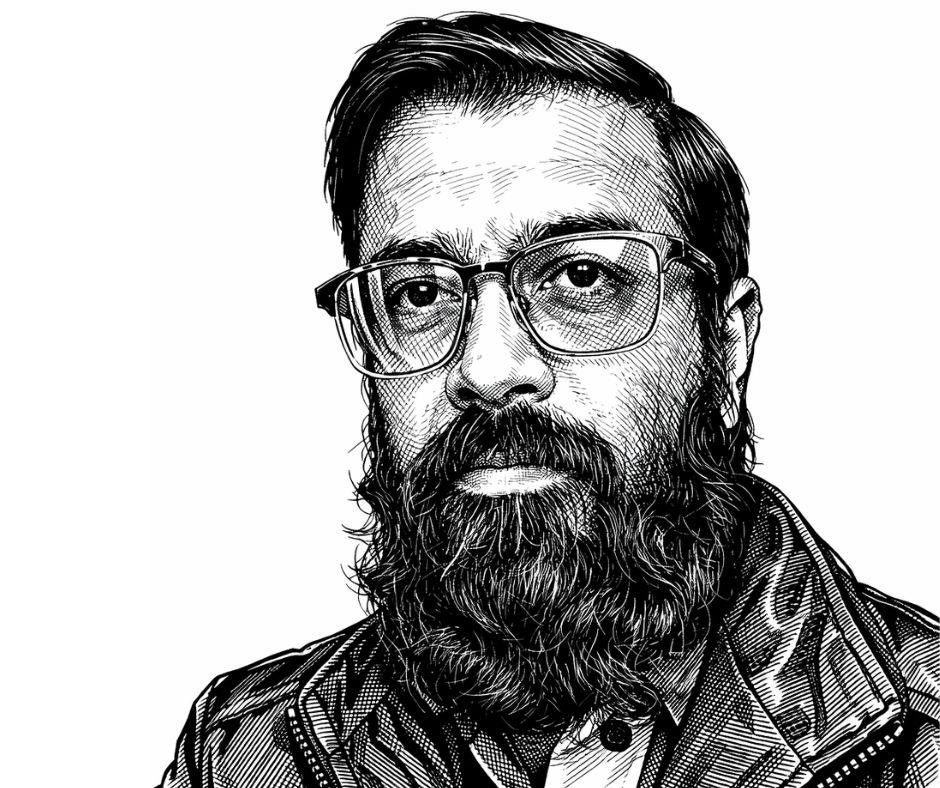
Trishikh Dasgupta
Adventurer, philosopher, writer, painter, photographer, craftsman, innovator, or just a momentary speck in the universe flickering to leave behind a footprint on the sands of time... READ MORE
This story is Free, and if you have found something here that stayed with you, some of my other books (collection of short stories, novels, and more) are available in print and digital editions. They gather many unique journeys, quieter questions, grand adventures, hair-raising anticipation, and stories that continue beyond this page.
 Weekend Stories by Trishikh
This is phenomenal storytelling and Prusco is a hero !!! Brilliant ~ ❤
LikeLiked by 3 people
Dear Sirium, thank you so much! I am delighted that Prusco touched you. He and all the other Mercy Dogs were indeed heroes. Though without a uniform, rank or medals Prusco did the uncomprehensible, going beyond training, doing ten times more of what was perhaps expected of him. Perhaps that is what makes his story even more remarkable. In the middle of a battlefield where so many lives were being lost, he simply kept searching for those who could still be saved.
I am so glad you enjoyed the story and Prusco’s journey through it. Thank you for reading and for calling it phenomenal storytelling. That means a great deal to me.
LikeLiked by 2 people
Saving for later
LikeLiked by 2 people
Thank you MM. I think that you will like this one too.
LikeLiked by 2 people
I know that I will my friend. I just need a little time is all.
LikeLiked by 1 person
The story is not going anywhere. It waits for you patiently 🙏🏼
LikeLiked by 1 person
Thanks! I need a little rest first
LikeLiked by 1 person
Take you rest dear friend, and rejuvinate.
LikeLiked by 1 person
Thank you my friend. We really should connect one day on Roost. Send each other PenPal messages.
LikeLiked by 1 person
A deeply immersive and haunting piece. I was struck by how vividly you bring the reader into the battlefield—not through grand descriptions of war, but through smell, sound, memory, fear, and small human details.
The contrast between the peaceful scent of the corn and the brutality of battle is especially powerful. Ghulam Nabi’s memories of Golconda, his family, prayer, horses, and home make him feel not like a soldier in history, but like a real human being caught in an unimaginable moment.
The image of the German soldier calling for his mother is heartbreaking, reminding us that beneath different uniforms, war leaves human beings with the same fears and longing for home.
LikeLiked by 4 people
Dear Verma’ji, thank you so much for reading Prusco so deeply and for noticing the very details I hoped would carry the story. I wanted the battlefield to be experienced rather than merely described, through the smell of corn, the sounds of the wounded, the memories of home, and the small fragments of life that remain with a man when everything around him has turned into war.
Ghulam Nabi’s memories of Golconda, his family, prayer and horses were especially important to me because history often remembers soldiers by their regiments, battles and casualty figures, while forgetting the human being behind the uniform. And the German soldier calling for his mother was my small reminder that, beneath the uniforms and the flags, grief and longing for home belong to all of us.
I am delighted that these elements stayed with you. Thank you for seeing not just the story, but the humanity I was trying to place inside it.
LikeLiked by 2 people
🙏👍
Aum Shanti
LikeLiked by 2 people
Thank you so much.
LikeLiked by 1 person
I think Prusco’s question had something to understand. Beautiful story 👏🏼
LikeLiked by 1 person
Dear Priti, thank you so much. I am delighted that you felt there was something deeper in Prusco’s question. For me, that was at the heart of the story. In the middle of a battlefield where everything had been reduced to survival, Prusco seemed to ask a very simple question through his actions: is there still life here that can be saved?
Perhaps the most beautiful part is that he never needed an answer in words. He simply went back into the darkness and kept searching. Thank you for noticing that deeper meaning and for enjoying the story.
LikeLiked by 1 person
Yes right. 🙏👏
LikeLiked by 1 person
As usual, wonderfully rich descriptions and the background adds to that richness. I’m very taken with your description of how it feels to be shot and lay in a field dying. It is so realistic that it seems to come from personal experience. I’d still love to see some of your paintings. :0)
LikeLiked by 4 people
Thank you so much for your wonderfully generous words. I am particularly glad that the descriptions of Ghulam Nabi’s wound and those moments lying alone in the field felt real to you. Fortunately, I have never experienced anything remotely like being shot or left wounded on a battlefield! I had to reach that moment through imagination, research, and perhaps a little empathy for what a frightened and wounded man might see, hear and feel when he realises that he may not be found.
And as for the paintings, that made me smile! I have been painting for years, though storytelling has rather mischievously taken over much of my time. Whho knows, maybe someday I will share some of my paintings with you.
LikeLiked by 2 people
I think it is your gift of empathy that brings your stories to life. I can’t help but wonder if your paintings have that same quality or if they reveal a different side of your nature. Be blessed, your work blesses me 🥰
LikeLiked by 1 person
A beautifully written story of a horrible moment in History–of the pain of death comes similarly to all people, no matter the side they take in a war; of hope and gratitude in moments of devastation; of thankfulness and mercy in face of death. Loved every moment of it.
LikeLiked by 3 people
Dear Shaily, thank you so much for such a thoughtful and heartfelt response. You have beautifully captured what I hoped Prusco would leave behind in the reader. War may divide people by uniforms, flags and causes, but pain, fear, hope, gratitude and the longing to live belong to every human being caught in its path.
For me, the story was also about finding a small, almost unexpected act of mercy in the middle of unimaginable devastation. I am delighted that you loved the story and felt its emotional heart. Thank you for reading it with such sensitivity.
LikeLiked by 1 person
Excellent story! The descriptions of the horrors of war and the miracles that can occur are outstanding. A beautiful tribute to the military, Prusco and other animals that played an important part in rescuing their human comrades.
LikeLiked by 4 people
Thank you so much for your wonderful words. I am particularly glad that you noticed the contrast between the horrors of war and the small miracles of mercy that can emerge from them. That was very much at the heart of Prusco.
The story is also my tribute to the soldiers who endured those unimaginable battlefields, and to the remarkable animals who stood beside them, often risking their own lives to find and rescue the wounded. Prusco may have been the central figure, but he represents so many silent, four-legged heroes whose courage deserves to be remembered.
Thank you for reading the story and for recognising the spirit in which it was written.
LikeLiked by 2 people
A wonderful story! The horrors of war leave an indelible print on heart and mind.
LikeLiked by 1 person
Dear KK, thank you so much. You are absolutely right. The horrors of war may eventually fade from photographs and history books, but the emotional scars they leave on the human heart and mind can endure for generations.
With Prusco, I wanted to capture not only that horror, but also the small moments of compassion and humanity that somehow survive within it. I am glad the story stayed with you. Thank you for reading and for sharing your thoughts.
LikeLiked by 1 person
You’re always welcome, Trishikh!
LikeLiked by 1 person
War makes strangers of us by dividing people into identities; compassion strips those identities away and sees only a human life.
When everything else is removed—nationality, religion, loyalty, heroism, enemy or friend—what remains is simply life itself: breath.
LikeLiked by 2 people
Thank you so much for expressing the heart of Prusco so beautifully. Your words, especially the final thought about what remains when everything else is stripped away, capture exactly what I hoped the story would leave with the reader.
In the end, Prusco does not see a soldier, an Indian, a Muslim, a friend or an enemy. He sees only a human being still breathing, and that breath is enough reason to turn back into the darkness and save him. Perhaps that is the simplest and purest form of compassion.
Thank you for seeing that beneath the battlefield, the history and the fiction, the story was ultimately about one fragile thing we all share: life itself.
LikeLiked by 1 person
Thank you sharing my story with the larger world. Now so many more people would be able to enjoy this story.
LikeLike