The turbulent waters of the river Hooghly were still half-asleep when the sky cracked open, in the circa of our Lord 1632 AD. A roar, low, rolling, the sound of hooves, boots, and the metallic breathing of war, tore into the Portuguese settlement on the banks of the river like a monstrous tide. Those who woke to the thunder first smelled it: burning thatch, gunpowder, and the acidic sting of fear. Emperor Shah Jahan’s forces descended with a discipline that felt inhuman, as though the army were a single enormous creature crawling over the riverside town. The church bell tried desperately to toll. It gonged only twice before the Mughal cannons silenced it with their unforgiving thunder.
Timber splintered. Red-turbaned soldiers poured through lanes where pepper once dried in wicker baskets. The priests and townsfolk fled with fragments of their world in their arms – a crucifix, a loaf of bread, a mother’s hand, but fire ran faster. The white façade of the church, built thirty-three years ago by Captain Pedro Tavares, buckled in the heat; the roof crashed inward with a groan that seemed like the infliction of stigmata on the skin of a saint.
Bodies lay as smoke rose from their charred remains towards the heavens. Rosaries melted into palms. And the river carried ash like drifting petals. By dawn, the proud little outpost, the Portuguese dream planted in the promising lands of Bengal in the rich and prosperous subcontinent of India in 1599 by Captain Tavares, allowed by Shah Jahan’s grandfather, Emperor Akbar himself, was nothing but a glowing cinder, and the church at its centre, run by a band of Augustinian friars from Goa – a seared skeleton staring at the mute sky in silent pain.
More than three centuries later, Bandel was a gentler place, the sort that wrapped its tragedies in stories and its miracles in laughter. By the mid-1980s, the once-burned church had long risen again, rebuilt by Gomez de Soto over the ruins of the old church in 1660. It carried secrets under its floor and legends in its walls. Meanwhile, just beyond its gates stood Don Bosco School, founded on the principles of Saint John Bosco – an Italian priest who believed that street children should not be punished but guided. His method was simple: love, kindness, and education before anything else. Salesians travelled across continents to India, arriving in the peninsula around 1906, carrying his dream like a bright blue flag, opening schools in different parts of the country. In 1978, they built the school in Bandel, an institute of discipline, faith, and an enthusiasm that children promptly used for mischief.
One sticky afternoon in 1985, the quiet town erupted once again, not with war this time, but with the far more uncontrollable force of children’s gossip. A Concorde of boys came sprinting out of Don Bosco’s gates, shouting, “A tunnel has been found under Bandel Church!” A chubby kid screamed in anguish,“with skeletons inside!” A lanky one blurted with excitement, “And maybe treasure!” A spectacled one corrected him, “No, no – a secret passage to Goa!” Another added, “I heard it leads to the river where the Portuguese hid their gold!”
By evening, the town was a carnival of theories. No one knew who had first whispered that a worker repairing the church floor had glimpsed a dark hollow below – perhaps a stairway, perhaps a chamber. But children, being the world’s most aggressive journalists, had upgraded it into a full-scale subterranean thriller.
Like monsoon clouds multiplying across the sky, the stories grew – A tunnel where a persecuted priest had escaped. A tunnel where an elephant had been hidden (why? nobody knew). A tunnel where the Portuguese left a map made of fish skin. A tunnel guarded by a ghost who spoke Portuguese-Bengali. A tunnel holding the bones of a Dutch soldier who never paid his tavern debt.
By dinnertime, people were discussing the “tunnel” with more passion than the election results. Bandel, a town familiar with miracle stories, embraced this new drama with full sincerity and mild hysteria. For the next few days, the church stood calm and dignified while the town around it behaved like a runaway theatre troupe.
Long before these children were even imagined, before the mast outside the church became a symbol of gratitude, a quieter miracle had unfolded – one that breathes through Bandel’s soul like a warm ember. Father John da Cruz, slight, soft-spoken, but with faith as unyielding as teak, had been captured during the Mughal attack. The soldiers had accused him of treachery, of collusion with foreign powers, of blasphemies he could not pronounce, let alone commit. He was sentenced to a death reserved for those who needed to be taught a lesson: Trampled by the Emperor’s elephant.
The royal courtyard was a furnace of sun and murmurs. Emperor Shah Jahan himself watched from a high pavilion, his face carved from sandstone, calm. The elephant, massive and dark as a monsoon cloud, was brought forward. Chains clinked. Dust rose. Father da Cruz knelt, lips whispering only, “Into your hands…”
The elephant approached. And then – in a moment that centuries later would still make Bandel’s priests speak in hushed awe, the beast stopped. It swayed, grumbled, lowered its head… and lifted the priest gently with its trunk, placing him safely aside, like a mother elephant sheltering her calf. Gasps scattered through the court like a startled murmuration.
The emperor’s eyes widened. This was no ordinary act of mercy. Nature had defied command. Power had bent its knee. Shah Jahan not only spared Father da Cruz and the remaining Christians but also gifted Father 777 bighas of land in Bandel. A miracle was recorded not in ink, but in breath and memory. The story became a lifeline for the devastated settlement. If the elephant could refuse violence, perhaps time, too, could refuse to bury Bandel.
After the 1632 destruction, the people under the leadership of Gomez de Soto rebuilt the church in 1660 – stone upon stone, grief upon hope, using whatever materials they could salvage. They placed the surviving keystone, carved with 1599, on the new façade, as if anchoring the present to the ghosts who once sang beneath its roof.
Years later, when a Portuguese ship survived a terrible storm off the Bengal coast, its captain gifted the church the ship’s great mast as a symbol of gratitude. It stood for centuries, weather-beaten and proud, a gesture carved into wood. When it finally fell to a storm, the timber was preserved like a saint’s relic.
And then there was the statue – Our Lady of the Rosary, that disappeared during the chaos of the Mughal attack. Some said it was stolen. Some said it sank. Others insisted the river took her home for safekeeping. And one story tells us that, wanting to save the statue from the Moghul wave of destruction, Father John da Cruz crossed the river with it and entrusted it to a young Portuguese soldier named Tiago, who leapt into the river with the statue clenched to his chest, while arrows pierced through the air and water, with one striking him on the back, taking down the brave soldier and the blessed statue into the depths. But one quiet dawn, years later, a fisherman found her resting gently on the riverbank. Untouched. Unbroken. As if the river goddess had decided to perform her share of miracles. The people of Bandel still speak of it as The Return – no explanations required.
Back in the 1980s, the “tunnel” story escalated into a local festival of absurdity. At the tea stalls, a pan chewing bong muttered, “It goes all the way to Chinsurah,” while an oldtimer added, “No, it goes to Goa.” A toothless Marwari, peeping from above the rim of his newspaper, said, “My cousin’s friend said it reaches Rome,” and a curious kid added, “ROME? My God, do we need a passport to travel through the tunnel!”
At the fish market, an elderly lady said, “A skeleton was found sitting in a chair,” quickly interrupted by the fishmonger slicing a piece of Katla for her, “No, no – it was standing up!” The professor measuring the circumference of tomatoes at the adjacent vegetable vendor corrected the two, saying, “Impossible! Skeletons don’t stand.” To which a mischievous teenager smirkily added, “This one was Portuguese – they were very disciplined.”
At Don Bosco, one boy solemnly insisted, “If you go through the tunnel, you come out in 1632.” Another whispered, “My uncle said it’s haunted by a priest who speaks only Latin. And a little Bangla.” A third added, “There’s treasure. Obviously.”
Teachers tried to restore sanity, but children had already decided that the Church was now officially more exciting than television. Even adults contributed. People in Bandel loved their history, but they loved their stories more. And this was the perfect marriage of fact, faith, fantasy, and deliciously unchecked imagination.
The priests remained politely amused, occasionally offering diplomatic statements like:“Well, the church is very old…” “Many things lie under old buildings…” “Let’s focus on our prayers, shall we?” This only convinced the children further that something spectacular, perhaps demonic, perhaps Portuguese, perhaps both, lurked beneath the church floor.
After a week of speculation so wild it could qualify as performance art, the truth emerged quietly: There was no tunnel. No secret passage. No skeleton waiting to deliver last rites in Portuguese. What existed beneath the church was something profoundly simple, profoundly ordinary, and profoundly sacred. A crypt – an underground chamber, built centuries ago, where priests and dignitaries were often buried close to the altar. Many old Catholic churches all over the world have crypts – silent rooms that hold names the world has forgotten, but heaven hopefully remembers.
The people of Bandel blinked, nodded… and then burst into laughter. A crypt! An ordinary, predictable, historically sensible crypt! After all that drama! The children pretended to be disappointed for exactly twelve seconds, after which they declared: “A crypt is even cooler.” And thus concluded the most entertaining historical misunderstanding Bandel had ever produced.
The church of Bandel is not a museum. It is a breathing biography. Ashes from 1632 still whisper in its rafters. The mast, felled by cruel weather in recent years, its timber preserved in a glass case, lingers on like an upright memory of gratitude turned to relic, like a wooden sailor listening to river winds. The returning Madonna smiles with the serenity of someone who has travelled far and seen strange things. Don Bosco’s teachings echo in the laughter of the students whose imaginations nearly turned the church into a Bollywood movie set.
Faith in Bandel has always lived in the tension between fear and wonder – as if the river itself teaches the town: what is lost returns, what is broken rises, and what is forgotten retells itself in another age. In the evenings, when the ferry horns drift over the water, and the basilica glows like a lantern, the people of Bandel sometimes pause and wonder: Were the old miracles truer than we think? Did the elephant really kneel? Did the river really return the statue? And did the crypt reveal itself when it wanted to be found? Perhaps. Or perhaps Bandel simply refuses to let its stories die. Perhaps that is the greater miracle.
Today, the Bandel Church stands awake – alive in faith, devotion, and pilgrimage. Not simply as a relic, but as a heart that still pulses. Thousands of devotees and curious visitors from across Bengal and beyond walk through its doors annually. In 1928, the care of the church and its monastery passed to the order of Salesians of Don Bosco, marking a new chapter when the “Padroado” (Portuguese-royal patronage) ended. Then, on 25 November 1988, under the pontificate of Pope John Paul II, the sanctuary was formally declared a minor basilica, cementing its significance for Catholics globally. Today, pilgrims come to seek boons and miracles at the shrine of Our Lady of the Rosary, also venerated as Our Lady of Happy Voyage, lighting candles, offering prayers, and seeking hope. The Bengali word for church – “Girja” – remains a living echo of the Portuguese word “Igreja,” a quiet but enduring testament that Christian roots in Bengal came not with the British but centuries earlier, carried by Portuguese traders, friars, and faith.
Stand in front of the church today and listen. The wind carries something old, something soft. You’ll hear the clang of muskets from 1632. The quiet tread of Father da Cruz stepping toward an elephant. The laughter of Don Bosco boys peddling tales of tunnels and ghosts. The splash of a statue rising from the river like dawn itself. You’ll hear Bandel – the town that stitches faith, fiction, fear, and fantasy into one unbroken tapestry. And deep below, in the cool stillness of the crypt, the past sleeps gently, holding its silence the way a mother holds her child, tenderly, forever, like a miracle.
Copyright © 2025 TRISHIKH DASGUPTA
This work of fiction, written by Trishikh Dasgupta is the author’s sole intellectual property. Some characters, incidents, places, and facts may be real while some fictitious. All rights are reserved. No part of this story may be reproduced, distributed, or transmitted in any form or by any means, including printing, photocopying, recording, or other electronic or mechanical methods, without the prior written permission of the author, except in the case of brief quotations embodied in critical reviews and certain other noncommercial uses permitted by copyright law. For permission requests, send an email to the author at trishikh@gmail.com or get in touch with Trishikh on the CONTACT page of this website.
ABOUT THE AUTHOR

Trishikh Dasgupta
Adventurer, philosopher, writer, painter, photographer, craftsman, innovator, or just a momentary speck in the universe flickering to leave behind a footprint on the sands of time... READ MORE
These stories are Free and if you have found something here that stayed with you, some of my other books are now available in print and digital editions. They gather longer journeys, quieter questions, and stories that continue beyond this page.
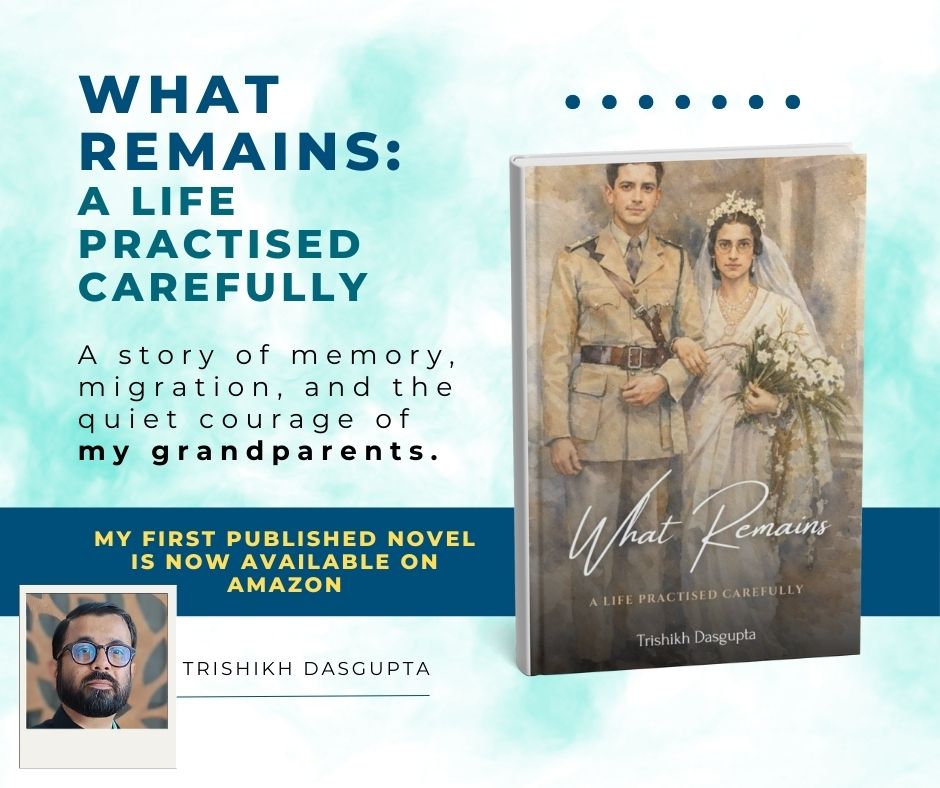
You may also like to read my1st Published novel now available on Kindle and Paperback versions.
 Weekend Stories by Trishikh
Wow, this one is intense
LikeLiked by 2 people
Thank you so much. So happy that you liked it.
LikeLiked by 2 people
I love your attention to historical detail. It’s like you were there and witnessed this yourself. You made me feel it too.
LikeLiked by 3 people
That is so nice of you to say. I shall do my best to keep on writing these stories by the grace of God, blessings of elders, encouragement of friends, and love of juniors.
LikeLiked by 1 person
🙏
LikeLiked by 1 person
Good morning writer 🌷
We are back… was not well so reading was task… So missed last two…
You literally teleported to the river banks of Hoogly…. The narrative in itself is the tide. Power had bent its knee.” It explains why the community’s faith is so unyielding—it was confirmed by a gentle, massive beast. The idea of the river taking the statue for safekeeping and then delivering her gently back to the bank years later is just beautiful. And the detail about the “Portuguese-Bengali” speaking ghost made me laugh out loud.😅
Bandel, as you characterise it, is truly a “breathing biography,” where the muskets, the elephant’s soft tread, and the children’s laughter all sound together in the wind.👌
It truly is a magnificent tapestry. Thank you again for letting us read this beautiful piece.
With warmth
Aparna🌷
LikeLiked by 3 people
Dear Aparna, as always, reading your comment gives me great joy. The way you appreciate my story adds so much more to it. Your comment is an extension to the story, allowing readers to enjoy the story even more.
Happy weekend to you and your family.
LikeLike
What an extraordinary piece of storytelling. The narrative flows with cinematic vividness—rich history, layered emotion, and a seamless blend of fact and folklore. Trishikh Dasgupta brings Bandel alive through haunting imagery, childlike wonder, and deep spiritual resonance. It’s rare to see history told with such tenderness and imaginative brilliance. A truly captivating and beautifully crafted work.
LikeLiked by 4 people
Dear Verma’ji, as always your comment gives me so much encouragement. I am also very happy about the way the story unfolded. It has given me much joy to write this piece. And appreciation such as yours makes writing it so worthwhile. In this story I experimented a bit with – starting with a ghastly scene and then moving into something comical, and underlying it all were the patches of history.
LikeLiked by 1 person
Dear friend, your words truly mean a lot. I’m delighted to hear how much joy this piece brought you while writing it—because that joy reflects beautifully in the final story. Your experiment with shifting tones, from a haunting opening to gentle humour and then weaving in subtle historical threads, was crafted with remarkable balance.
LikeLiked by 1 person
Thank you so much Verma’ji. A great weekend to you and your family.
LikeLiked by 1 person
Thank you so much for your warm wishes! 🙏😊
Wishing you and your family a wonderful, peaceful, and joy-filled weekend as well.
LikeLiked by 1 person
You are a master at storytelling.. This piece of work was brilliant… my favorite so far. Other readers have expressed it better than I can. I am amazed at the quality of your work!!🙏🏽
LikeLiked by 3 people
I am so happy that this is your most favourite story till now. That is a big compliment that I really treasure. My capacity to write short stories is a blessing from God, and possible through the love and blessings of friends and well-wishers. Do keep on reading my stories dear friend.
LikeLiked by 1 person
Oh, no worries. I will keep reading your stories. They never disappoint and always give an added dimension to my life. 🙏🏽ellen
LikeLiked by 1 person
Dear Ellen, it is such a joy to find such a dedicated reader and friend like you. I am really blessed.
With kind regards,
Trishikh
LikeLiked by 1 person
Thank you Ned for sharing my story with a larger audience. Always treasure your support.
LikeLiked by 1 person
What a truly remarkable piece, Trishikh! My heart is genuinely touched, and I can vividly sense the vibrant historical pulse radiating from behind the screen. Your narrative about this ancient church on the banks of the Hooghly truly flows, much like the tide carrying fragments of past stories. You successfully unified the essence of faith and fantasy, demonstrating that miracles are always born from our courage to remember and narrate. This is not merely history; it is a heartfelt legacy being told. May this fire of passion continue to burn brightly!
Another factor that resonates warmly within this story is the role of laughter as a spiritual lubricant, particularly in the narrative of the ‘tunnel’ search by the Don Bosco children. The ability of the Bandel residents to laugh freely after the truth about the crypt was revealed is a genuinely humanistic healing mechanism. It proves that the resilience of a community is not only found in the strength of its faith (divine) but also in their warmth, their capacity to celebrate imagination, and their enjoyment of sweet, collective joy.
You have successfully woven an unbroken tapestry, where every story, even the most fictitious, becomes an eternal footprint. Highest praise to you, Trishikh, for bringing this ‘breathing biography’ to us with such a gentle touch. We hope, as you intend, that Bandel will continue to refuse to let its beautiful stories die, and that your noble goal as a storyteller—to leave a legacy through every piece of writing—will be achieved forever. Keep up the excellent work!
LikeLiked by 3 people
🙏
Aum Shanti
LikeLiked by 1 person
Thank you so much.
LikeLiked by 1 person
Thank you so much, Trishikh, for the wonderfully interesting tale of the history of the church, going back a hundred years, written, as always, with the extraordinary talent and masterful detail that enchant your readers. As a born writer, your words paint an unforgettable picture that brings the events to life and engages readers’ imagination. One day, your book of stories from India will be a worldwide bestseller.
Joanna
LikeLiked by 1 person
Dear Joanna, thank you so much. I always treasure your appreciation. So happy that this tale gave you so much joy. Your constant appreciation is a great encouragement for me to keep on writing these stories.
May your words come true, and one day my stories will be published in a book.
LikeLike
Thank you, Trishikh, for your beautiful reply, and I know that you have a great future ahead.
Joanna
LikeLiked by 1 person
Another wonderful tale, you make your stories come alive.. thank you, Fiona ❤️
LikeLiked by 1 person
Dear Fiona, it is I who must thank you for always being so appreciative, and enjoying my stories so much.
LikeLiked by 1 person
reading the comments is almost as satisfying as reading the story! thanks so much for sharing your new story, which always brightens my day🌞😎🌞 😊🙏🏼😊❤️🌹❤️
LikeLiked by 2 people
Yes, I am really thankful to my dedicated readers – my friends who love my short stories so much, and lovingly comment with great depth and enthusiasm. You are very right, they add so much more to my stories, and you are one of them.
LikeLiked by 2 people
🙏🏼❤️😊❤️🙏🏼
LikeLiked by 1 person
Very interesting one. Great job! 👍
LikeLiked by 2 people
Thank you, yes the story came out really interesting.
LikeLike
“the Portuguese are very disciplined” 😂
LikeLiked by 1 person
Ya, indeed that was a fun line to add… ,😜
LikeLiked by 1 person
Another beautiful story and history lesson. It seems to me that a church is simply bricks, boards, stones etc. It is the dedication to it over the years, the prayers/appreciation/healing uttered, the history that evolves around it that shapes it into the church it becomes. The unseen energies of all that is what people respond to.
LikeLiked by 1 person
That is so true, people, words, action, and memories make any place holy and not the materials with which it is made and/ or the building itself. There can be congregations of unbelievers, false believers, bigots, and so many other kinds – who can run a so called religious building of any faith, and there we may find these people quoting scriptures and fanatically praying, but lacking in godliness, goodness, and spirituality.
LikeLike
Great read!!
LikeLiked by 1 person
Through your stories I will get to know India, stone by stone, person by person. This could be a great movie.
LikeLiked by 1 person
Dear Rebecca, I am so glad that my stories offer you a window to India. That is one of my aims for writing these stories. Maybe one day people would say, if you want to know a bit about India – its history, geography, people, sights, sounds and smell, read a few stories by Trishikh.
Yes, this certainly could be a great movie. Many of my other stories could also be movies.
Thank you for always being so appreciative. I really treasure your appreciation.
LikeLiked by 1 person
well that was superb mate, love when you go back in time, history is a passion of mine and I always get it here. bravo.
LikeLiked by 1 person
Dear William, it’s such an honour to be appreciated by someone like you, who has deep knowledge and experience in the field of history. I have not formally studied history. In fact, my field of studies had been commerce, and then fine arts, and ultimately graphic designing. My profession for the past 25 years is Communications Specialist for the Social Development Sector. Yet History and Writing are things that give me the greatest joy.
LikeLiked by 3 people
well im surprised at that, makes it even more exciting that your imagination can conjure up these masterpieces.
LikeLiked by 2 people
I have always been very passionate about history, and love to do a lot of research. Sometimes I think that coming from generations of teachers I should have also taken up the teaching profession.
LikeLiked by 1 person
hahahha yes indeed…
LikeLiked by 1 person
Stunning imagery, and, history woven into fiction with the laughter and mischief of the school boys, wit and imagination of the quintessential Bengali.
LikeLiked by 3 people
Dear Kajoli, thank you for your beautiful words of appreciation, they encourage me a lot to keep on writing these short stories.
LikeLiked by 1 person
very nice and enjoyed reading.
LikeLiked by 1 person
Thank you Savitha. I always treasure your appreciation.
LikeLike
Mind blowing history.Enjoyed reading like a swiftly flowing river.
LikeLiked by 1 person
Thank you Amit. So glad that you liked the story so much.
LikeLike
An excellent read, spiked with a good dose of humour and superb metaphors. Thank you Trishikh.
LikeLiked by 2 people
Thank you so much. So happy that you liked the story so much. Yes humor was something that I really wanted to use in the story. I am really glad the way it came out.
LikeLiked by 1 person
“Stillness between breaths…” – Once again magical storytelling and chronicling of history. In today’s overwhelming rewriting of history it is really significant to remember that the past should be let to rest in corridors of human memory and annals of history.
LikeLiked by 1 person
That is so beautifully said. Thank you for liking this story so much. It is such a joy to receive your appreciation.
I try to package history in the form of short stories that perhaps becomes easier for people to read and retain.
The more people read my stories, the more joy I receive.
LikeLiked by 1 person
Thank you very much, Trishikh, for this absolutely amazing story with the exceptional elefant!
LikeLiked by 1 person
Dear Martina, thank you for liking the story so much. It is always such a pleasure to receive your appreciation. I am really glad to have been able to write and share this story with the world.
LikeLiked by 1 person
Beautiful and uplifting. You have a gift for storytelling.
LikeLiked by 1 person
Thank you so much Anna. This is only possible by the grace of God and the love, blessings, and appreciation of friends like you – who constantly encourage me to keep on writing these stories.
LikeLiked by 1 person
That joy is universal to all writers – reading and relating.
LikeLiked by 1 person
Yes, that is indeed true.
LikeLiked by 1 person
Thank you for this delightful story of the Basilica and faith. Thanks also for stopping by my blog.
LikeLiked by 1 person
Thank you for appreciating the story. It is also my pleasure to visit your blog and like your posts.
LikeLiked by 1 person
Thanks for visiting my blog.
LikeLiked by 1 person
You are most welcome. It is my pleasure to visit your blog.
LikeLike
Exquisite, Trishikh. You are truly a weaver of memories that heal trauma and keep hope and miracles alive across centuries. 💜🪶
LikeLiked by 1 person
Dear Carol, that is so nice of you to say. I really want these stories to resonate long after I am gone. My humble efforts to keep history and memories alive.
LikeLiked by 1 person
captivating story that weaves through history. Thank you for your stories
LikeLiked by 1 person
You are most welcome. It really makes my day when someone smiles reading one of my stories, and comes to know a little bit about the past.
LikeLike
I have been to Bandel Church. A little further down is the temple of Hangsheswari of BaanshBeria (বাঁশ বেড়িয়া)which also carries fascinating history. If you have not been there you can now. Perhaps your visit can bring to live another history.
This story is very precious because I have been there and can relate to it.
Keep posting.
LikeLiked by 2 people
Wow, I did not know about the Hangeshwari Temple, the name itself sounds very interesting. Now, I have to research about it and write a story.
LikeLiked by 1 person
Thank you for your beautiful comment. Yes, a story indeed becomes very special when the reader can personally relate to the place.
LikeLike
I hope you can read Bangla. If you do then please read the eponymous book by Narayan Sanyal. The King’s palace is in ruins but the temple is well maintained. The idol is also unique because it’s a combination of Goddess Kali and Goddess Saraswati. It’s a must visit because of its architecture and the uniqueness of the deity.
LikeLiked by 1 person
Oh yes, I can speak, read, and write Bangla very well. Will certainly check out the book if I ever get the chance.
Short stories gives one faster access to a story than a novel or a book, which can be read later if the subject peaks enough interest.
So I strongly feel inclined to write the story of the temple. A visit would have obviously helped much more in writing the tale, but I can’t travel right now. But I strongly want to write about the temple.
Let’s see what happens.
LikeLiked by 1 person
Such a wonderful story. to think that people belived that a tunnel could go to Goa! I made so many plans to visit the church but always faied to do so. Now, I must make one that won’t fail. It is a must see in Bengal.
LikeLiked by 3 people
That is so true. Apart from the Church being beautiful and historically rich, it is said to grant the prayers and wishes of those who believe. We have prayed there a few times in the past and given thanks, and we have found solace. It is a must visit for those who like such places.
LikeLiked by 1 person
I will surely go there and pray for mother earth. 😊🙏
LikeLiked by 1 person
On a second reading, I realized this story stayed with me not because of its history, but because of its kindness — toward memory, toward loss, toward the ordinary lives that continue beneath it all. That gentleness moved me more than I can easily explain. Thank you for trusting the reader with such quiet emotional truth.
LikeLiked by 1 person
Dear Livora, thank you, that means more to me than you know. I hoped the story would carry its history lightly, the way memory often does, not as spectacle, but as something tender we live alongside. Your reading caught exactly that quiet pulse beneath the stones. I’m grateful you listened so closely.
LikeLiked by 1 person
UN ANNO DI TANTA SALUTE
LikeLiked by 1 person
Wishing you and your family a great new year too.
LikeLike